
Freelancers, software firms and consultants who bill foreign clients often charge 18% GST on the invoice “just to be safe”, then find that the foreign client refuses to pay it. The result is either an unrecoverable tax cost or a long refund claim. The right route is a Letter of Undertaking (LUT), which lets you export services without paying IGST, and it is a basic point in freelancer taxation.
Sharda Associates is a Bhopal-based CA firm with 45,500+ CA-certified reports delivered, and we handle GST registration, LUT filing and export refund claims for service providers through our GST services. We check whether your supply qualifies as an export, file the LUT on time and prepare the refund file.
This guide explains the five conditions for an export of services, how to file the LUT, how refund of unused credit works, and what changed for intermediaries in 2026. For the wider zero-rating concept, see our note on zero-rated supply under GST.
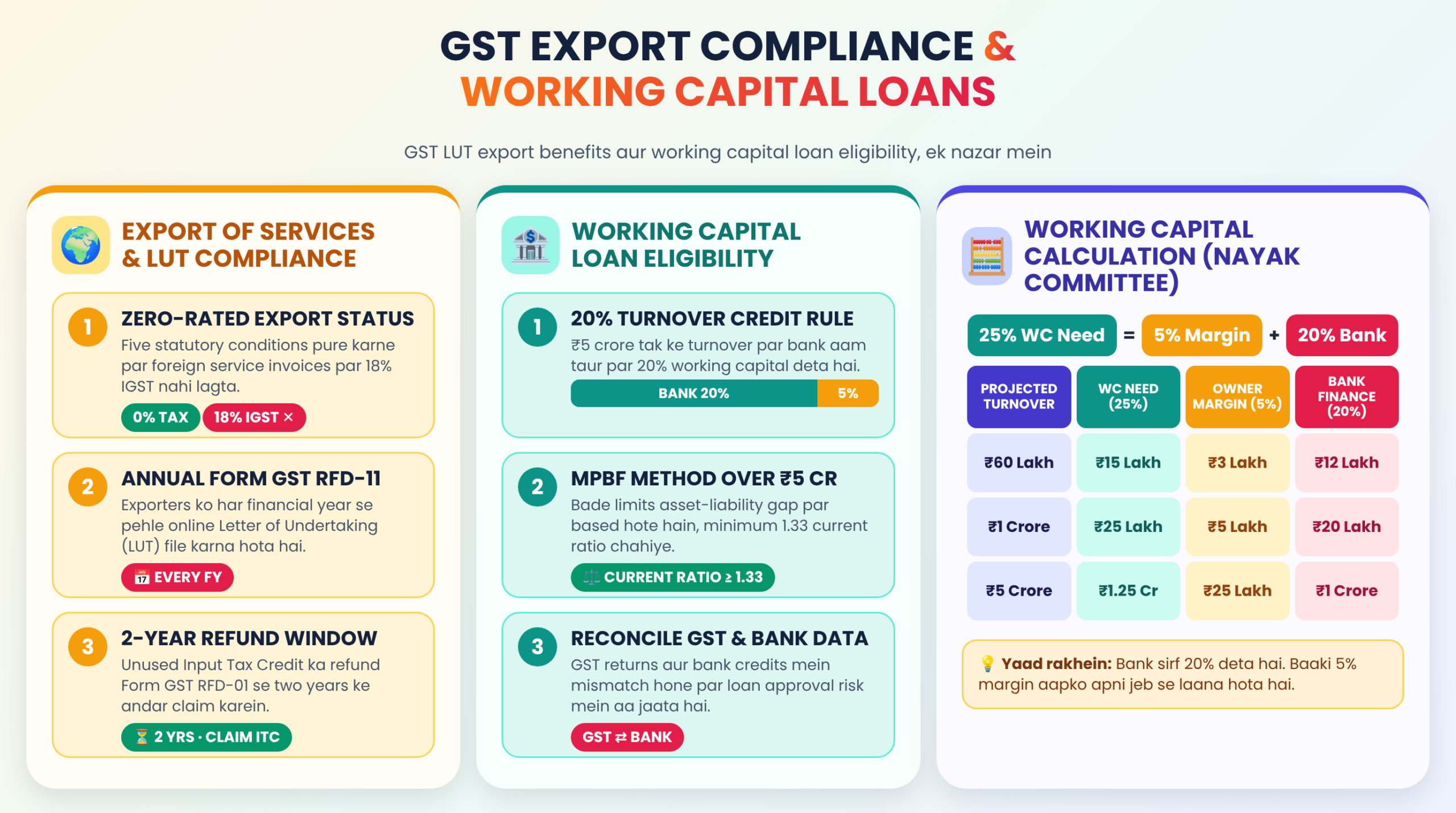
Quick Answer: An export of services is a zero-rated supply under GST, which means no tax on the output but your input tax credit stays intact. To qualify, five conditions must be met: the supplier is in India, the recipient is outside India, the place of supply is outside India, payment comes in convertible foreign exchange (or in INR where RBI permits), and the two parties are not merely establishments of the same person. You can export without paying IGST by filing a Letter of Undertaking (LUT) in Form GST RFD-11, valid for one financial year. Unused ITC can then be claimed as a refund in Form GST RFD-01 within two years of the relevant date.
Export of services at a glance
| Point | Rule |
| Treatment | Zero-rated, not exempt |
| Two routes | Export under LUT without IGST, or pay IGST and claim refund |
| LUT form | GST RFD-11, filed online |
| LUT validity | One financial year, file afresh every year |
| Foreign exchange realisation | Within one year of the invoice for services |
| Refund form | GST RFD-01 |
| Refund time limit | Two years from the relevant date |
The five conditions for an export of services
All five must be satisfied under Section 2(6) of the IGST Act:
- The supplier of service is located in India.
- The recipient of service is located outside India.
- The place of supply is outside India.
- Payment is received in convertible foreign exchange or in INR where the RBI permits it.
- The supplier and recipient are not merely establishments of a distinct person.
If one condition fails, the supply is taxable at 18% like a domestic supply. Condition 3 is where many service exporters go wrong, because the place of supply depends on the type of service.
LUT or IGST payment: which route is better?
You have two ways to export. You can charge and pay IGST, then claim a refund, or you can file an LUT and export without paying IGST. Most service exporters choose the LUT route, because paying 18% upfront blocks working capital while you wait for the refund. You cannot use both routes for the same export.
Good invoices matter in both cases. Use proper GST billing software that can generate export invoices with the LUT number.
How to file an LUT
- Log in to the GST portal and open the LUT option under services, user services.
- Fill Form GST RFD-11 and select the financial year.
- Sign it with DSC or EVC and submit.
- Quote the LUT number on every export invoice.
- Renew it before the next financial year starts. A fresh LUT is needed each year.
Any registered exporter can file the LUT, except a person prosecuted for tax evasion of ₹2.5 crore or more, who must furnish a bond with a bank guarantee instead. No fee is mentioned for filing.
The one-year realisation rule
Rule 96A says you must receive foreign exchange for services within one year of the export invoice. If you do not, you must pay the unpaid IGST with 18% interest within 15 days. Keep the Foreign Inward Remittance Certificate (FIRC) or bank realisation advice for every payment. Accurate bookkeeping and accounting will make this tracking easy.
How does the refund of unused ITC work?
Because exports bear no output tax, your input credit can pile up. You can claim a refund under Section 54(3) using Rule 89(4):
Refund = Zero-rated turnover × Net ITC ÷ Adjusted total turnover
Example: export turnover ₹40 lakh, domestic turnover ₹10 lakh, Net ITC ₹5 lakh. Refund = 40 × 5 ÷ 50 = ₹4 lakh.
File Form GST RFD-01 with an invoice-wise statement, the LUT, and declarations that the services were exported. Attach the BRC or FIRC as proof of foreign exchange. A complete claim should be processed within about 60 days, and interest can apply after that, according to one source. A provisional refund of 90% can also be possible, subject to conditions.
What changed for intermediaries in 2026?
An intermediary arranges or facilitates a supply between two other parties. Earlier, the place of supply for intermediary services was the supplier’s location in India, so these services were taxed at 18% even when the client was abroad. One source reports that the Finance Act, 2026 omitted that provision from 30 March 2026, so intermediary services now follow the recipient-location rule. Services before that date stay under the old rule. If you work as a sales agent, a booking agent or a marketing facilitator for foreign clients, ask a professional which side of the line you fall on.
Documents to keep
- LUT acknowledgement for the year.
- Export invoices with LUT number.
- FIRC or bank realisation advice for each payment.
- Contract or purchase order showing the foreign client.
- GSTR-1 and GSTR-3B data showing the export. Our GST return due dates guide helps you plan filing.
Conclusion
Export of services gives you zero GST on the output and a way to recover the credit on your costs. The LUT is the key document, and it must be renewed every year.
File the LUT before you raise your first export invoice of the year, keep FIRCs safe, and claim the refund within two years. Check your intermediary status before you assume the supply is an export.
Want Sharda Associates to file your LUT and refund claim? Call us on +91 79870 21896 or +91 89899 77769, or contact us online.
Frequently asked questions
1. Is export of services taxable under GST?
It is zero-rated. You can export without paying IGST under an LUT, or pay IGST and claim a refund.
2. What is an LUT?
A Letter of Undertaking in Form GST RFD-11 that lets an exporter supply without paying IGST.
3. How long is an LUT valid?
One financial year. You must file it afresh every year.
4. Who cannot file an LUT?
A person prosecuted for tax evasion of ₹2.5 crore or more has to give a bond with a bank guarantee instead.
5. What if I do not receive payment in foreign exchange?
Under Rule 96A, you must pay the IGST with 18% interest within 15 days after one year from the export invoice.
6. How is the refund calculated?
Zero-rated turnover × Net ITC ÷ Adjusted total turnover, under Rule 89(4).
7. What is the time limit to claim a refund?
Two years from the relevant date, under Section 54.
8. Are intermediary services exports now?
A reported 2026 amendment shifts the place of supply to the recipient’s location, from 30 March 2026. Confirm how it applies to your service.