
Many founders think income tax is something to settle after the year ends, when the return is filed. For a company with taxable profit, the law wants the tax in four instalments during the year, and the third one falls on 15 December 2026. Miss it and interest starts, even when you pay the full tax later, as it does for late filing under Section 234A.
Sharda Associates is a CA firm with 45,500+ CA-certified reports delivered, and our taxation team estimates the tax of startups and small companies, calculates each instalment and pays it on time. We also tell you when you do not need to pay at all.
This guide explains who must pay, how much is due on 15 December, what the interest is if you fall short, and what is different for startups. Good books make the estimate far easier, so keep your accounting and bookkeeping up to date.
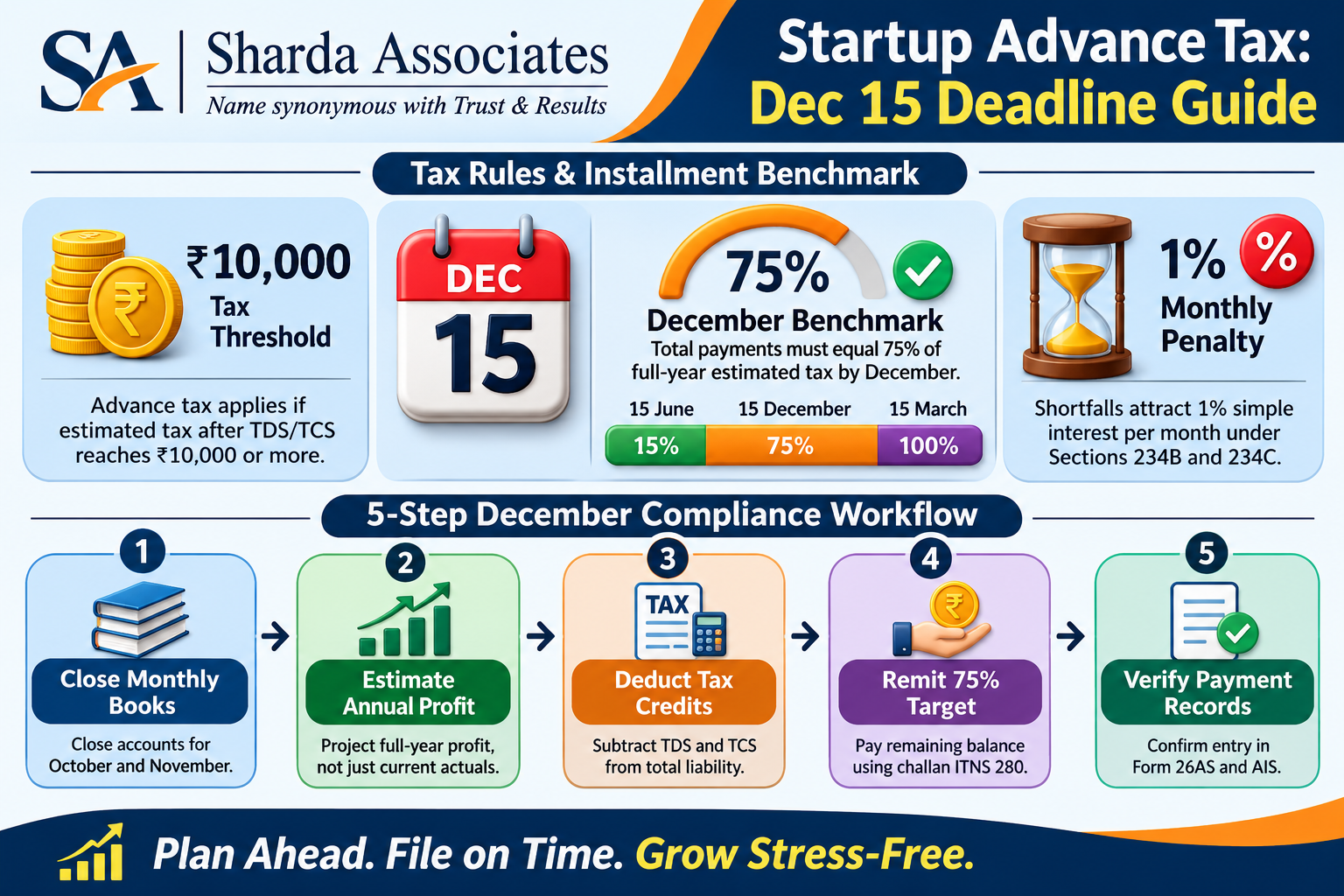
Quick Answer: Companies pay advance tax in four cumulative installments: 15% by 15 June, 45% by 15 September, 75% by 15 December and 100% by 15 March. The 15 December 2026 instalment therefore brings your total payment to 75% of the estimated tax for the year. Advance tax applies when the estimated tax after TDS and TCS is ₹10,000 or more (Section 404 of the Income-tax Act, 2025). Shortfalls attract 1% simple interest per month under Sections 234B and 234C (Sections 424 and 425 of the new Act). Taxpayers on the presumptive scheme pay the full amount by 15 March.
Instalments at a glance
| Due date | Cumulative advance tax | Minimum to avoid 234C interest |
| 15 June | 15% | 12% |
| 15 September | 45% | 36% |
| 15 December | 75% | 75% |
| 15 March | 100% | 100% |
The dates and percentages are unchanged under the Income-tax Act, 2025, which applies from 1 April 2026. No extension of the 15 December date was found at the time of writing.
Who must pay advance tax?
You must pay advance tax if your estimated tax for the year, after deducting TDS and TCS, is ₹10,000 or more. A private limited startup with profit will usually cross this line.
A startup with a loss and no tax payable does not need to pay anything. Still, check the figure before you assume it, because a mid-year profit can change the picture.
Taxpayers on the presumptive scheme pay the whole advance tax in one go, by 15 March. A company with regular accounts follows the four installments.
How much is due on 15 December?
Take your estimated tax for the full year, subtract TDS and TCS, and apply 75%. Then subtract what you paid by 15 June and 15 September. The balance is your 15 December payment.
Example (illustrative): estimated tax after TDS is ₹8,00,000. By 15 December you must have paid ₹6,00,000 in total. If you paid ₹1,20,000 and ₹2,40,000 earlier, the December instalment is ₹2,40,000.
If your profits are rising, revise your estimate now. Underestimating in December means a larger payment in March and interest in between.
What happens if you miss it?
Interest under Section 234B applies if you pay less than 90% of the assessed tax by the end of the year. Interest under Section 234C applies if your payments fall below 12%, 36%, 75% or 100% at the four dates.
Both are charged at 1% per month or part of a month, as simple interest. Section 234C runs for three months on the first three instalments and one month for March.
Example (illustrative): if you have paid only ₹4,00,000 against a ₹6,00,000 requirement on 15 December, the shortfall is ₹2,00,000. Interest for three months at 1% is ₹6,000.
What is different for startups?
A DPIIT-recognised startup with an approved tax holiday under Section 80-IAC (Section 140 in the new Act) may pay little or no tax in its chosen years. Ask your CA what tax is left after the deduction, and read our guide to the 80-IAC tax exemption.
Startups with irregular income should re-estimate each quarter. A big client payment in November can push you above the 75% mark.
If you also run a small business on a presumptive basis, see our note on presumptive taxation.
How to pay advance tax
Pay online through the income tax portal using challan ITNS 280, with minor head 100 for advance tax. Select the correct assessment year, and keep the challan receipt.
Check that the payment appears against your PAN in Form 26AS and AIS. A wrong PAN or assessment year can make the payment invisible.
Your payments reduce the tax payable when you file your income tax return.
A 5-step checklist before 15 December
- Close the books for October and November.
- Estimate profit for the full year, not just till now.
- Subtract TDS and TCS from the estimated tax.
- Pay 75% cumulative by 15 December.
- Save the challan and check Form 26AS.
Startups that are registered on the portal should also keep an eye on Startup India registration benefits that depend on clean compliance.
Conclusion
Advance tax is not a year-end job. It is a payment schedule, and the 15 December date is the one that catches most growing startups, because profits by then are no longer a guess.
Take an hour this week to close the books, estimate the full-year profit and work out your 75%. A small payment on time costs nothing extra, while a shortfall costs 1% a month and a lot of avoidable stress in March.
If you want this done for you, call Sharda Associates directly on +91 79870 21896 or +91 89899 77769, or contact us online. We will estimate your tax, tell you the exact amount and help you pay before 15 December.
Frequently asked questions
1. What is the advance tax due date in December 2026?
15 December 2026, when the cumulative payment should reach 75% of the estimated tax for the year.
2. Who must pay advance tax?
Anyone whose estimated tax after TDS and TCS is ₹10,000 or more.
3. What are the advance tax instalments for companies?
15% by 15 June, 45% by 15 September, 75% by 15 December and 100% by 15 March.
4. Do presumptive taxpayers pay advance tax in instalments?
No. They pay the full amount by 15 March.
5. What is the interest on missing advance tax?
1% per month or part of a month, as simple interest, under Sections 234B and 234C (now Sections 424 and 425).
6. Does a loss-making startup pay advance tax?
Not if no tax is payable. Check the estimate before you skip it.
7. Which challan is used?
ITNS 280, with minor head 100 for advance tax.
8. Has the 15 December 2026 date been extended?
No extension was found at the time of writing. Check the income tax portal before the date.