
A shop owner paying ₹50,000 monthly rent may wonder whether GST applies to the rental payment. The answer depends on the landlord’s GST registration, the tenant’s registration status and whether the property is commercial or residential. Under the applicable GST rules, the responsibility to pay tax may fall on the landlord or tenant.
Sharda Associates provides GST registration, GST compliance and taxation consultancy for landlords, tenants and businesses. Our team reviews rental agreements, explains applicable GST provisions, assists with tax payments and helps eligible businesses claim Input Tax Credit (ITC).
Explore our GST registration services and understand the applicable GST rates before making rental payments.
This guide explains the 18% rate, the ₹20 lakh registration limit, the reverse charge that now applies to commercial rent from unregistered landlords, how tenants claim ITC, and how GST differs from TDS on rent. If you want the reverse charge basics first, read what is reverse charge in GST.
Quick Answer: Rent of commercial property is taxable at 18% GST (9% CGST + 9% SGST within a state, or 18% IGST across states). A landlord must register for GST once total annual turnover, including rent from all properties, exceeds ₹20 lakh (₹10 lakh in special category states). Since 10 October 2024, if a commercial property is rented by an unregistered landlord to a registered tenant, the tenant pays GST under reverse charge. Residential property rented for personal living is exempt. A registered tenant using the property for business can claim input tax credit with a valid invoice or a reverse charge payment record.
GST on rent at a glance
| Situation | GST treatment |
| Commercial property, registered landlord | 18%, landlord charges GST on the invoice |
| Commercial property, unregistered landlord, registered tenant | 18% under reverse charge, tenant pays |
| Commercial property, both unregistered | No GST |
| Residential property rented for personal living | Exempt |
| Residential property rented to a registered business | Reported as 18% under reverse charge; confirm for your case |
What is the GST rate on commercial rent?
Commercial rent is taxed at 18%. If the property and the landlord are in the same state, tax is split into 9% CGST and 9% SGST. If the rent crosses state lines, it is 18% IGST. For example, rent of ₹2,50,000 plus GST of ₹45,000 makes an invoice of ₹2,95,000. The place of supply for property is its location, so the property’s state decides the tax type.
When must a landlord register for GST?
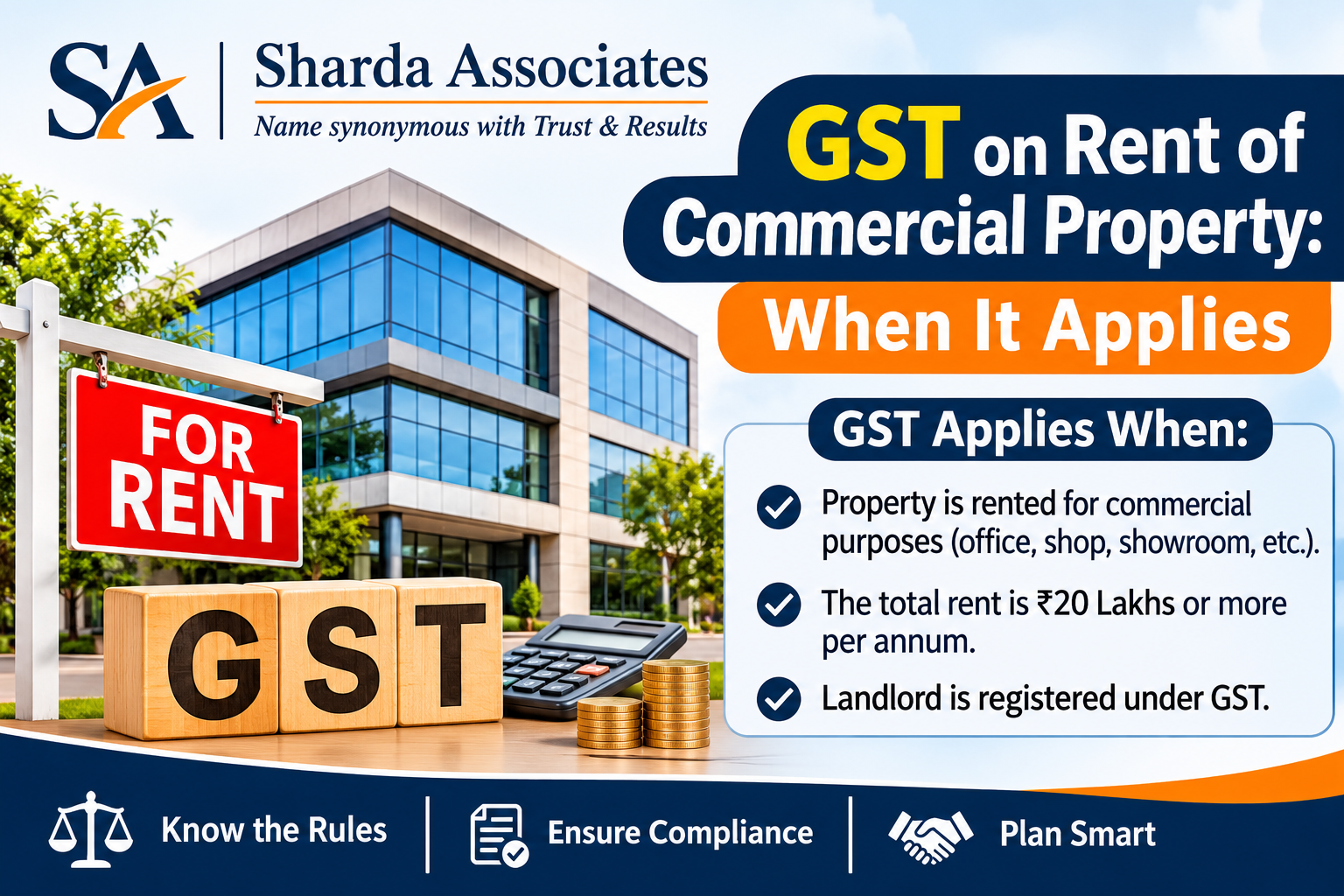
A landlord must register when total annual turnover crosses ₹20 lakh, or ₹10 lakh in special category states. The limit counts rent from all properties together, not each property alone. Once registered, the landlord charges GST on every rent invoice and files returns. Our GST registration service covers the process.
When does the tenant pay under reverse charge?
Under Notification 09/2024 (Integrated Tax, Rate), effective 10 October 2024, a registered tenant pays GST directly to the government when a commercial property is rented from an unregistered landlord. Residential dwellings are excluded. If the tenant is also unregistered, no GST is due.
One point is unclear in sources. One article says landlords below the ₹20 lakh limit are outside the rule, while commentators describe the change as covering any unregistered landlord. Check the notification text for your case.
Pay the reverse charge tax in cash, report it in your GSTR-3B, and then claim the credit. Keep a self-invoice and the payment proof. A tidy accounting and bookkeeping system makes this routine.
Can the tenant claim input tax credit?
Yes, if the property is used for taxable business, you hold a valid tax invoice (or the reverse charge payment record), and the amount matches your returns. Credit is generally not available for personal accommodation, rent linked to exempt activity, or credits blocked under Section 17(5). If you keep rent invoices in order, claiming credit is easy, as shown in our guide to organising billing and payment records.
Residential property: when is rent taxed?
Residential property rented to an unregistered person for living is exempt, whatever the rent. A registered individual who rents a house for their own residence in a personal capacity is also reported to be exempt. If a registered business rents a residential property, most sources describe 18% under reverse charge, but sources conflict, so verify the current position.
GST on rent vs TDS on rent
GST and TDS are separate. TDS is an income tax withholding on the rent you pay, and GST is a tax on the supply.
| Point | GST | TDS |
| Rate | 18% on commercial rent | 10% on land, building, furniture; 2% on plant and machinery |
| Threshold | Landlord’s ₹20 lakh turnover for registration | ₹6 lakh a year per landlord (FY 2025-26) |
| Base | Rent amount | Rent excluding GST |
| Who deposits | Landlord, or tenant under reverse charge | Tenant, if liable |
TDS is calculated on the rent excluding GST. On ₹2,50,000 rent, TDS at 10% is ₹25,000. Individuals and HUFs who are not liable to audit deduct 2% when monthly rent exceeds ₹50,000. The Income-tax Act, 2025 applies from 1 April 2026, so confirm the section number and threshold in the new Act. Landlords must also report rent in their returns through income tax return filing.
Conclusion
GST on commercial rent depends on the landlord’s registration status and applicable GST rules. Generally, commercial rent attracts 18% GST when taxable. If the landlord is unregistered, the registered tenant may need to pay GST under Reverse Charge Mechanism (RCM), subject to applicable exemptions and conditions.
Always verify your rental agreement, GST invoices and payment records. Maintain separate GST and TDS entries to avoid compliance errors and claim eligible Input Tax Credit (ITC).
Need help understanding GST on commercial rent? Contact Sharda Associates at +91 79870 21896 or +91 89899 77769, or contact us online.
Security deposit and other points
A refundable security deposit is generally not taxed until it is adjusted against rent, but confirm this with your CA. Make sure the rent agreement states who bears GST, because a silent agreement often leads to disputes.
Frequently asked questions
1. What is the GST rate on commercial rent?
18%, split into 9% CGST and 9% SGST, or 18% IGST for inter-state supply.
2. When must a landlord register for GST?
When aggregate turnover, including rent from all properties, exceeds ₹20 lakh (₹10 lakh in special category states).
3. What is RCM on commercial rent?
Since 10 October 2024, a registered tenant pays GST under reverse charge when the commercial landlord is unregistered.
4. Is residential rent taxable?
Not when rented for personal living. If rented to a registered business, most sources say reverse charge at 18% applies, so confirm it.
5. Can I claim ITC on rent?
Yes, if the property is used for taxable business and you have a valid invoice or reverse charge payment record.
6. Is TDS deducted on rent including GST?
No. TDS is calculated on rent excluding GST, where GST is shown separately.
7. Is GST payable if both landlord and tenant are unregistered?
No. GST under reverse charge applies only when the tenant is registered.
8. Does the ₹20 lakh limit count each property separately?
No. It counts total turnover from all properties and other supplies together