
Founders in the first year of a startup are usually focused on the product, the first customers, and simply staying afloat, which is exactly why financial record-keeping tends to get the least attention it will ever get relative to how much it matters later. The habits formed in this period—sloppy invoicing, no clear expense tracking, informal cash handling—do not stay small. They compound, and by the time a startup needs to raise funding or apply for working capital, cleaning up a year or two of messy records becomes its own project.
For startups, choosing the right accounting software from the beginning can make it easier to manage invoices, GST records, expenses, payments, customer accounts, and financial reports as the business grows. Sharda Associates has worked with and evaluated several accounting platforms, including TallyPrime, Zoho Books, BUSY, Vyapar, Marg ERP, QuickBooks, and MyBillBook, gaining experience with different accounting workflows and features. While each software has its own strengths, Vinimay stands out as a free accounting software option for startups that want to control costs while managing essential billing and accounting activities. Its focus on simplifying everyday financial management makes it a practical option for new businesses looking for an easy and budget-friendly accounting solution.
Why Early-Stage Financial Habits Matter More Than They Seem
A startup with ten transactions a month can survive almost any level of disorganization. The same startup at a hundred transactions a month cannot, and the shift from ten to a hundred usually happens faster than founders expect. Building the right habits early means the same process simply scales, rather than needing to be rebuilt under pressure later.
What Startups Financial Management Should Cover From Day One
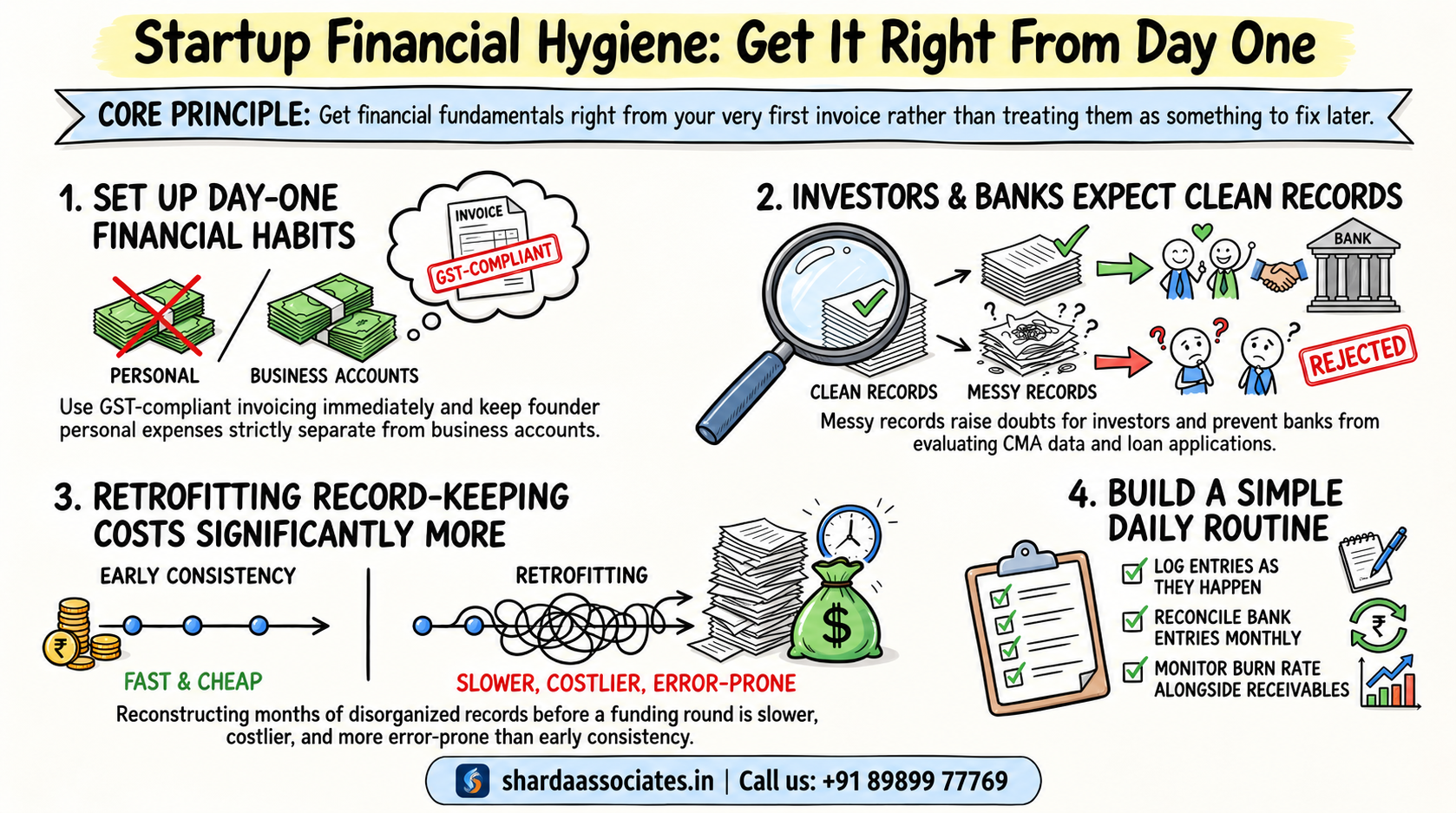
- GST-compliant invoicing from the very first sale, not retrofitted once volume grows
- A clear separation between founder personal expenses and business expenses
- Consistent categorization of costs, so burn rate and runway can actually be calculated
- A record of every payment received and its status, since early-stage cash flow is often tighter than founders assume
Investor and Lender Expectations Founders Often Underestimate
What Investors Actually Look At
Investors reviewing a startup’s financials are not just checking revenue, they are checking whether the founders can be trusted to manage money responsibly, and messy or inconsistent records raise doubts that a good product alone cannot offset.
What Banks Look At for Working Capital or Loans
Banks assess repayment capacity using consistent financial statements, and a startup without clean records struggles to produce the CMA data or project report a bank actually needs to evaluate the application.
Building a Simple Financial Routine
- Record every invoice and expense as it happens, not in a batch at month-end
- Reconcile bank transactions against recorded entries at least monthly
- Review burn rate and outstanding receivables together, since both affect real runway
- Keep founder and business finances in genuinely separate accounts from the start
Startups Stage vs Financial Management Priority
| Stage | Primary Financial Priority | Software Need |
| Pre-revenue / idea stage | Basic expense tracking | Simple, free tools sufficient |
| Early revenue | GST-compliant invoicing, cash flow visibility | Free invoicing plus consistent habits |
| Seeking investment/loan | Clean, exportable financial statements | Software supporting reports and reconciliation |
| Scaling team | Multi-user access, approval workflows | Paid accounting system with role control |
The Cost of Fixing Records Later Instead of Building Them Right
Reconstructing a year of disorganized records before a funding round or loan application is slower, more expensive, and more error-prone than maintaining clean records from the start would have been.
This is one of the most avoidable costs a startup ends up paying, and it is entirely preventable with a simple routine established early.
Conclusion
Sharda Associates has worked with enough early-stage founders to see the same pattern repeat: the ones who treat financial record-keeping seriously from month one spend far less time and money getting investor-ready or loan-ready later than those who wait until it becomes unavoidable.
The firm applies the same discipline to its own billing through Vinimay, not because a startup’s needs and a CA firm’s needs are identical, but because the underlying principle holds regardless of business type: get invoicing and record consistency right immediately, since retrofitting it later always costs more.
If your startup is still in its first year and has not yet built a consistent billing and expense routine, this is the easiest point to start, well before investors or lenders start asking questions your records cannot yet answer. Call +91 89899 77769 if you would like help setting up financial management for your startup or preparing documentation for funding or a loan.
Frequently Asked Questions
1. When should a startup start using proper accounting software instead of spreadsheets? Ideally from the first invoice, since habits formed early tend to stick, and retrofitting proper record-keeping after disorganised months is considerably harder than starting correctly.
2. What do investors actually check in a startup’s financial records? Beyond revenue numbers, investors look at consistency and organisation, since messy records raise doubts about financial management regardless of how good the product is.
3. Is free accounting software enough for a pre-revenue startup? Yes, a pre-revenue or early-revenue startup generally does not need more than free, GST-compliant invoicing and a simple expense tracking habit at this stage.
4. Why is separating founder and business expenses so important? Mixing the two makes it impossible to see true business costs and burn rate accurately, which affects both internal decision-making and how the business looks to outside investors or lenders.
5. How does messy record-keeping affect a startup’s ability to raise a bank loan? Banks need consistent, exportable financial statements to assess repayment capacity, and disorganised records slow this process down and can raise doubts during appraisal.
6. What is the biggest financial mistake early-stage startups make? Delaying proper invoicing and expense tracking until volume grows is one of the most common mistakes, since the resulting cleanup later is more costly than doing it right from the start.
7. Can Sharda Associates help a startup set up financial management from scratch? Yes, Sharda Associates works with early-stage businesses on financial statements, project reports and loan or funding documentation, often starting from an initial cleanup of existing records.