
By Sharda Associates | CA Firm, Bhopal, Madhya Pradesh, India
The question is which of the two costs my business less over the next 5 years and which one gives me access to benefits the other cannot.
And this is what makes all the difference. Temporary considerations of speed and convenience. Interest rate differential, government scheme eligibility, and repayment tenure impact your business finances every month for years.
Our CA team at Sharda Associates, a CA firm in Bhopal, Madhya Pradesh, has prepared more than 45,500 loan documents for businesses across India for bank and NBFC application. Every week we see this decision play out both ways. This guide gives you the full and honest picture.
Get Your MSME Loan Documentation Prepared →
What Is the Core Difference Between a Bank and an NBFC
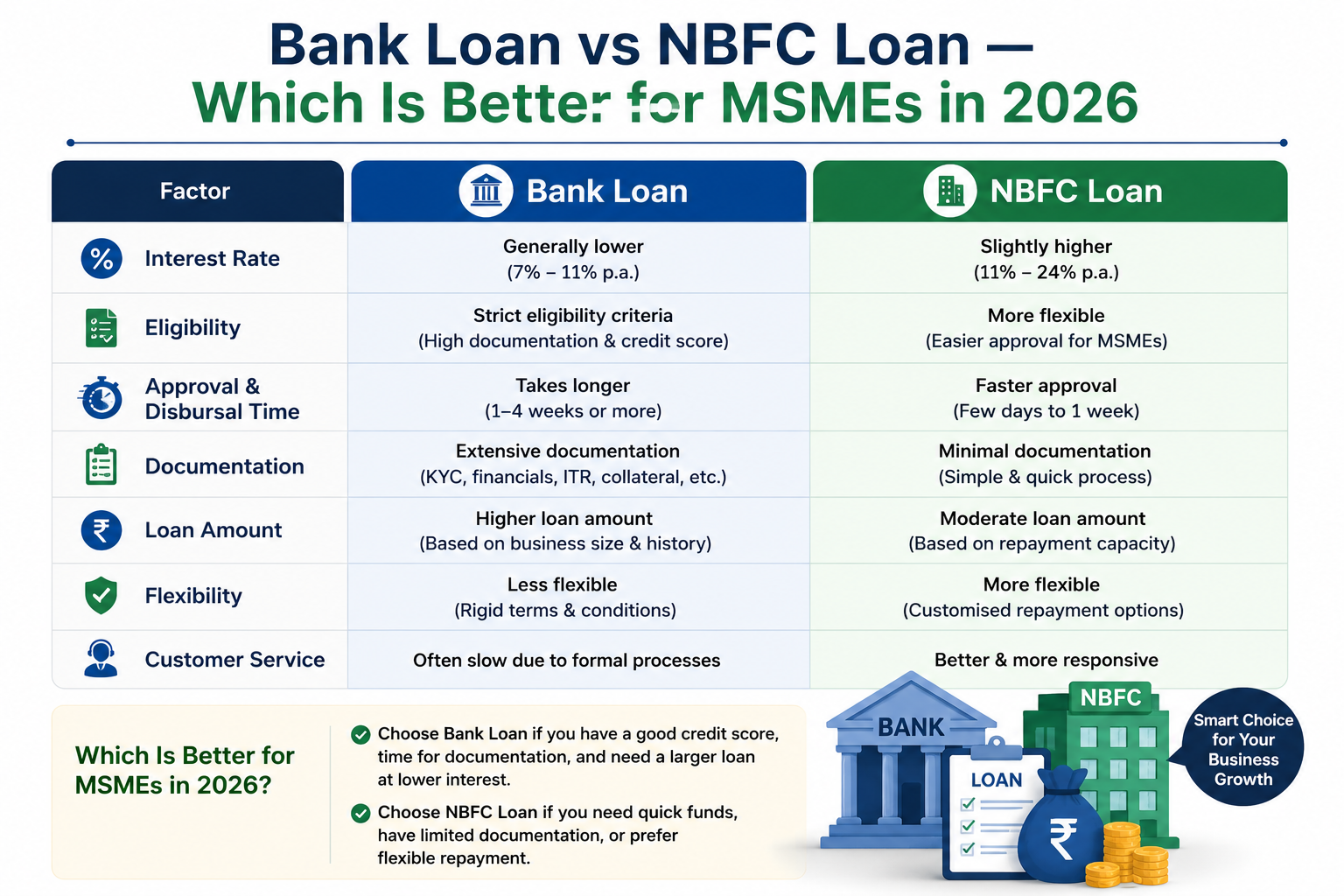
A bank is a deposit-taking institution licensed by the RBI and lends at regulated rates. NBFCs are non-deposit financial companies which borrow from capital markets and lend at market rates faster, more flexibly but significantly more expensively. The interest rate differential for most MSMEs between the two is 6 to 12 per cent per annum, which means Rs.6 lakh to Rs.10 lakh more in total interest to an NBFC than a bank on a Rs.20 lakh loan over five years.
What a Bank Actually Is
A scheduled commercial bank operates under the Banking Regulation Act 1949. Banks accept deposits, maintain RBI-mandated reserves, and lend under strict regulatory oversight. Interest rates are linked to EBLR (External Benchmark Lending Rate) or MCLR. Rates are transparent, comparable, and regulated.
What an NBFC Actually Is
A non-banking financial company is registered under the Companies Act and regulated by RBI but it cannot accept public deposits. NBFCs borrow money from banks and bond markets at wholesale rates and lend at retail rates with their margin built in. This cost structure means NBFC rates are structurally higher than bank rates for equivalent borrower profiles.
Get Your Detailed Project Report →
Interest Rate Comparison — The Numbers That Matter
Banks offer MSME term loans at 9 to 13 percent per annum. NBFCs charge 14 to 30 percent for the same loan categories. This is not a small difference — it is the difference between a business that is cash-flow positive and one that is permanently stretched.
Side-by-Side Rate Comparison
| Loan Category | Bank Rate | NBFC Rate | Annual Cost Difference on Rs.20 Lakh |
| MSME Term Loan | 9% to 13% | 14% to 24% | Rs.1 lakh to Rs.2.2 lakh per year |
| Working Capital CC | 10% to 14% | 16% to 28% | Rs.1.2 lakh to Rs.2.8 lakh per year |
| Unsecured Business Loan | 12% to 16% | 20% to 36% | Rs.1.6 lakh to Rs.4 lakh per year |
| Mudra Kishore or Tarun | 8.5% to 11% | 13% to 20% | Rs.90,000 to Rs.1.8 lakh per year |
The Five-Year Cost Reality : On a Rs.20 lakh MSME term loan over five years at 11 percent bank rate versus 22 percent NBFC rate the total additional interest paid to the NBFC is approximately Rs.7.5 lakh to Rs.9 lakh.
That money does not build your business. It funds the NBFC’s operations.
Where Banks Win — Four Clear Advantages
Advantage 1 — Government Scheme Access That NBFCs Cannot Offer
PMEGP subsidy, CGTMSE guarantee, NABARD refinance, Stand Up India, and all major government MSME scheme benefits flow exclusively through scheduled commercial banks. No NBFC can give you access to these schemes. If you qualify for PMEGP — a 15 to 35 percent subsidy on your project cost — taking an NBFC loan instead means permanently losing that subsidy.
This is the most overlooked advantage of bank lending for MSME borrowers.
Government Schemes Available Only Through Banks
- PMEGP — 15 to 35 percent subsidy on project cost up to Rs.50 lakh for manufacturing
- CGTMSE — Collateral-free guarantee coverage up to Rs.10 crore
- NABARD — Agricultural and rural business refinance with subsidised effective rates
- Stand Up India — Rs.10 lakh to Rs.1 crore for SC/ST and women entrepreneurs with CGFSI guarantee
- PM KUSUM — Solar farming infrastructure loans with interest subvention
Advantage 2 — Significantly Lower Interest Rate Over Full Loan Tenure
Every percentage point of interest rate difference compounds over the loan tenure. At Rs.20 lakh for five years, the difference between 11 percent and 22 percent is approximately Rs.7.5 lakh in total additional interest. That is 37 percent of your original loan amount paid purely as extra cost for choosing an NBFC over a bank.
If your CIBIL score is above 700 and your documentation is complete — you should almost never choose an NBFC over a bank purely on rate.
Advantage 3 — Longer Repayment Tenures
Banks offer MSME term loan tenures of 5 to 10 years, sometimes 15 years for infrastructure projects. Most NBFCs cap at 3 to 5 years. A longer tenure means lower monthly EMI — which directly improves your working capital position and keeps your DSCR comfortably above the bank’s 1.25 minimum benchmark.
A Rs.20 lakh loan at 11 percent over 7 years has an EMI of approximately Rs.33,000. The same loan over 3 years has an EMI of approximately Rs.65,000. The difference in monthly cash flow strain is Rs.32,000 — every single month.
Advantage 4 — Working Capital CC Limits at Lower Rates
Bank Cash Credit and Overdraft facilities for working capital cost 10 to 14 percent annually. NBFC working capital products cost 18 to 30 percent. For businesses with large ongoing working capital requirements — a Rs.10 lakh CC limit costs Rs.1 lakh to Rs.1.4 lakh per year at a bank versus Rs.1.8 lakh to Rs.3 lakh at an NBFC. Over three years that is Rs.2.4 lakh to Rs.4.8 lakh in avoidable interest expense.
Where NBFCs Win — When They Actually Make Sense
Situation 1 — Your CIBIL Score Is Below 650
Most scheduled commercial banks require a minimum CIBIL score of 700 to 720 for MSME loan approval. If your score is between 580 and 650 — from a past default, missed EMI, or credit card late payment — NBFCs offer a viable credit path while you rebuild your profile. This is a temporary bridge, not a permanent strategy.
Fintech NBFCs increasingly use alternative credit assessment through GST return transaction volume, bank statement debit-credit patterns, and UPI transaction history which can work in your favour when traditional CIBIL scores are damaged.
Situation 2 — Genuine Time-Critical Business Need
An NBFC makes financial sense only when the cost of a 4-week bank processing delay has a specific, quantifiable value that exceeds the additional interest cost. A confirmed purchase order worth Rs.50 lakh that expires in 10 days. A closing tender where raw material procurement is time-bound. A seasonal inventory window that shuts in 2 weeks.
Be honest about whether the urgency is real. Most urgency that justifies NBFC rates is actually impatience — not a genuine time-critical business event.
Situation 3 — Minimal Formal Documentation
Some MSME businesses have limited formal financial history — no audited accounts, minimal ITR, no GST registration. Banks cannot process these through standard credit appraisal channels. NBFCs — particularly fintech-oriented ones — can underwrite based on GST data, UPI transaction history, and e-commerce sales data.
This makes NBFCs a practical entry point for genuinely informal businesses transitioning to formal credit for the first time.
Situation 4 — Very Small Short-Term Amounts
For loan requirements below Rs.3 lakh that you plan to repay within 12 months — the absolute rupee interest difference between bank and NBFC is relatively small. An NBFC’s speed advantage may outweigh a Rs.8,000 to Rs.15,000 interest cost premium for a specific short-term business need.
Beyond this window — the rate differential compounds quickly and bank is almost always the better choice.
The Hidden Costs of NBFC Loans
The headline interest rate is not the true cost of an NBFC loan. Processing fees, prepayment penalties, annual maintenance charges, and insurance bundling add 3 to 8 percent to your effective annual cost. Always calculate the Annual Percentage Rate — APR — before comparing any two loan offers.
Hidden Cost Breakdown
1. Processing Fees
NBFCs charge 2 to 4 percent of loan amount upfront. On Rs.10 lakh — that is Rs.20,000 to Rs.40,000 paid on Day 1. Banks charge 0.5 to 1.5 percent.
2. Prepayment Penalties
Many NBFCs charge 3 to 5 percent penalty if you repay early. If you receive a large payment and want to reduce your loan burden — you pay a penalty for doing so. Most banks are more flexible on prepayment.
3. Annual Maintenance Charges
Some NBFCs charge Rs.5,000 to Rs.15,000 annual maintenance on working capital facilities. Banks rarely impose this.
4. Insurance Bundling
NBFCs frequently bundle insurance products with loans — marketed as mandatory but often optional. Adding Rs.5,000 to Rs.20,000 per year in insurance premiums to your already-higher interest rate.
The True APR Example
An NBFC offering 18 percent interest with 3 percent processing fee, 1 percent annual maintenance, and insurance bundling has a true APR of 24 to 26 percent — not 18 percent.
A Decision Framework — Bank or NBFC
Choose a bank if your CIBIL score is above 700, you have complete documentation, you qualify for any government scheme, and your loan requirement is above Rs.5 lakh. Choose an NBFC if your CIBIL score is below 650, your documentation is informal, you have a genuine urgent need, or your amount is small and short-term.
When to Choose a Bank — Decision Checklist
- CIBIL score 700 or above — bank lending is accessible to you
- Loan above Rs.10 lakh — interest rate difference is significant
- Government scheme eligible — PMEGP, CGTMSE, NABARD benefits only through banks
- Need tenure above 5 years — banks offer longer repayment schedules
- Working capital ongoing need — bank CC rates are structurally lower
- Building long-term credit history — bank relationship compounds over time
When to Consider an NBFC — Decision Checklist
- CIBIL score below 650 — banks are not practically accessible
- Time-critical opportunity — specific, quantifiable cost of delay
- Minimal formal documentation — bank channels not suitable
- Amount below Rs.3 lakh — short-term, fast repayment planned
- Informal business transitioning — NBFC as entry point to formal credit
The Combined Strategy That Works Best
Many experienced MSME businesses maintain both — a primary bank relationship for large long-term capital at low rates, and an NBFC or fintech credit line for urgent short-term working capital. This gives cost efficiency for core capital needs and speed flexibility for urgent operational needs.
What Documentation You Need for Each
For Bank Loan Applications
- CA-certified Project Report — mandatory for loans above Rs.10 lakh
- CMA Report with all 7 RBI statements — mandatory above Rs.10 lakh
- Feasibility Report — for government scheme applications
- Last 2 to 3 years ITR and audited financials
- 12 months GST returns and bank statements
- Collateral documents where applicable
For NBFC Loan Applications
- KYC documents — Aadhaar and PAN
- 6 to 12 months bank statements
- GST returns for 6 to 12 months
- ITR for 1 to 2 years if available
- Basic business plan or Project Report for better negotiation
A well-prepared Project Report helps you negotiate lower NBFC interest rates too. NBFCs have discretion on rate pricing within a range. A business that presents credible financials gets a rate closer to the lower end of the NBFC’s range. Our CA team prepares documentation that works across both bank and NBFC applications — starting at Rs.2,999.
Get Your Documentation Ready →
Conclusion
A bank or NBFC is not a difficult decision when you frame it correctly. If you can qualify for a bank loan — the lower interest rate, government scheme access, longer tenure, and credit history benefits make the bank the right choice in almost every case. The 4 to 8 week processing time is a small price for saving Rs.5 lakh to Rs.10 lakh over a five-year loan tenure.
If you cannot qualify for a bank loan right now an NBFC is a legitimate bridge. Use it deliberately. Keep the tenure short. Plan to refinance with a bank as soon as your CIBIL profile recovers.
The documentation you bring to either institution determines your position. A well-prepared CA-certified project report and CMA report get you better bank approval probability and better Banks always give lower interest rates. The extra total interest paid on a five-year loan of Rs.20 lakh is about Rs.7.5 lakh to Rs.9 lakh when the bank rate is 11 per cent and the NBFC rate is 22 per cent.
Office HIG-B-59, Sector A, Vidya Nagar, Hoshangabad Road, Bhopal 462026
Frequently Asked Questions
1. What is the difference between Bank Loan and NBFC loan for MSME?s
Banks lend at regulated rates – 9 to 13 per cent for MSME term loans. NBFCs charge market rates: 14 to 30 percent for the same categories. Banks are cheaper but need better documentation and take 3 to 8 weeks. NBFCs are expensive but disburse in 3 to 10 days with lighter documentation requirements.
2. Which has lower interest rates — bank or NBFC?
Banks consistently offer lower interest rates. On a Rs.20 lakh loan over five years, the difference between 11 percent bank rate and 22 percent NBFC rate amounts to approximately Rs.7.5 lakh to Rs.9 lakh in additional total interest paid.
No. Only through scheduled commercial banks are available PMEGP subsidy, CGTMSE guarantee, NABARD refinance and all major government MSME scheme benefits. By taking an NBFC loan you are losing out on these scheme benefits forever.nd all major government MSME scheme benefits flow exclusively through scheduled commercial banks. 4. Bank MSME Loan: What is the minimum CIBIL Score required? these scheme benefits.
4. What CIBIL score do I need for a bank MSME loan?
Most of the scheduled commercial banks require minimum CIBIL score between 700 to 720. Some banks will consider 650 to 700 with good compensating documentation. Below 650 — NBFCs or fintech lenders are more viable options while you rebuild your credit profile.
5. When is an NBFC loan better than a bank loan? NBFC makes sense if your CIBIL score is below 650, or if you have a real time-critical business opportunity where the cost of delay is more than the interest premium, or if your documentation is minimal and bank channels are not suitable, or if your amount is small and repayment is planned within 12 months.
6. What are the hidden costs of an NBFC loan?
Upfront processing fees of 2 to 4 percent, prepayment penalties of 3 to 5 percent, annual maintenance fees and insurance product bundling can tack on 3 to 8 percent to your effective annual borrowing cost. Always calculate the true APR (not just the headline interest rate).
7. Is a Project Report required for an NBFC Loan?Not always a formal requirement. But a well drafted Project Report helps you negotiate better terms
Not always formally required. But a well-prepared Project Report helps you negotiate lower interest rates — NBFCs price within a rate band and credible businesses get rates toward the lower end. Our team prepares loan documentation for both bank and NBFC applications starting at Rs.2,999.
8. Can I use both a bank and an NBFC at the same time?
Yes. Many experienced MSME businesses maintain both. A primary bank relationship for large long-term loans at lower rates and an NBFC credit line for urgent short-term working capital needs. This gives you cost efficiency and speed flexibility without being dependent on either alone.
9. How long does bank MSME loan processing take?
Standard processing takes 3 to 8 weeks after complete documentation submission. Well-prepared documentation with CA-certified Project Report and CMA reports reduces this significantly. NBFCs typically disburse in 3 to 10 working days for approved applicants.