
A bank statement is treated less like a document and more like an audit trail. While your project report and ITR describe the business as it’s meant to be, your bank statement shows what actually moved through the account — and underwriters read it specifically to answer three questions that can directly influence Business Loan Approval: is the revenue real, is it consistent, and is there anything hidden that the rest of the application didn’t mention? At Sharda Associates, when we prepare loan documentation for clients, reviewing the bank statement pattern before submission is one of the first things we check, precisely because this is where an otherwise strong file can quietly lose ground.
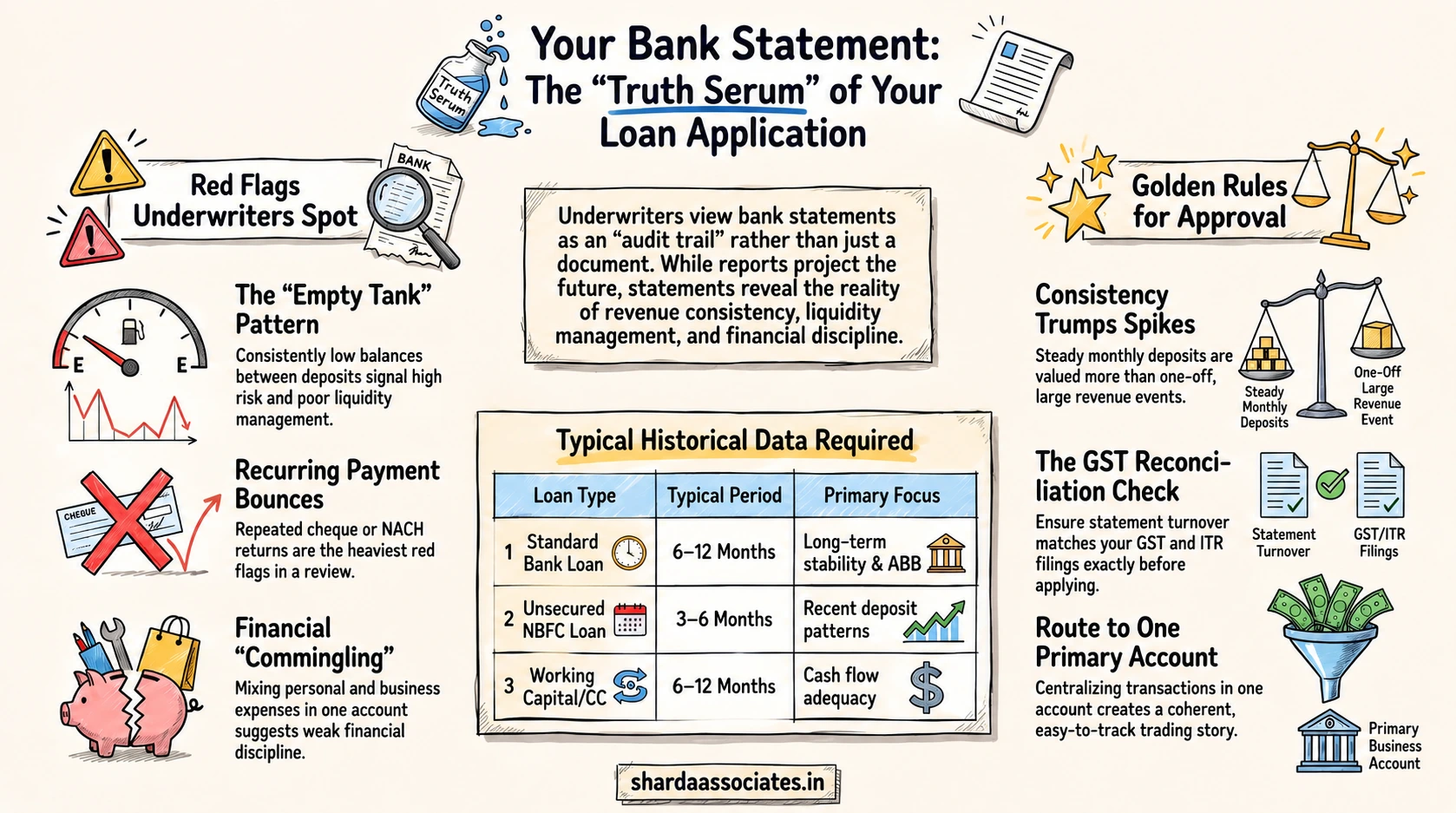
Average Balance Is the First Number Checked
Average Bank Balance (ABB), calculated over the review period, shows whether cash genuinely stays in the account or gets drawn down to near-zero between deposit events.
| Pattern | How It Reads |
| Balance builds steadily, dips modestly, recovers | Healthy liquidity management |
| Large deposit on day 1, drawn to near-zero by day 15, every month | Higher risk — no real cash cushion between cycles |
| Consistently low or negative balance, frequent overdraft use | Cash flow stress |
A business that maintains a moderate average balance throughout the month is generally read as more stable than one with the same total inflow concentrated into a single spike.
Cheque, NACH, and EMI Bounces
Repeated returns — cheques, NACH mandates, or existing EMI debits — are one of the most heavily weighted red flags in the entire review, because they directly signal that money isn’t reliably available when obligations fall due. A single bounce with a clear, resolved explanation is treated very differently from a recurring pattern across several months.
Deposit Consistency Matters More Than Peak Revenue
A single exceptional month surrounded by weak ones raises more concern than a lower but steady monthly pattern. Underwriters are specifically checking whether revenue is genuinely recurring or concentrated around one large, possibly one-off event — the latter reads as fragile even if the total looks impressive.
Circular Transfers and Commingling
Two specific patterns get flagged quickly:
- Circular/round-tripping transfers — money moving between related accounts in a way that doesn’t reflect a genuine trade transaction, often used to artificially inflate apparent turnover
- Commingling of personal and business funds — using the business account for personal expenses, or vice versa, which makes it harder for a lender to isolate genuine business cash flow and reads as weaker financial discipline
Neither is always intentional, but both slow down or complicate the review regardless of intent.
How Many Months of Statements You’ll Actually Need
| Loan Type | Typical Statement Period | Primary Focus |
| Standard term loan (bank) | 6–12 months | Long-term stability, average balance, minimal overdraft use |
| Working capital/ cash credit | 6–12 months | Cash flow adequacy against the sanctioned limit |
| Unsecured NBFC/fintech loan | 3–6 months | Recent, consistent deposit pattern |
| MSME/scheme-linked loan | 6–12 months | Consistency alongside GST/ITR reconciliation |
A shorter statement period from a fintech lender doesn’t mean lighter scrutiny — it just compresses the same checks into a smaller window.
Overdraft and Credit Limit Utilisation
Where the business already operates an overdraft or cash credit facility, how close it consistently runs to the sanctioned limit matters. Persistent near-maximum utilisation, month after month, is read as a business operating with little spare capacity — a separate signal from the average balance calculation, and one lenders specifically weigh against normal working-capital cycles rather than a fixed universal percentage.
Cross-Checking Against the Rest of the Application
Bank statement figures don’t get assessed in isolation — they’re checked against GST filings, ITR-reported turnover, and the account holder’s name and entity type on record. A mismatch here doesn’t just raise a question about the statement; it raises a question about every other document in the file.
What a Clean Statement Actually Looks Like
- Consistent business receipts and supplier payments that tell a coherent trading story
- No unexplained large cash withdrawals or deposits without a traceable business reason
- Returned payments, if any, resolved and explained rather than left as open gaps
- A single primary operative account, rather than turnover fragmented across several accounts with no clear pattern
- Name, entity type, and account details matching registration records exactly
How to Prepare Before You Apply
- Route transactions through one primary business account, rather than splitting activity across several with no clear logic
- Resolve any bounced cheques or returned NACH mandates before applying, and be ready to explain any that remain on record
- Avoid large, unexplained transfers close to the application date — these draw immediate scrutiny
- Keep personal and business transactions separate, even where the account technically permits both
- Reconcile statement-visible turnover against GST and ITR figures before submission, so any gap is understood and explainable rather than discovered by the underwriter first
Conclusion
A bank statement doesn’t just support a business loan application — in practice, it’s one of the most closely read documents in the entire file, because it shows what actually happened rather than what was projected or declared. A clean, consistent, well-explained statement can move a borderline application forward; an inconsistent or unexplained one can undo an otherwise strong project report. At Sharda Associates, we review this pattern as part of preparing loan documentation, so the statement supports the rest of the file rather than working against it. Call us at +91 89899 77769 to get your documentation reviewed before you apply.
Frequently Asked Questions
Q1. What is Average Bank Balance (ABB), and why does it matter for loan approval?
It’s the average amount held in the account over the review period — a healthy, steady ABB signals genuine liquidity, while a balance that spikes and drains repeatedly signals a thinner cash cushion.
Q2. How many cheque bounces are considered too many?
There’s no fixed universal number, but a recurring pattern across several months is treated far more seriously than a single, resolved, well-explained instance.
Q3. Does one exceptionally strong revenue month help my application?
Not as much as steady, consistent revenue would — a single spike surrounded by weaker months is often read as less reliable than a lower but stable monthly pattern.
Q4. Why do lenders care if I mix personal and business expenses in one account?
It makes it harder to isolate actual business cash flow, and it’s generally read as a sign of weaker financial discipline, independent of your total revenue.
Q5. How many months of bank statements will I need to submit?
Commonly 6–12 months for standard bank loans, though some fintech and NBFC lenders work with as little as 3–6 months for smaller unsecured loans.
Q6. Can bank statement figures alone get my application flagged, even if the numbers look fine?
Yes — if they don’t reconcile with your GST filings or ITR-reported turnover, the mismatch itself becomes the issue, regardless of how healthy the numbers look individually.
Q7. Why do banks check regular credits in a business bank account?
Regular credits help lenders understand whether the business generates consistent operating cash flow. Predictable transaction activity can provide stronger evidence of ongoing business operations and repayment capacity.
Q8. Can low bank balance affect business loan approval?
Yes. A consistently low balance may indicate limited liquidity or difficulty meeting short-term obligations, particularly when compared with the proposed EMI and overall business cash flow.
Q9. Do large cash deposits create problems during loan assessment?
They can attract additional questions if they are frequent, unexplained, or inconsistent with the business’s reported turnover. Lenders may want to understand the source and business purpose of substantial deposits.
Q10. Does a high monthly turnover guarantee business loan approval?
No. Turnover is only one part of the assessment. Banks may also consider profitability, existing liabilities, repayment history, credit score, cash flow, GST returns, ITRs, and the proposed loan’s affordability.
Q11. Do lenders check EMI payments in bank statements?
Yes. Existing EMI payments help lenders understand your current debt obligations and whether sufficient cash flow remains to service an additional loan.
Q12. Can frequent withdrawals affect my loan application?
Frequent or unusually large withdrawals can lead lenders to examine the account more closely, especially when they cannot be clearly connected to normal business expenses or operations.