
A well-built project report earns your file a fair reading. It does not, on its own, earn a sanction. Banks run a business loan proposal through several independent checkpoints, and a flawless project report only clears one of them. Business Loan Applications applicants are often genuinely confused when a “perfect” report still comes back rejected—the answer is usually sitting in one of the checks that has nothing to do with the report itself. Sharda Associates helps businesses prepare CA-certified project reports that align project costs, financial projections, repayment capacity and lender requirements, while also helping applicants understand the other factors banks consider before approving a business loan.
A Project Report Is Only One Part of Bank Loan Approval
Before approving a business loan, banks evaluate the complete financial profile of the borrower and the proposed project.
| Evaluation Area | What Banks Analyse |
| Borrower Profile | Credit history, business experience and financial background |
| Business Feasibility | Market demand, competition and growth potential |
| Financial Strength | Cash flow, profitability, DSCR and repayment ability |
| Documentation | GST returns, ITR, bank statements, licences and approvals |
A project report can explain the business plan, but banks also verify whether the information provided is realistic and supported by actual financial evidence.
Difference Between Projected Numbers and Actual Business Performance
One of the most common reasons for loan rejection is a mismatch between the information provided in the project report and the borrower’s actual financial records.
Banks compare different sources of information, including:
- GST returns
- Income Tax Returns
- Financial statements
- Bank statements
- Existing business performance
For example, if a project report shows significant future growth but existing business transactions, GST filings or banking records do not support those assumptions, the bank may question the reliability of the projections.
Financial projections should not only show growth potential but should also explain how that growth can realistically be achieved.
A credible project report should connect:
Market Demand → Sales Projection → Revenue → Profitability → Loan Repayment Capacity
When these elements do not match, the bank may reduce the loan amount or reject the proposal.
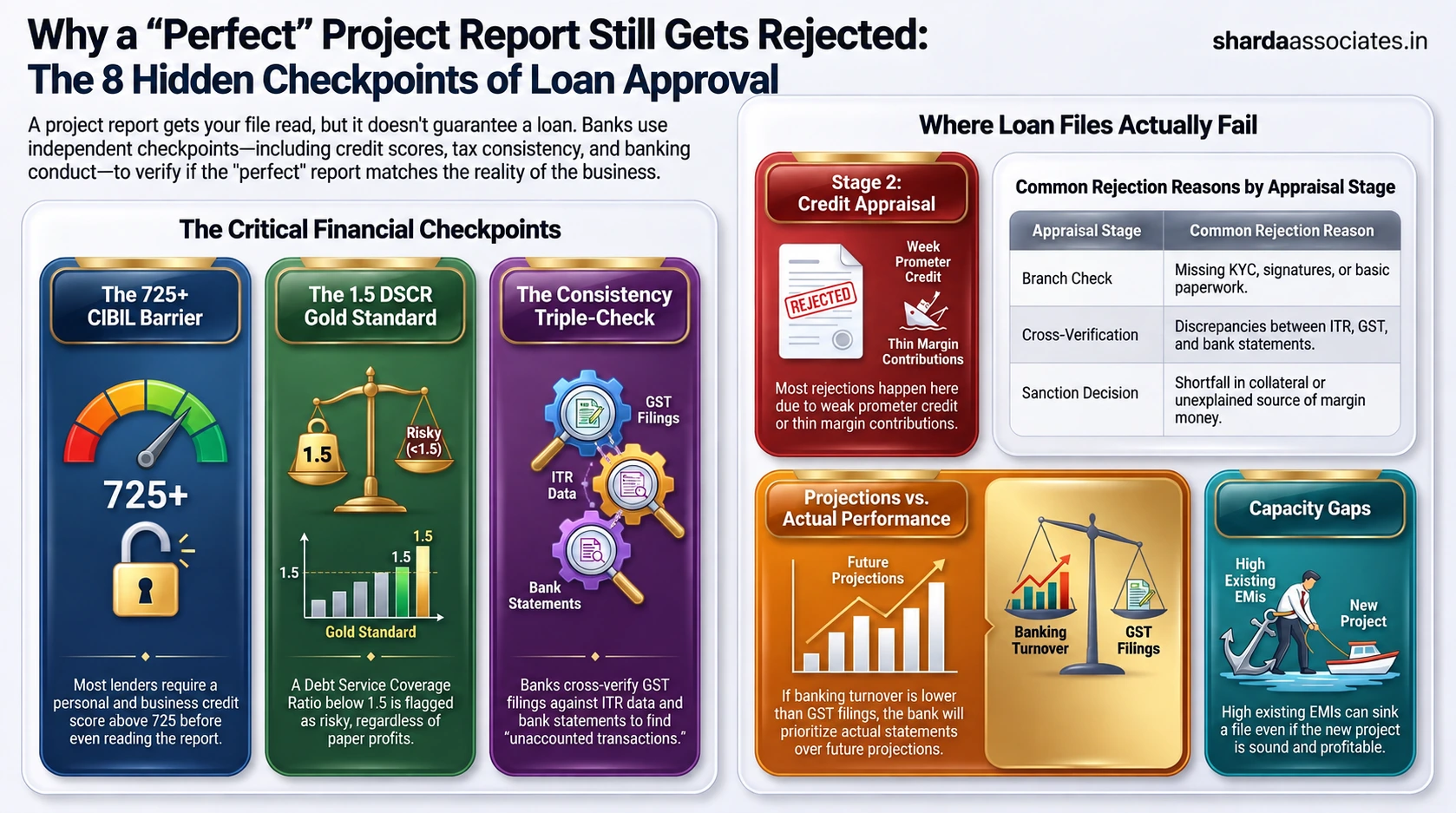
Where a Loan File Actually Gets Stopped
| Appraisal Stage | What Gets Checked | Typical Reason for Rejection Here |
| Branch completeness check | KYC, signatures, basic paperwork | Missing documents — file returned before the report is even read |
| Credit appraisal | Bureau score, ratios, DSCR | Weak promoter/guarantor credit, thin margin contribution |
| Cross-verification | ITR, GST returns, bank statements, projections | Figures across documents don’t tell the same story |
| Sanction decision | Collateral, unresolved queries | Shortfall in security, unexplained source of margin money |
A project report can be excellent and still not survive stage 2 or 3 — which is exactly where most rejections happen.
1. Your Personal and Business Credit Score
This is checked before anyone reads a single page of your report. Most lenders look for a CIBIL score above 700 (many prefer 725+), and this applies to every promoter and guarantor on the file, not just the business entity. A single overlooked issue — a settled default, a credit card write-off from years ago, or a casual guarantee given to a relative’s loan that later went bad — can sink an otherwise strong application.
2. Mismatch Between Your GST Returns and Income Tax Returns
Banks now cross-check GST filings against ITR data as a matter of routine. If GST shows high turnover while ITR shows much lower income, it reads as inconsistency, not ambition — and it’s specifically flagged as suspicious of unaccounted transactions rather than treated as a paperwork gap.
3. What Your Bank Statements Actually Show
Your projections in the report describe the business you plan to run. Your bank statements describe the business you’re actually running. If banking turnover is consistently lower than what’s reported in your GST filings or projections, or if there’s a pattern of cheque bounces and irregular credits, this carries more weight with the appraiser than the projections do.
4. How Much You’re Already Carrying
- High existing EMI obligations relative to income
- Multiple ongoing loans across lenders
- A new loan request that pushes total obligations past what your cash flow can service
None of this is a flaw in your project — it’s a flaw in your capacity to take on more, and no project report can offset it.
5. Collateral and Margin Money Gaps
Even where a scheme offers credit guarantee cover (like CGTMSE), banks typically still assess and self-retain a first-loss share internally. A shortfall in offered security, or margin money whose source can’t be clearly explained, is a common reason a file stalls at the sanction stage even after clearing credit appraisal.
6. DSCR Below the Bank’s Comfort Level
Your project report may show profits — but the number that actually matters here is Debt Service Coverage Ratio. A DSCR below roughly 1.5 is generally treated as risky, regardless of how the P&L looks on paper, because it signals thin room for the business to absorb a slow month and still pay the EMI.
7. Documentation and Compliance Gaps That Have Nothing to Do With the Project
Missing Udyam registration, an expired trade license, incomplete KYC for a partner or director, or a compliance lapse unrelated to the loan purpose itself can all stall a file at the very first completeness check — before appraisal even begins.
8. Industry or Segment Risk Category
Some sectors attract extra caution purely due to internal lender risk policy — this isn’t disclosed upfront and has nothing to do with your specific business’s performance. A genuinely strong applicant can still face resistance simply because the segment carries a higher internal risk weight at that lender.
9. Applying for More Than the Business Can Justify
A loan amount that doesn’t match the scale, turnover, or repayment capacity shown across your other documents raises a flag on its own — independent of whether the underlying project is sound.
Unclear Project Cost, Promoter Contribution and Loan Requirement
Banks also evaluate whether the proposed project cost and funding structure are justified.
A loan application may become difficult when:
- Project cost appears higher than actual requirements
- Machinery quotations are not properly supported
- Promoter contribution is insufficient
- Source of margin money is unclear
- Requested loan amount does not match business capacity
Promoter contribution is important because it shows the entrepreneur’s own financial involvement in the project.
Banks may also ask questions if the promoter contribution comes from unexplained sources or sudden fund transfers before submitting the loan application.
A properly structured project report should clearly explain:
- Total project cost
- Own contribution
- Loan requirement
- Use of funds
- Repayment plan
What This Means Practically
A strong project report gets you a serious first read. What decides the outcome after that is whether your credit history, tax filings, bank statements, existing liabilities, and collateral position all tell the same consistent story the report is telling. At Sharda Associates, when we prepare a project report for a bank loan, we also flag these adjacent checks upfront — GST-ITR consistency, DSCR levels, existing obligations — so the file isn’t strong in isolation while something else quietly works against it.
Frequently Asked Question
Q1. If my project report is well-prepared, why would the bank still reject my loan?
Because the report is only one of several checkpoints — credit score, banking conduct, tax-return consistency, and collateral are assessed independently and can each cause rejection on their own.
Q2. Does a good CIBIL score guarantee approval?
No, but a poor one can single-handedly stop an otherwise strong file at the credit appraisal stage before the project itself is even weighed.
Q3. Can a government guarantee scheme like CGTMSE override these checks?
No. Even with guarantee cover, the bank typically retains a portion of the risk internally and continues its usual credit checks.
Q4. Is there a specific DSCR number I should aim for?
There’s no universal fixed number, but a DSCR meaningfully below 1.5 is generally viewed as risky by most lenders — check the specific threshold your lender applies.
Q5. What are the main reasons banks reject business loan applications?
Common reasons include weak credit history, insufficient repayment capacity, inconsistent ITRs or GST returns, poor banking conduct, inadequate promoter contribution, unrealistic projections, insufficient collateral and incomplete documentation.
Q6. Can inconsistent ITR and project report figures lead to loan rejection?
Yes. If reported turnover, income, expenses or profitability differs significantly from the figures projected in the project report, the bank may question the assumptions and reduce or reject the proposed funding.
Q7. Can a low bank balance cause my business loan application to be rejected?
It can affect appraisal if the account shows weak cash flows, frequent overdrafts, bounced payments or insufficient funds. Banks generally examine banking conduct along with the project’s projected financial performance.
Q8. Will existing business loans affect my chances of getting another loan?
Yes. Existing EMIs and outstanding debt affect repayment capacity. The lender may consider your existing obligations while calculating whether the business can comfortably service additional borrowing.
Q9. Can banks reject a loan because the project cost is too high?
Yes. If the proposed project cost appears excessive compared with the business scale, promoter contribution, expected revenue or repayment capacity, the bank may question the project’s viability.
Q10. Why do banks question the financial projections in a project report?
Banks compare projected sales, expenses, margins, cash flows and repayment capacity with historical performance, industry conditions and supporting documents. Unrealistic assumptions can weaken the credibility of the proposal.