
Every year, thousands of entrepreneurs sit down and prepare their own project report for a bank loan — sometimes using a downloaded template, sometimes with help from a general consultant. Many of these reports get stuck at the bank’s desk, not because the business idea is weak, but because the financial figures and projections were never properly verified by a qualified professional. Understanding the Benefits of a CA-Certified Project Report for Business Loans can help entrepreneurs recognize why professionally prepared and certified financial documentation can add credibility to a loan application and support a more structured assessment by lenders.
This is exactly the gap a CA-certified project report from Sharda Associates is built to close: a project report reviewed and formally certified by a practising Chartered Accountant registered with the Institute of Chartered Accountants of India (ICAI), carrying that CA’s membership number and official seal. This single addition changes how a bank’s credit team treats the entire document, because it tells them the financial projections, cost estimates and repayment calculations behind your loan or subsidy request have already been checked by an accountable, licensed professional — not just assembled to look presentable.
It’s the same reason so many first-time applicants who come to Sharda Associates do so only after a self-prepared or generic report has already been rejected once. If you’re trying to understand whether the certification is worth the extra step or why so many banks specifically ask for it, this article walks through exactly what changes once a CA puts their name on your report, based on what actually happens on a bank’s side of the desk once your file lands there.
What Exactly Is a CA-Certified Project Report?
It’s a Detailed Project Report (DPR) or feasibility report — covering business background, project cost, means of finance, financial projections (profit & loss, cash flow, balance sheet), and key ratios like DSCR and break-even — that has been reviewed, verified and formally certified by an ICAI-registered Chartered Accountant. The certification itself is a signed declaration, along with the CA’s membership number and stamp, that the figures presented have been checked for consistency and reasonableness against standard accounting practices.
Why Certification Changes How a Bank Reads Your File
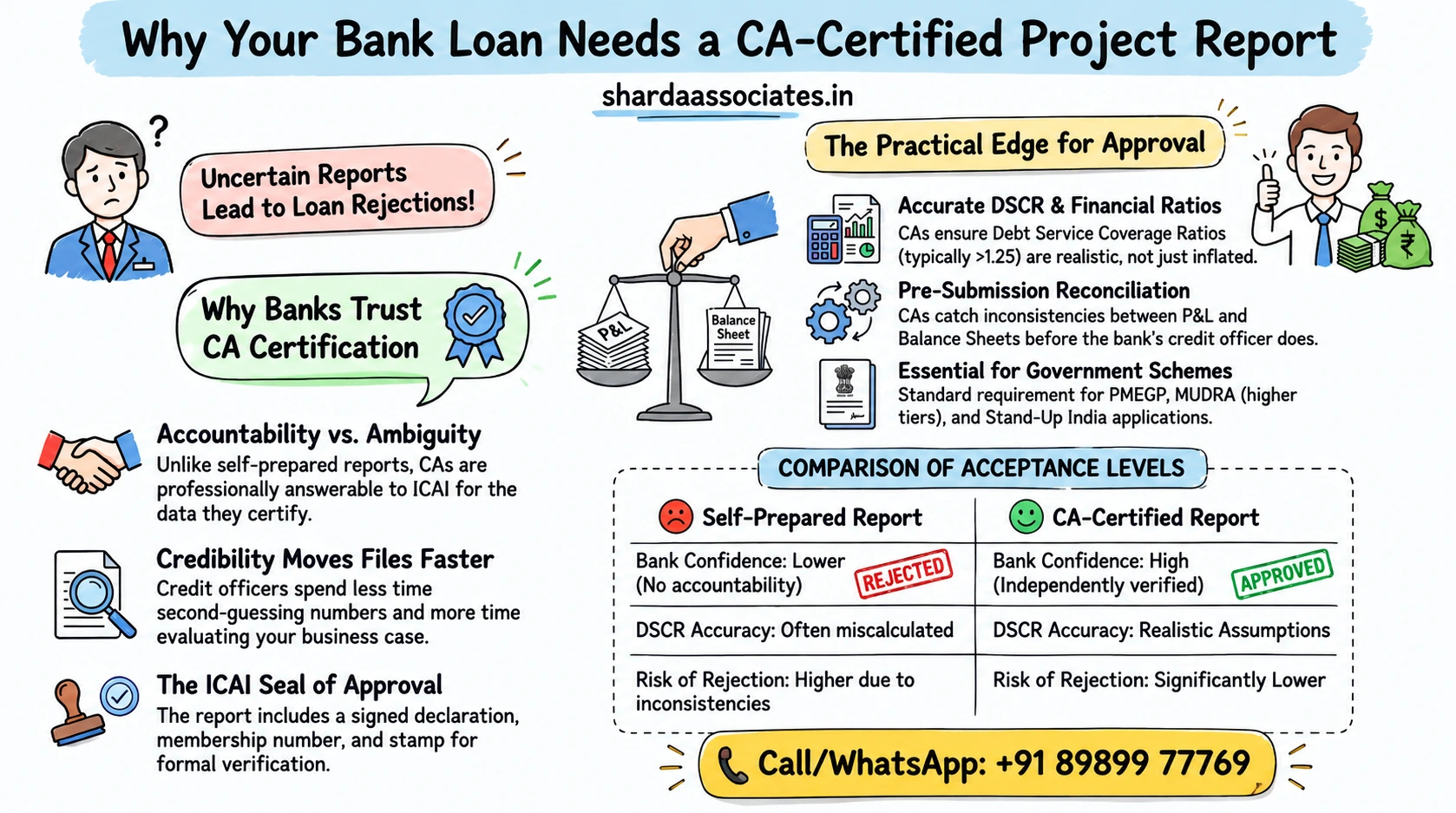
A bank’s credit officer reviews dozens of loan proposals, and every one of them is essentially asking the same question: can I trust these numbers? A self-prepared or generic report gives the officer no independent basis to answer that beyond their own judgement. A CA’s certification adds a layer of professional accountability — a chartered accountant who certifies unrealistic or false figures is answerable to ICAI and can face disciplinary action, which is exactly why banks treat a CA-certified report with more confidence than one with no independent review behind it.
Key Benefits of a CA-Certified Project Report
1. Higher Credibility With Banks and Scheme Authorities
Since the numbers carry independent professional verification, credit officers generally spend less time second-guessing the projections and more time evaluating the actual business case — which tends to move your file forward faster.
2. Fewer Rejections Due to Weak or Inconsistent Financials
A large share of loan and subsidy rejections trace back to a profit & loss statement that doesn’t tie back to the balance sheet, or cash flow figures that don’t match reported sales. A CA reviewing the report before submission catches these inconsistencies before a credit officer does.
3. Accurate DSCR and Ratio Calculations
The Debt Service Coverage Ratio is one of the first things a bank checks, and most require at least 1.25 for the loan amount to be approved as requested. A CA calculates this correctly against realistic assumptions, rather than a figure that happens to clear the threshold on paper but doesn’t hold up under scrutiny.
4. Acceptance Across Government Schemes
PMEGP, MUDRA, Stand-Up India and CGTMSE-backed applications are all credit-linked schemes where the bank’s own appraisal ultimately decides the outcome. A CA-certified report is generally accepted without additional questions across these schemes, since it already meets the documentation standard banks expect.
5. Realistic, Defensible Projections
CAs build financial projections around a business’s actual cost structure, market conditions, and a realistic capacity ramp-up — rather than the inflated first-year sales figures that are one of the most common reasons credit officers lose confidence in a report.
6. Saves Time on Revisions and Re-Submissions
A report that’s internally consistent and properly certified from the start avoids the multiple rounds of bank queries and resubmissions that often follow a weak, self-prepared report — which can add weeks to your loan timeline.
7. Professional Accountability Behind the Numbers
Because a CA’s ICAI membership number is attached to the certification, there’s a real professional standing behind the figures — this is precisely the accountability a bank’s own internal Credit Appraisal Memo relies on when recommending a proposal for sanction.
CA-Certified vs Self-Prepared or Generic Project Report
| Factor | CA-Certified Report | Self-Prepared / Generic Report |
| Bank confidence in figures | High — independently verified | Lower — no professional accountability |
| DSCR accuracy | Calculated correctly against realistic assumptions | Often miscalculated or inflated |
| Consistency across statements | Checked and reconciled | Frequently mismatched |
| Acceptance for PMEGP/MUDRA/CGTMSE | Generally accepted without extra scrutiny | May face additional queries or rejection |
| Risk of resubmission | Lower | Higher |
| Professional accountability | Yes (ICAI membership number attached) | None |
When Do You Actually Need One?
- Applying for a term loan above roughly ₹10 lakh, where most banks expect certified financials as standard.
- Applying under PMEGP, MUDRA (higher tiers), Stand-Up India, or any CGTMSE-backed loan.
- Seeking a working capital limit or CC/OD facility where CMA data needs to reconcile with your project report.
- Reapplying after a previous rejection caused by weak or inconsistent financials.
- Expanding an existing business and needing updated projections that match your actual books.
What Should Be Included in a Genuine CA-Certified Report
A complete report should cover the business and promoter profile, a realistic project cost breakdown, the means of finance (your contribution versus the bank loan), 3–5 year financial projections, a correctly calculated DSCR and break-even point, and—where relevant—scheme-specific details like PMEGP margin money or CGTMSE eligibility. The CA’s certification, membership number and seal should appear clearly on the final document, not just in a cover note.
Conclusion
The difference a CA’s certification makes isn’t cosmetic — it’s the difference between a bank’s credit officer trusting your numbers on sight versus having to independently second-guess every figure in the file, which is exactly where delays and rejections tend to start. If you’ve been putting off getting your project report properly certified, or you’re not fully sure whether your current one would actually hold up to a bank’s scrutiny, it’s worth having it reviewed by someone who does this daily rather than finding out after a rejection.
At Sharda Associates, our project reports are prepared and certified by an ICAI-registered Chartered Accountant, and we’re happy to have an honest look at what you already have before you submit anything. Call or WhatsApp our CA team at +91 89899 77769 and send us what you have, and we’ll tell you plainly what needs to change before you put the application back in.
Frequently Asked Questions
1. Is a CA-certified project report legally required for every business loan?
Not universally, but most banks expect it for term loans above roughly ₹10 lakh and for most government scheme-linked loans, since it meets their standard documentation requirement.
2. Does CA certification guarantee loan approval?
No — it improves the credibility and quality of your documentation, but final approval still depends on the bank’s own credit appraisal, including your credit score, existing obligations and business viability.
3. How is a CA-certified report different from a CMA report?
A project report focuses on projected viability for a loan or new project; CMA data is a broader, standardised financial analysis format often used for working capital or limit-renewal purposes — both can carry CA certification.
4. Can I get my own self-prepared report certified by a CA afterward?
Generally, a CA needs to review and often rework the underlying figures to certify them responsibly — certification isn’t simply a signature added to an existing document without verification.
5. Does every bank accept CA-certified project reports the same way?
Most scheduled banks accept properly certified reports as meeting their documentation standard, though specific formatting preferences can vary slightly by lender.
6. Is a CA-certified report more expensive than a regular one?
It typically costs more than a purely self-prepared report, reflecting the professional review and accountability involved, though pricing varies by project complexity and lender requirement.
7. Can a CA-certified report help with a loan enhancement or renewal, not just a new loan?
Yes — certified, updated financials are commonly used for enhancement requests and annual working capital renewals as well.
8. What happens if the CA’s figures turn out to be inaccurate?
Since the CA’s ICAI membership number is attached to the certification, they carry professional accountability for the figures, which is part of why banks place more trust in certified reports.
9. Is CA certification the same as an audit?
No — certification of a project report is a review and verification of projected/estimated figures for a specific purpose, while an audit is a separate, more extensive examination of actual historical financial statements.
10. Do I need a CA-certified report for a very small MUDRA loan?
Often not for the smallest Shishu-category loans, but as the loan size increases into Kishor and Tarun categories, banks increasingly expect certified projections.