
Quick answer: A mismatch between turnover in your books turnover in your GST returns is common, and many differences have valid reasons such as timing, advances or exempt supplies. During a tax audit, the CA will ask you to reconcile the two, and unexplained differences can lead to GST notices, income tax queries and tax, interest and penalty.
At Sharda Associates, our Chartered Accountants (CA) reconcile books with GSTR-1, GSTR-3B and GSTR-9, conduct tax audits, file income tax returns and reply to GST and income tax notices, and also prepare CA-certified project reports for bank loans and business funding. A reconciled turnover is the best protection during audit and assessment.
Why Does Turnover in Books Differ from GST Turnover?
Books follow accounting rules, while GST returns follow the time and value of supply rules in the GST law. This creates differences even when both are correct. During tax audit, the CA compares sales in the profit and loss account with GST turnover, because the department can compare both data sets through GST returns, the Annual Information Statement and other systems.
Common Reasons for Mismatch
| Reason | Example | What to do |
| Timing difference | Invoice raised in March but reported in the April GST return | Show the invoice list in the reconciliation |
| Advances received | Advance shown in GST return but not yet sales in books | List advances and adjust against later invoices |
| Credit notes and returns | Credit note booked in March, GST adjustment made later | Match credit notes with return period |
| Exempt, nil-rated or non-GST supplies | Exports, SEZ supplies, nil-rated goods and items outside GST | Separate such sales in the working |
| Other income in books | Interest, discount or scrap sales mixed in turnover | Remove non-turnover income before comparing |
| Reverse charge and stock transfers | Branch transfers or inward supplies under reverse charge | Identify and tag these entries |
| Errors and omissions | Missing invoices, wrong tax rate or duplicate entries | Correct books or returns and pay the differential tax |
| Rate and value differences | Discounts, freight or GST included in the book value | Compare values on the same basis |
Which Turnover Do You Compare in a Tax Audit?
The starting point is the turnover shown in the profit and loss account. The CA compares it with taxable value in GSTR-1, GSTR-3B and the annual return GSTR-9, and with the reconciliation statement in Form GSTR-9C where it applies. Where GST is collected separately, it is generally excluded from turnover, so make sure that both sides are compared on the same basis.
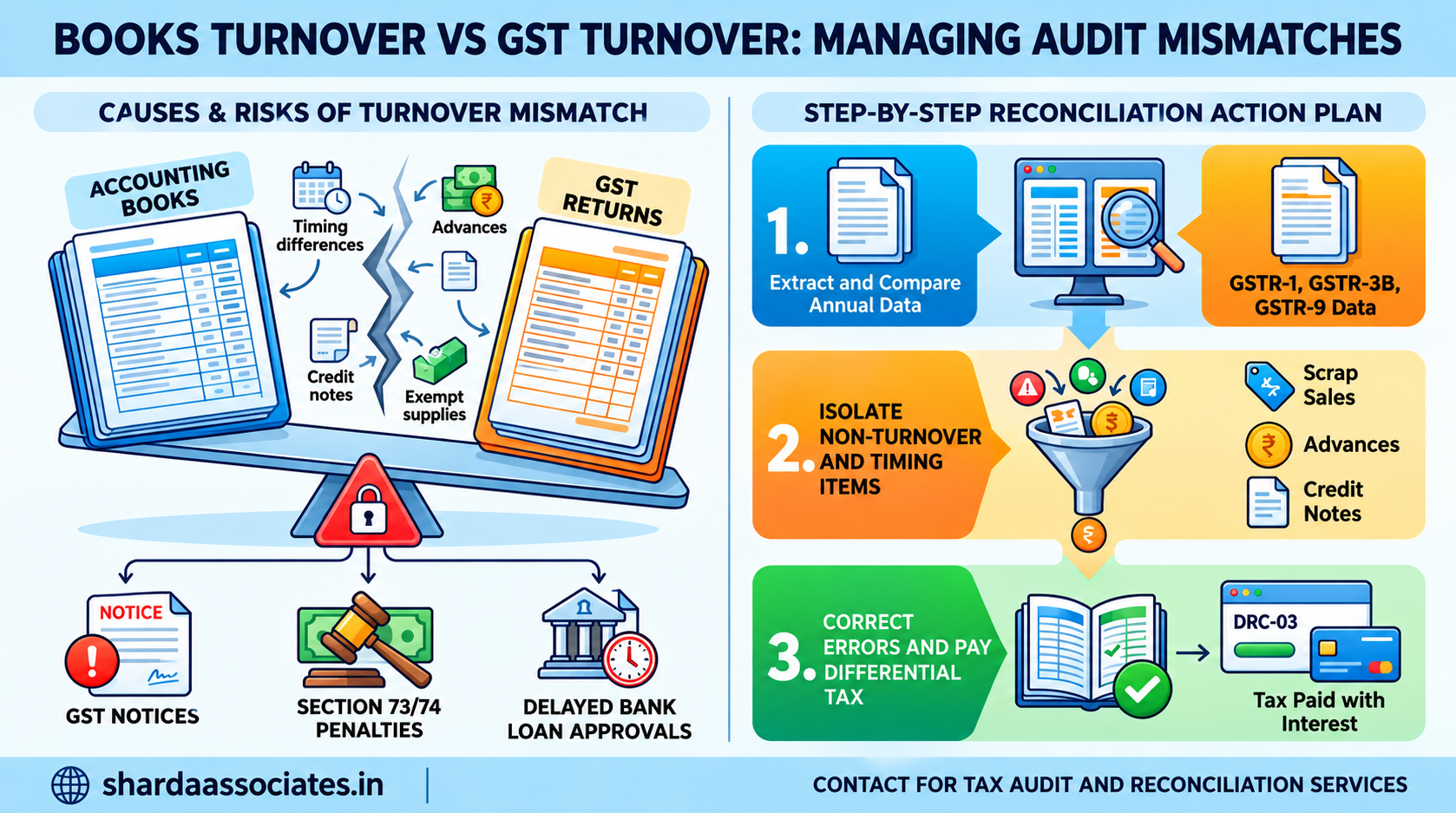
Consequences of an Unexplained Mismatch
- GST notices. The officer can scrutinise returns under Section 61 and issue a notice seeking an explanation. Unexplained differences can result in a demand with interest and penalty under Section 73 or 74 (or Section 74A for later years).
- Income tax questions. If GST turnover is higher than turnover in the income tax return, the department can question the profit and may estimate income or make additions.
- Penalty for under-reporting. Wrong reporting can attract penalty on under-reported income under the Income Tax Act.
- Qualified audit report. The CA may mention the difference in the audit report if it remains unexplained.
- Loan and credibility issues. Banks and lenders compare GST, ITR and financial statements, so a mismatch can delay approval.
How to Reconcile Turnover Step by Step
- Extract total sales from the profit and loss account and the sales ledger for the full financial year.
- Download GSTR-1, GSTR-3B and GSTR-9 data for the same period.
- Remove items that do not belong to turnover, such as other income.
- List timing differences, advances, credit notes and exempt or non-GST supplies.
- Identify the unexplained balance and trace it to invoices or entries.
- Correct the books or returns, and pay any short tax with interest, using Form DRC-03 where applicable.
- Keep a signed reconciliation file with the CA before the audit report is finalized.
How to Prevent Mismatch Throughout the Year
Reconcile sales with GSTR-1 and GSTR-3B every month, not at year end. Use accounting software linked to GST data and review credit notes, advances, and exempt sales separately. Ask your CA to review the position at least once every quarter.
Conclusion
A mismatch between books turnover and GST turnover is not always a problem, but it must always be explained. Timing, advances, exempt supplies and other income explain most differences, while errors need correction and, where required, payment of tax.
Make reconciliation a monthly habit and keep working papers ready. A documented reconciliation helps the audit move faster and gives you a strong reply if the department asks questions.
For tax audit, GST reconciliation, notice replies and CA-certified project reports, contact Sharda Associates at +91-8989977769.
Frequently Asked Questions (FAQs)
1. Is a mismatch between books and GST turnover allowed?
Yes, if it is explained by valid reasons such as timing differences, advances or exempt supplies.
2. Does the CA check GST turnover during tax audit?
Yes. The CA compares books turnover with GST returns and asks for a reconciliation.
3. Which GST returns are used for comparison?
GSTR-1, GSTR-3B, GSTR-9 and, where applicable, the GSTR-9C reconciliation.
4. What if GST turnover is higher than books turnover?
You must explain it or correct the books, since the department may question under-reported income.
5. What if books turnover is higher than GST turnover?
The department may suspect unreported GST supplies, so you must trace the difference and pay tax with interest if due.
6. Can I correct a mismatch after filing returns?
Often yes, through amendments or payment of differential tax, subject to the time limits in GST law.
7. Is other income included in turnover for tax audit?
No. Items such as interest and scrap sales are generally not part of turnover and should be excluded.
8. How can I avoid mismatch in the future?
Reconcile monthly, keep supporting invoices and review advances and credit notes regularly.