
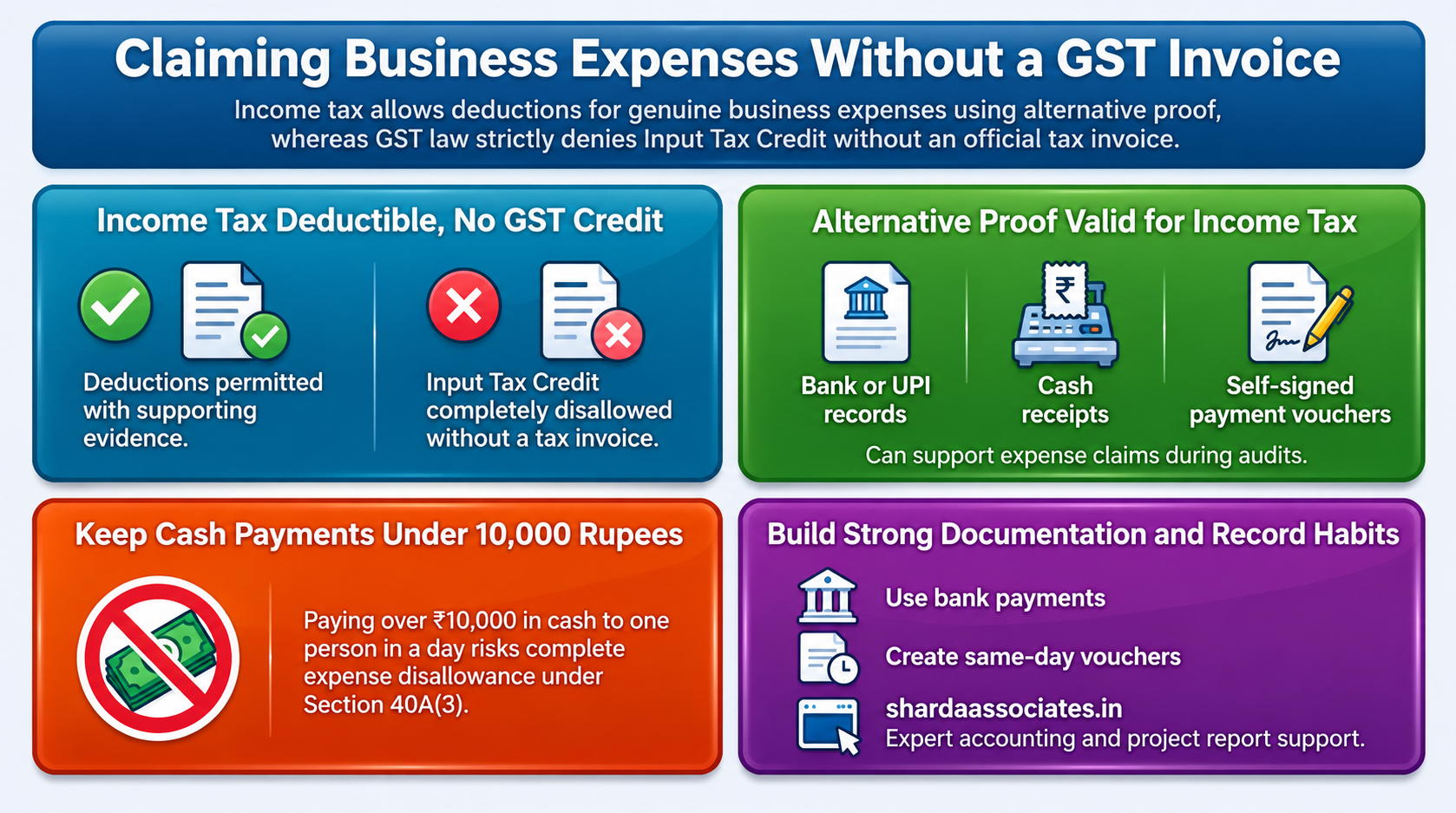
Short answer: For income tax, a business claim expenses even without a GST invoice if it is genuine, incurred wholly and exclusively for the business, and supported by other reliable evidence, with cash payment limits observed. For GST, input tax credit cannot be claimed without a valid tax invoice or other prescribed document. So the expense may be deductible, while the GST paid on it may not be recoverable.
Business owners often hear two opposite answers to this question from two different advisers: “no bill, no expense” and “bill is not necessary”. Both are half right, because income tax and GST apply different rules to the same payment.
Sharda Associates is a CA-led firm that has prepared over 45,500 CA-certified project reports. Lenders and auditors read the profit and loss account closely, and a pile of weakly supported expenses lowers confidence in the whole set of accounts.
This guide separates the income tax position from the GST position, explains the evidence you need, and lists the common cases. It is general information. The Income-tax Act, 2025, has been in force from 1 April 2026 with renumbered sections, so confirm the section references with your CA.
What Is the Income Tax Position?
Under the principle in Section 37(1) of the Income Tax Act, 1961, an expense is deductible if it is incurred wholly and exclusively for the purposes of business and is not capital or personal in nature. The law does not say that only an invoice proves it, but the burden of proof is on you. A bill is the best evidence, and where it is missing you need other proof.
What Is the GST Position?
Section 16(2)(a) of the CGST Act requires possession of a tax invoice, debit note or other prescribed document for ITC. Without it, you cannot claim input tax credit. If you bought from an unregistered supplier, no GST was charged, so there is no credit to claim in any case.
What Evidence Can Support a Business Claim Expenses Without a GST Invoice?
- A cash memo, bill or receipt from the seller, even if it is not a GST invoice
- A payment voucher signed by you, with date, amount, purpose and payee
- Bank or UPI proof of payment
- Quotations, delivery challans, work records or correspondence
- For regular suppliers, an agreement or rate list
Common Cases at a Glance
| Case | Income tax deduction | GST ITC |
| Supplier is registered but gave no invoice | Possible with other evidence, but weaker | No |
| Supplier is unregistered, issues a bill | Yes, if genuine and business-related | No GST charged |
| Small expenses such as local travel | Possible with a voucher and a record | Usually no |
| Supplier is under composition scheme | Yes, with a bill of supply | No |
| Reverse charge applies | Yes | Possible, subject to conditions |
How Do Cash Payment Rules Affect the Claim?
A payment in cash above the prescribed limit to one person in a day can lead to disallowance of the expense under Section 40A(3) of the 1961 Act. The limit is generally ₹10,000, with a higher limit for some transport payments. Paying by cheque, bank transfer or UPI avoids the issue and also creates proof.
What About Unregistered Suppliers?
Purchases from unregistered suppliers are common for small items. GST on some supplies from unregistered persons is payable by the recipient under reverse charge, but only for notified categories. Check whether your purchase is one of them. If it is not, the purchase is simply a cost without ITC.
What Are the Risks of Claiming Without Proper Bills?
An expense with weak documents is more likely to be disallowed in an assessment, and disallowance adds to taxable income and can bring interest and penalty. For companies and firms that are audited, missing bills also draw auditor comments. Lenders may also adjust your profit when they see unsupported expenses.
How Can You Fix the Habit?
- Ask for a bill every time, and ask a registered supplier for a GST invoice in your name and GSTIN
- Pay by bank or UPI wherever possible
- Prepare a payment voucher for any expense without a bill
- Scan and store documents the same week
- Review missing documents at every month end
What Should You Do with Past Expenses That Have No Bill?
Do not create bills after the event. A document dated or prepared to look as though it was issued at the time of the expense can create a much bigger problem than the missing bill. Instead:
- Collect real evidence such as bank statements, UPI records and messages with the seller
- Ask the seller for a duplicate bill or a written confirmation of the sale
- Prepare a note, dated today, that records what the expense was and why it was needed for the business
- Disclose the gap to your CA and agree on how it will be treated in the accounts
A candid note with real evidence is far stronger than a late voucher that looks manufactured.
Conclusion
The answer is two answers: the expense may be claimable under income tax if it is genuine and provable, but GST credit needs the invoice. The safest approach is to treat a bill as the default and an alternative document as the exception.
Most disputes come from habits, not rules. A voucher written on the day, a payment by bank and a folder of scans can make a small expense safe, while a large cash payment without a record can make it risky.
If you would like help reviewing your expense records before a filing or a loan application, call Sharda Associates on +91 89899 77769. Outcomes depend on the facts, so no result can be promised.
Frequently Asked Questions
1. Can I claim an expense without any bill? It is risky. Genuine expenses may be allowed with other reliable evidence, but a bill is the strongest proof.
2. Can I claim GST input tax credit without an invoice? No. Section 16(2)(a) requires a tax invoice or other prescribed document.
3. Can I claim expenses from an unregistered supplier? Yes for income tax, if genuine and business-related, but there is no GST ITC.
4. What is a payment voucher? A document you prepare recording the date, amount, purpose and payee of a payment.
5. Are cash expenses allowed? They can be, but payments above the prescribed limit to one person in a day can be disallowed under Section 40A(3).
6. What if a registered supplier refuses to give an invoice? Ask in writing, and consider raising it with the supplier or a CA, since you may lose ITC.
7. Do small expenses need bills? Keep a voucher and a record. A small item without a bill is lower risk than a large one.
8. Will lenders look at expense proof? They look at the profit and loss account and may adjust unsupported items.
9. Is the answer different under the new Income Tax Act, 2025? The principle is similar, but section numbers differ, so check current references.
10. Can a CA help? Yes, a CA can review your documentation and advise on gaps.