
Turnover is usually the first number a lender asks about. It’s also the one applicants misunderstand the most when it comes to the Business Loan Turnover requirement.
It’s not really about how big your business looks. It’s about whether your revenue is large and steady enough to support the EMI you’re asking for.
At Sharda Associates, we help clients put together the CA-certified financials that actually demonstrate this. A strong turnover figure without consistent, verifiable records doesn’t carry much weight with an underwriter. If you’re unsure whether your business clears the Business Loan Turnover requirement for the loan you want, get in touch and we’ll take a look at your numbers first.
Why Business Loan Turnover Matters More Than It Seems To
Turnover works as a rough proxy for how much cash actually moves through your business. That tells a lender how comfortably you could absorb a new EMI on top of what you’re already paying.
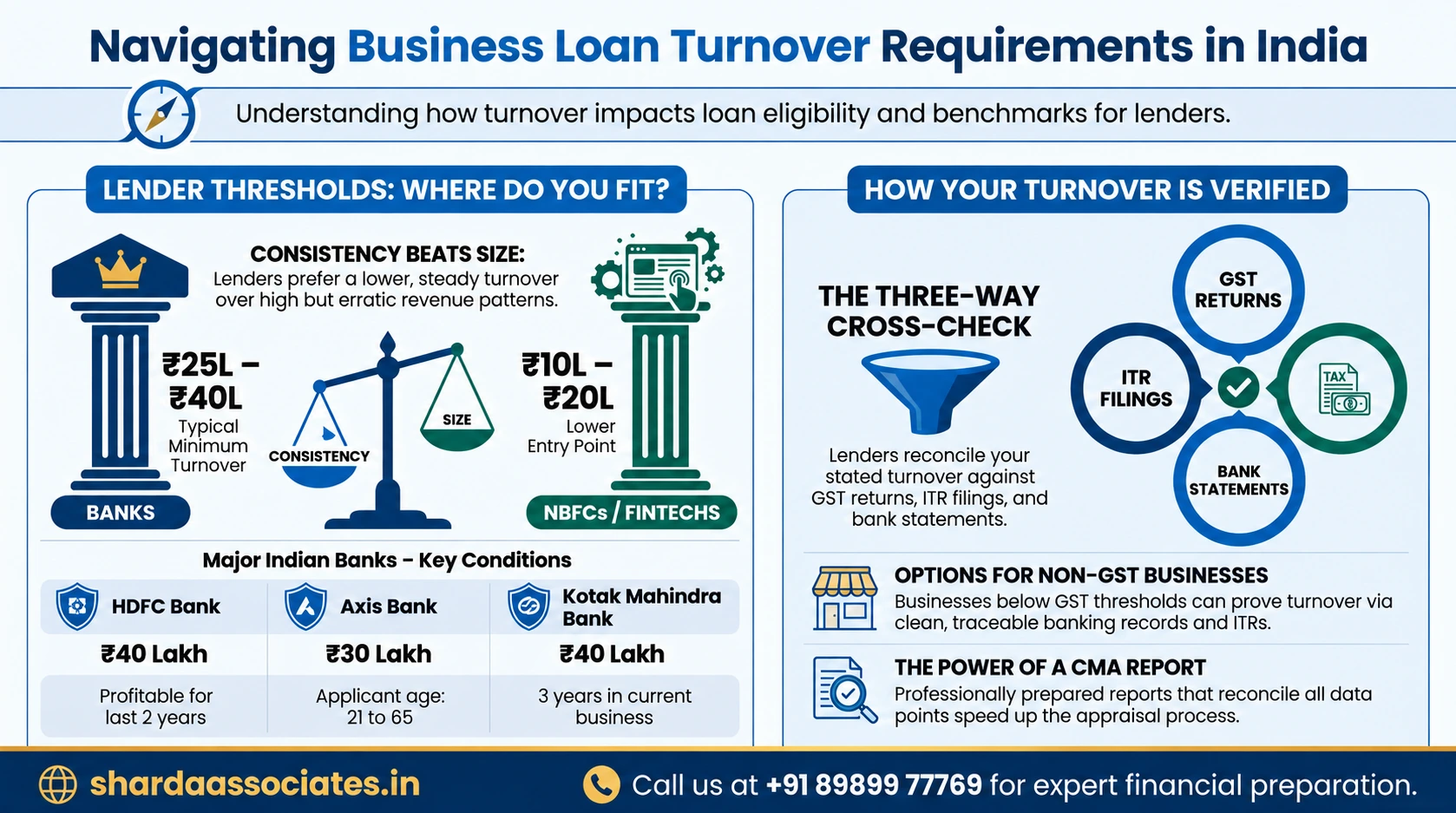
A business with high but inconsistent turnover is often viewed more cautiously than one with a lower, steady number. The figure alone never tells the full story.
What Banks Typically Ask For
Requirements vary by lender, but a pattern shows up across most major banks.
| Bank | Typical Minimum Turnover | Other Common Condition |
| HDFC Bank | ₹40 lakh | Profitable for the last 2 years |
| Axis Bank | ₹30 lakh | Applicant aged 21 to 65 |
| Kotak Mahindra Bank | ₹40 lakh | 3 years in current business |
| Most other scheduled banks | ₹25 lakh | 2 to 3 years of vintage |
These figures shift periodically. Confirm the current number directly with the bank you’re applying to, rather than relying on a general benchmark.
NBFCs and Fintech Lenders Work With a Different Baseline
A lower turnover doesn’t mean you’re out of options. NBFCs and digital-first lenders often start much lower, somewhere between ₹10 lakh and ₹20 lakh for unsecured business loans.
They tend to weigh cash flow pattern and recent bank statement conduct just as heavily as turnover itself. This segment exists specifically for businesses that are real and functioning but haven’t yet grown into what a large bank considers safe.
Turnover Doesn’t Work in Isolation
A lender rarely looks at turnover alone. It’s read alongside business vintage, typically 1 to 3 years, and profitability, usually at least one recent profitable year.
Strong turnover with no profit raises a different question than modest but consistently profitable turnover. In practice, the second often fares better, even with a smaller top-line number.
What If Your Business Isn’t GST Registered?
Plenty of small businesses fall under the GST threshold and aren’t required to register. Service businesses under roughly ₹20 lakh and goods-based businesses under ₹40 lakh commonly fall here.
Lenders haven’t shut this segment out. Turnover gets demonstrated instead through declared income and consistent banking records. Clean, traceable records matter even more when GST filings aren’t there to lean on.
How Turnover Actually Gets Verified
A stated turnover figure isn’t taken at face value. It’s checked against GST returns where applicable, cross-referenced with ITR filings, and compared against what actually shows up in your bank statements.
A CMA report that reconciles all three into one picture usually moves through appraisal faster than a file the underwriter has to piece together themselves.
If Your Turnover Falls Short
A turnover figure below your target lender’s threshold isn’t necessarily the end of the road. Smaller NBFC and fintech products exist specifically for this gap.
A well-prepared project report explaining your growth trajectory can sometimes offset a modest current-year number, especially if the business is clearly trending upward. Inflating the figure to hit a threshold rarely works. It gets caught during verification and does more damage than an honest, lower number ever would.
Conclusion
Turnover requirements aren’t arbitrary gatekeeping. They’re a rough first filter for repayment capacity, and the actual number depends heavily on who you’re approaching, a bank, an NBFC, or a fintech platform.
Knowing where your business stands before you apply saves you weeks with a lender whose minimum you were never going to clear. At Sharda Associates, we help clients work this out and get the supporting financials ready before approaching a bank. Call us at +91 89899 77769 or reach out through our contact form.
Frequently Asked Questions
1. What is the minimum turnover required for a business loan in India?
There is no single minimum turnover applicable to every business loan. The requirement varies by lender, loan product, business type, loan amount, repayment capacity, and the applicant’s financial profile.
2. How much annual turnover is required to get a business loan?
The required turnover depends on the lender and loan scheme. Banks and NBFCs may consider turnover along with profitability, bank transactions, GST returns, ITRs, existing liabilities, credit history, and repayment capacity.
3. Can I get a business loan with low turnover?
Yes, some lenders may consider businesses with relatively low turnover, depending on the business’s financial strength, credit profile, banking history, loan requirement, and eligibility under the particular loan product.
4. Can a new business get a business loan without turnover?
A newly established business may have limited or no historical turnover, making standard business loans more difficult. However, certain startup, government-backed, MSME, or business-specific financing options may have different eligibility criteria.
5. Is turnover more important than profit for a business loan?
Turnover and profit serve different purposes in loan assessment. Turnover indicates the scale of business activity, while profitability helps demonstrate whether the business generates sufficient earnings to support repayment.
6. Do banks verify the turnover mentioned in a business loan application?
Yes. Depending on the lender, turnover may be cross-checked against documents such as GST returns, income-tax returns, audited financial statements, bank statements, and other business records.
7. Does GST turnover affect business loan eligibility?
GST turnover can be an important financial indicator for eligible businesses. Lenders may compare GST records with other financial information to understand business activity and assess the consistency of reported revenue.
8. Can bank statement turnover be used for a business loan?
Bank transactions can help lenders understand the actual cash flow of a business. However, bank statement activity alone may not replace other documents required by the lender.
9. Can Sharda Associates help if my business turnover is low?
Yes. Sharda Associates can help assess the available business information and prepare appropriate project reports, financial projections, feasibility reports, and loan documentation based on the actual business profile.
10. Can Sharda Associates prepare a project report based on my business turnover?
Yes. A project report can incorporate available turnover, expenses, projected sales, profitability, working capital requirements, fixed investment, and other relevant financial information to present the business proposal in a structured manner.