
Depositing cash from your own sales into a business bank account is legal and completely normal. A notice usually arrives only when the cash deposited does not match what your books, GST returns, and income tax return show, or when the total crosses limits that banks must report to the income tax department.
We see this almost every month at Sharda Associates. A shop owner, clinic or contractor gets a message about “high value cash deposits” and assumes something is wrong, even though the money came from honest sales. As a CA firm that also prepares project reports for bank loans, we know that clean cash records help in both tax assessments and loan approvals. Here is how the department looks at the numbers and how you can stay ready.
What the Department Can Already See
You do not have to file anything for the department to know about your deposits. Banks report certain transactions every year, and these appear in your Annual Information Statement (AIS). The officer compares that data with your return, your GST turnover, and your balance sheet.
| Rule or limit | What it covers | Why it matters to you |
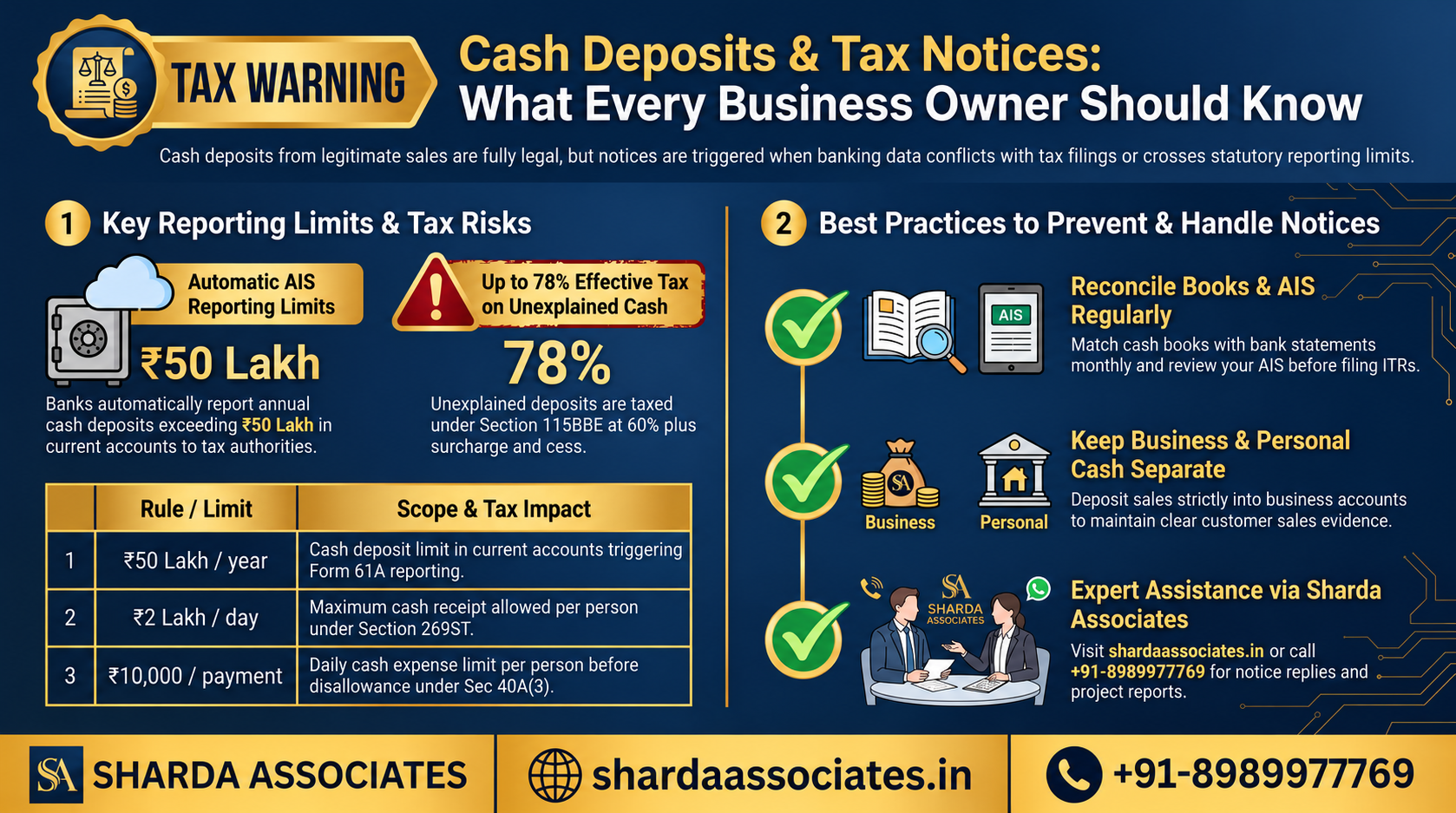
| ₹50 lakh in a year | Total cash deposits in all current accounts of a person | Bank reports it to the department in Form 61A |
| ₹10 lakh in a year | Total cash deposits in savings accounts | Same reporting, which matters if business money goes into a personal account |
| ₹50,000 in a day | Cash deposit at a bank | PAN must be quoted |
| ₹20 lakh in a year | Cash deposits across accounts | PAN or Aadhaar is required |
| ₹2 lakh in a day | Cash received from one person | Section 269ST bars it, and the penalty can equal the amount received |
| ₹10,000 per payment | Cash expenses paid to one person in a day | Section 40A(3) can disallow the expense |
These are reporting and compliance limits, not a ban on depositing cash. Crossing them simply puts your account in front of the system.
Five Situations That Usually Raise Questions
- Deposits are higher than recorded sales. If your bank statement shows ₹60 lakh in cash deposits and your books show ₹40 lakh of cash sales, someone will ask where the rest came from.
- A sudden jump in cash. A steady business that suddenly deposits large sums without a matching rise in turnover draws attention.
- Deposits kept just below a limit. Repeated deposits of ₹49,000 or similar amounts look like an attempt to avoid PAN rules.
- Business cash in personal accounts. Mixing family and business deposits makes it hard to prove the source.
- GST and income tax figures that disagree. If GST returns show less turnover than the cash you deposited, the mismatch can lead to notices under both laws.
An impossible cash balance in the books, such as a negative cash figure on some days, is another red flag that officers check quickly.
When a Deposit Gets Taxed as Income
If you cannot satisfactorily explain a cash deposit, the officer can treat it as unexplained money under Section 68 or Section 69A and add it to your income. Such additions are taxed at a special rate of 60% under Section 115BBE, plus surcharge and cess, which can take the effective rate to about 78%. Penalty and interest can follow. That is why a clear explanation at the first notice matters more than arguing later.
What the Officer Will Ask For
Notices on cash deposits can come under Section 133(6) as a request for information, or as a scrutiny or reassessment notice. In most cases you will be asked to explain the source of each large deposit and to produce supporting records.
- cash book and daily sales register, with opening and closing balances
- bills, invoices and customer-wise sales records
- bank statement with each deposit tagged to a sale or a cash withdrawal
- GST returns and books reconciled to the same turnover
- proof of earlier cash withdrawals, if the deposit is a redeposit
- confirmations from customers for large single receipts
If a deposit came from a loan, a sale of an asset or a gift, keep the agreement, sale papers or documents that prove it.
Habits That Keep You Safe
Write the cash book every day and match it with the bank statement each month. Deposit your sales in the business account, not in a personal one. Avoid receiving large cash payments from customers, since digital receipts are easier to defend. Check your AIS before filing your return, because a figure you cannot explain today is easier to fix than one explained under notice.
Before You Make Your Next Deposit
A cash deposit is not the problem. A deposit you cannot explain is. Keep your sales, cash book and bank entries telling the same story, and most notices become a matter of sending documents rather than defending yourself.
If you already have a notice, do not delay or guess. A short, well-documented reply sent within the due date is usually worth more than a long explanation sent late, and it keeps the matter from growing into a scrutiny assessment.
For help with cash deposit notices, books review, ITR filing and CA-prepared project reports for loans, call Sharda Associates on +91-8989977769.
Questions Business Owners Ask Us
Q1. Is there a limit on depositing cash in a business account?
There is no legal limit on the amount, but banks report cash deposits of ₹50 lakh or more a year in current accounts.
Q2. Will every cash deposit lead to a notice?
No. Notices usually follow when deposits do not match your declared sales or look unexplained.
Q3. Can I deposit cash received from customers?
Yes, if the sale is recorded in your books and reported in GST and income tax returns.
Q4. What happens if I cannot explain the source?
The amount can be added to your income and taxed at a high rate under Section 115BBE, along with interest and penalty.
Q5. Do cash deposits in a personal account also get reported?
Yes. Savings account cash deposits of ₹10 lakh or more in a year are reported to the department.
Q6. Is a cash sale of more than ₹2 lakh allowed?
Cash receipts of ₹2 lakh or more from one person in a day, or for one transaction, are barred by Section 269ST.
Q7. How do I reply to a notice about cash deposits?
Reply within the time given, with your cash book, sales records and bank mapping, preferably through a CA.
Q8. Can a CA help before a notice arrives?
Yes. A CA can review your AIS, reconcile cash records and fix gaps before the department asks.