
The CBDT has extended the tax audit report date for AY 2026-27 from 30 September to 21 October 2026 and the return date for audit cases from 31 October to 21 November 2026. If your accounts are subject to tax audit, you now have a few days left to get the audit report uploaded, and about five weeks after that to file your return. Use this window to close the books properly, not to relax.
At Sharda Associates, our Chartered Accountants (CA) complete tax audits, prepare Form 3CB-3CD, file returns and handle notices for proprietors, firms, LLPs and companies. We also prepare CA-certified project reports for bank loans, and an audited, filed return makes that report much easier to support.
Banks usually ask for the latest audited financials and ITR before sanctioning a loan or renewing a limit. If you plan to apply this year, getting the audit and return done early means your project report, balance sheet and tax filings can all be submitted together. Contact a CA now if your audit is still pending.
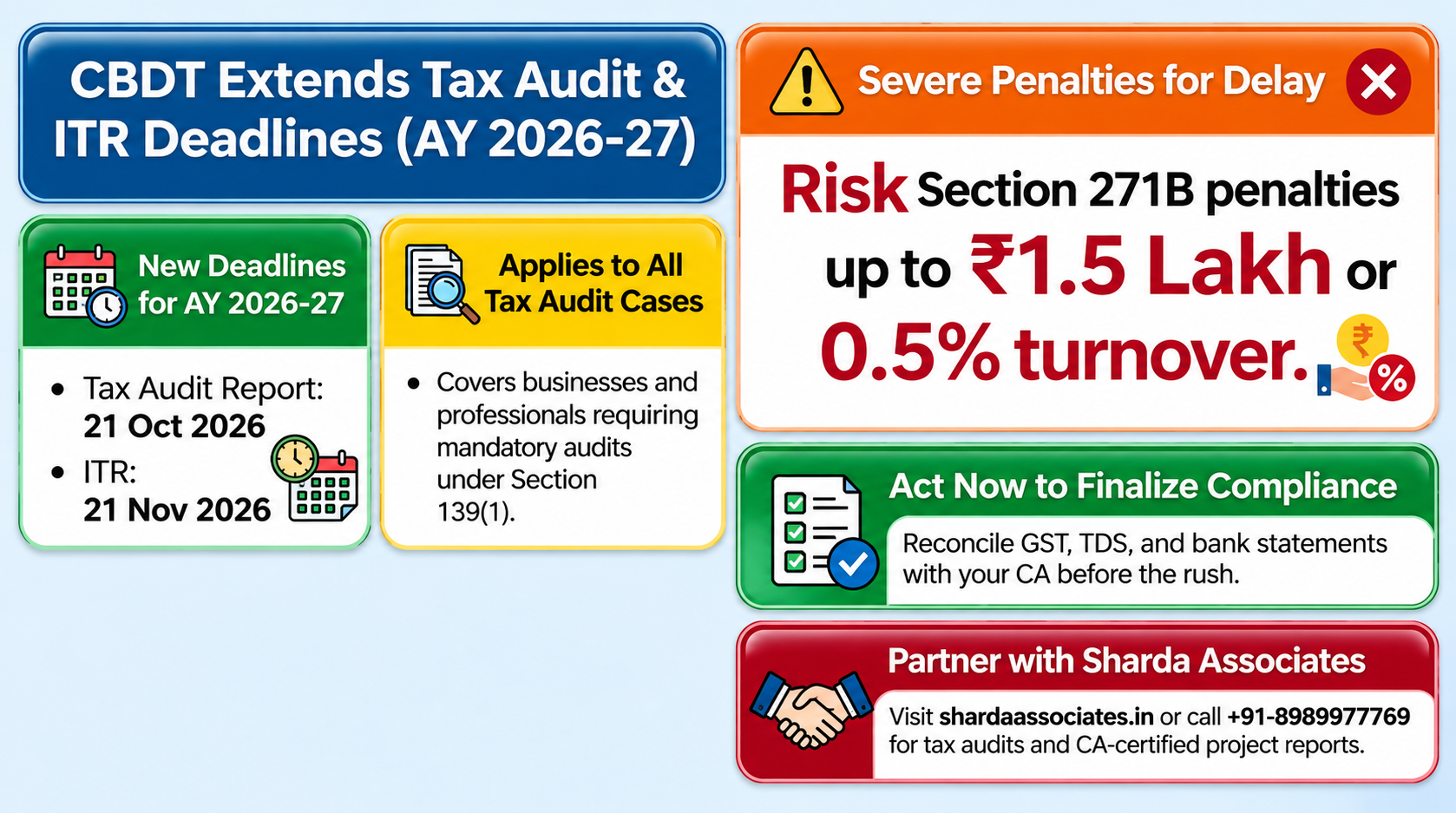
What Changed: Old vs New Dates
| Item (AY 2026-27, audit cases) | Earlier date | Extended date |
| Tax audit report | 30 September 2026 | 21 October 2026 |
| Income tax return | 31 October 2026 | 21 November 2026 |
CBDT Circular No. 07/2026 dated 28 September 2026 gives effect to these extensions.
Who Is Covered?
The relief applies to persons whose return due date falls under the audit category in Explanation 2 to Section 139(1) of the Income-tax Act, 1961. In simple terms, it covers taxpayers whose accounts must be audited, such as:
- businesses with turnover above the audit limits
- professionals with receipts above the audit limit
- presumptive taxpayers who declared lower profit and need an audit
The CBDT release does not indicate any change to other income tax filing deadlines. If you are not an audit case, check your own due date separately.
What to Do in the Next Few Days
- Confirm with your CA whether you are an audit case for AY 2026-27.
- Finalise your books and reconcile bank, GST and TDS data.
- Share pending documents, such as bank statements, loan statements, fixed asset details and stock figures.
- Review Form 3CD points, including cash payments, TDS compliance, loans accepted and Clause 44 expenditure breakup.
- Approve the audit report so that it is uploaded on or before 21 October.
- Prepare your return and file it well before 21 November.
- Keep a copy of the filed report and acknowledgement.
What Happens If You Miss the New Date?
- A late or missing audit can attract a penalty under Section 271B, generally 0.5% of turnover or ₹1.5 lakh, whichever is lower, unless reasonable cause is shown.
- A late return can mean a late fee, interest and loss of carry-forward of business losses.
- Banks may delay loan processing without audited accounts.
Check current penalty provisions before relying on these figures.
Do Not Treat the Extension as Free Time
- Auditors get busy near deadlines, and late data leads to errors.
- Last-minute rushes increase the chance of wrong Form 3CD reporting.
- GST, TDS and books should match before the audit starts.
- Interest on tax paid after the original due dates may still apply, so check whether any self-assessment tax is due.
Quick Checklist for Your CA
- Trial balance and final accounts
- Sales and purchase registers matched with GST returns
- TDS challans and returns
- Bank and loan statements
- Fixed asset register and depreciation
- List of related-party transactions and loans
- Cash payment details above ₹10,000 per day to one person
Conclusion
Tax audit and ITR filing are important compliance requirements for businesses and taxpayers who fall under the applicable provisions of the Income Tax Act. Understanding the applicable deadlines helps taxpayers plan their documentation and avoid last-minute complications.
To ensure a smooth filing process, finalise your books of accounts, reconcile financial records, verify income and expenses, and share the necessary documents with your Chartered Accountant well before the due date. Proper preparation also helps reduce errors and discrepancies in the tax audit report and income tax return.
Do not wait until the last moment to complete your tax compliance. Consult your CA to confirm the applicable deadlines, review your financial records, and file the tax audit report and ITR on time to minimise the risk of late-filing fees, penalties, and other compliance issues and CA-certified project reports for bank loans. Call Sharda Associates on +91-8989977769
FAQs
Q1. What is the new tax audit report date for AY 2026-27?
21 October 2026, extended from 30 September 2026.
Q2. What is the new ITR due date for audit cases?
21 November 2026, extended from 31 October 2026.
Q3. Does this extension apply to salaried taxpayers?
No. It applies to taxpayers covered under the audit category.
Q4. Is a formal notification issued?
Yes, CBDT Circular No. 07/2026 gives effect to the extension.
Q5. Will interest be waived?
The press release speaks only of due dates. Check with your CA whether interest on any tax payable applies.
Q6. What is the penalty for not getting the audit done?
Generally 0.5% of turnover or ₹1.5 lakh, whichever is lower, subject to reasonable cause.
Q7. Can I file my return before the audit report?
For audit cases, the audit report must be furnished before the return is filed.
Q8. How does tax audit help with a loan?
It gives banks audited financials that support your project report and credit proposal.