
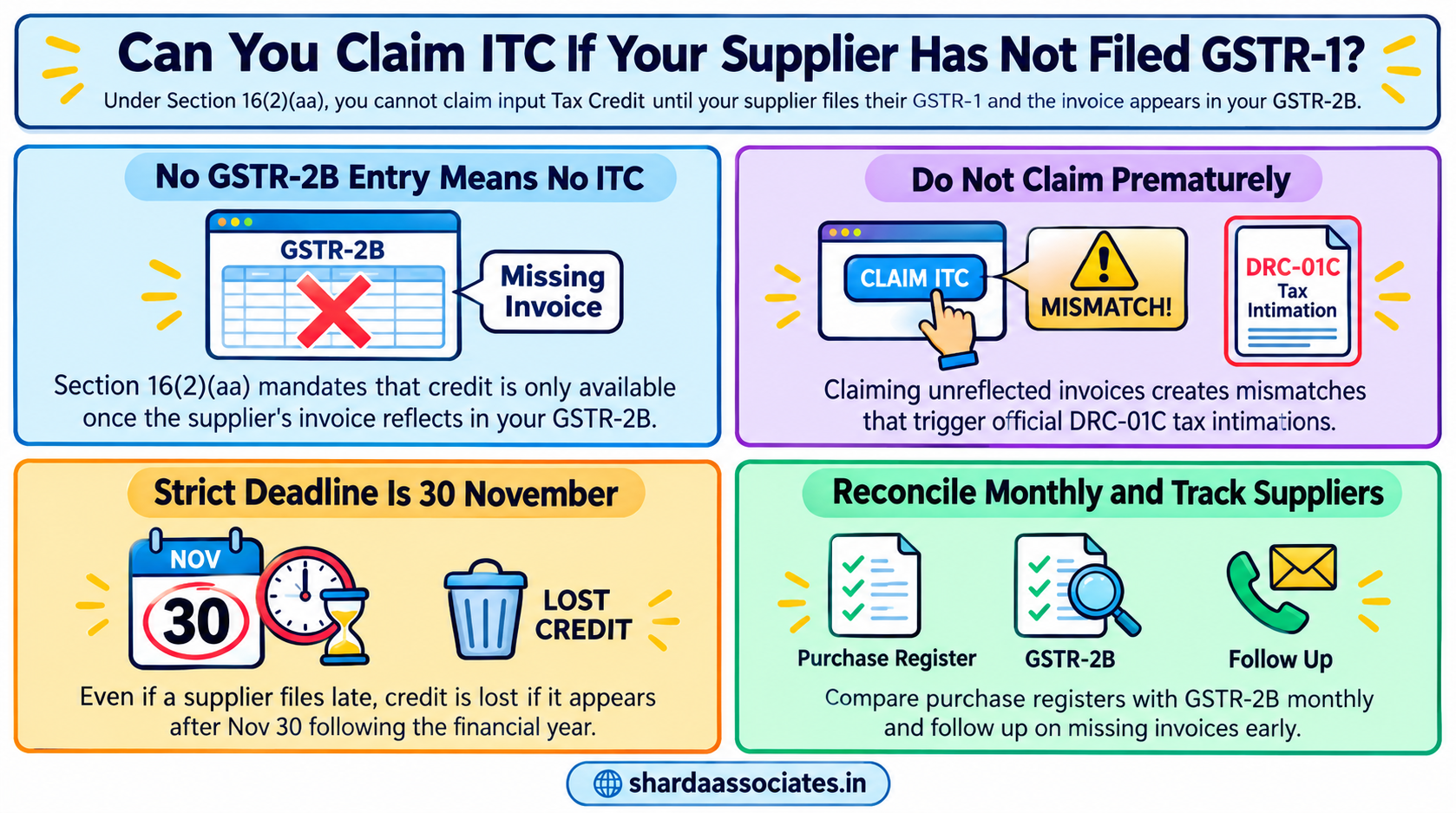
Short answer: Generally, no, not until the invoice appears in your GSTR-2B. Section 16(2)(aa) allows ITC only when the supplier has furnished the invoice details in GSTR-1 or IFF and they are communicated to you in GSTR-2B. If the supplier files later, you can claim when the invoice appears, but it must be within the Section 16(4) time limit, which falls on 30 November after the financial year. Some courts have given relief on specific facts, but you should not rely on that as a rule.
You bought the goods, you have the invoice, you paid the supplier, and the invoice still does not show in GSTR-2B because the supplier has not filed GSTR-1. It feels unfair that your credit depends on someone else’s filing, and many business owners are surprised to learn that it does.
Sharda Associates is a CA-led firm that has prepared over 45,500 CA-certified reports. Because lenders and auditors look at GST figures, we pay attention to how businesses handle ITC they cannot yet claim.
This guide explains the rule, what to do while you wait, how the deadline works, and where relief may exist. It is general information, so confirm your case with a CA.
What Does the Law Say?
Section 16(2)(aa), effective from 1 January 2022, makes ITC available only if the supplier has furnished the details of the invoice or debit note in GSTR-1 or the Invoice Furnishing Facility, and those details have been communicated to you through GSTR-2B. This sits with the other conditions of Section 16(2): you must hold a tax invoice, have received the goods or services, the tax must have been paid to the government, and you must have filed your own return.
What Should You Do If the Invoice Is Not in GSTR-2B?
- Do not claim it yet. Claiming an invoice not reflected in GSTR-2B creates the mismatch that can lead to a DRC-01C intimation.
- Tell the supplier early. Send the invoice number, date and amount and ask for filing.
- Track it every month. Check each month’s GSTR-2B to see when it appears.
- Claim when it appears. Take the credit in the month it shows up, subject to the time limit.
- Record the pending amount in your reconciliation, so you can explain it if asked.
What Is Section 16(4) Deadline?
Even when the supplier files late, your credit must be claimed by 30 November following the end of the financial year to which the invoice pertains, or the date of filing the annual return, whichever is earlier. For example, if a supplier reports a March invoice only after that date, the credit may be lost. This is why following up early matters more than following up late.
Quick Reference
| Situation | Can you claim now? | What to do |
| Invoice not in GSTR-2B, supplier not filed | Generally no | Follow up and wait |
| Supplier files late, invoice appears this month | Yes, if conditions are met | Claim in this month’s GSTR-3B |
| Invoice appears after 30 November deadline | Generally no | Take advice, consider recovery from supplier |
| Supplier reported wrong amount | Only the amount in GSTR-2B | Ask supplier to amend |
What About Payment to the Supplier?
A separate rule requires you to pay the supplier the value of the supply plus tax within 180 days of the invoice date. If you do not, you must reverse the credit with interest, and you can claim it again after payment. The time limit of Section 16(4) does not apply to re-claiming credit that was reversed earlier.
Is Any Relief Available?
Courts have looked at this issue. The Gauhati High Court, in a judgment of 9 December 2025, did not strike down Section 16(2)(aa) but read it down so that ITC should not be denied to a bona fide buyer merely because of the supplier’s default. Other cases have gone differently, and relief depends on facts, so treat it as something to discuss with a professional, not as a plan.
How Can You Reduce the Risk?
- Choose and monitor suppliers who file regularly
- Pay through banking channels and keep proof
- Reconcile GSTR-2B with purchases before every GSTR-3B
- Set a reminder before the 30 November cut-off for any unmatched invoices
- Write to the supplier and keep copies whenever an invoice is missing
A Worked Example Using the Deadline
Here is an illustration with made-up figures. You receive an invoice dated 10 July 2025 for ₹1,00,000 plus GST of ₹18,000, and you pay the supplier. The supplier has not filed GSTR-1, so the invoice is not in your GSTR-2B. You hold back the ₹18,000 and write to the supplier each month.
For an invoice of financial year 2025-26, the Section 16(4) cut-off is 30 November 2026. If the supplier files and the invoice appears in a GSTR-2B before that date, you claim the ₹18,000 in the next GSTR-3B. If it appears after that date, the credit is generally lost, and your remaining options are to recover the amount from the supplier or to seek professional advice on any relief. This is why a supplier follow-up list should be reviewed well before the cut-off, not after it.
Conclusion
ITC depends on the supplier’s compliance as well as yours, which is why the practical answer is to wait, follow up and claim when the invoice appears. The most expensive mistake is claiming first and explaining later.
A simple monthly habit, comparing GSTR-2B with your purchase register, shows you which invoices are missing while there is still time to chase them. Keep the paper trail, since it supports both a reply to a notice and any later claim.
If you have invoices stuck because of a supplier default, or want your ITC reconciliation reviewed, call Sharda Associates on +91 89899 77769. Outcomes depend on the facts, so no result can be promised.
Frequently Asked Questions
1. Can I claim ITC if my supplier has not filed GSTR-1?
Generally no, until the invoice appears in your GSTR-2B.
2. What if the supplier files late?
You can claim when the invoice appears in GSTR-2B, within the Section 16(4) time limit.
3. What is the Section 16(4) deadline?
30 November following the financial year of the invoice, or the annual return date, whichever is earlier.
4. Can I claim the ITC and reverse it later?
Claiming what is not in GSTR-2B can create a mismatch and a notice, so it is better to wait.
5. What if I have already paid the supplier?
Payment does not replace the requirement that the invoice appears in GSTR-2B. Keep proof for your records.
6. Do courts allow relief?
Some have in specific cases, such as the Gauhati High Court in December 2025, but it depends on facts and is not a general rule.
7. Is reverse charge ITC affected by this rule?
Reverse charge ITC does not appear in GSTR-2B and follows its own conditions. Check with a CA.