
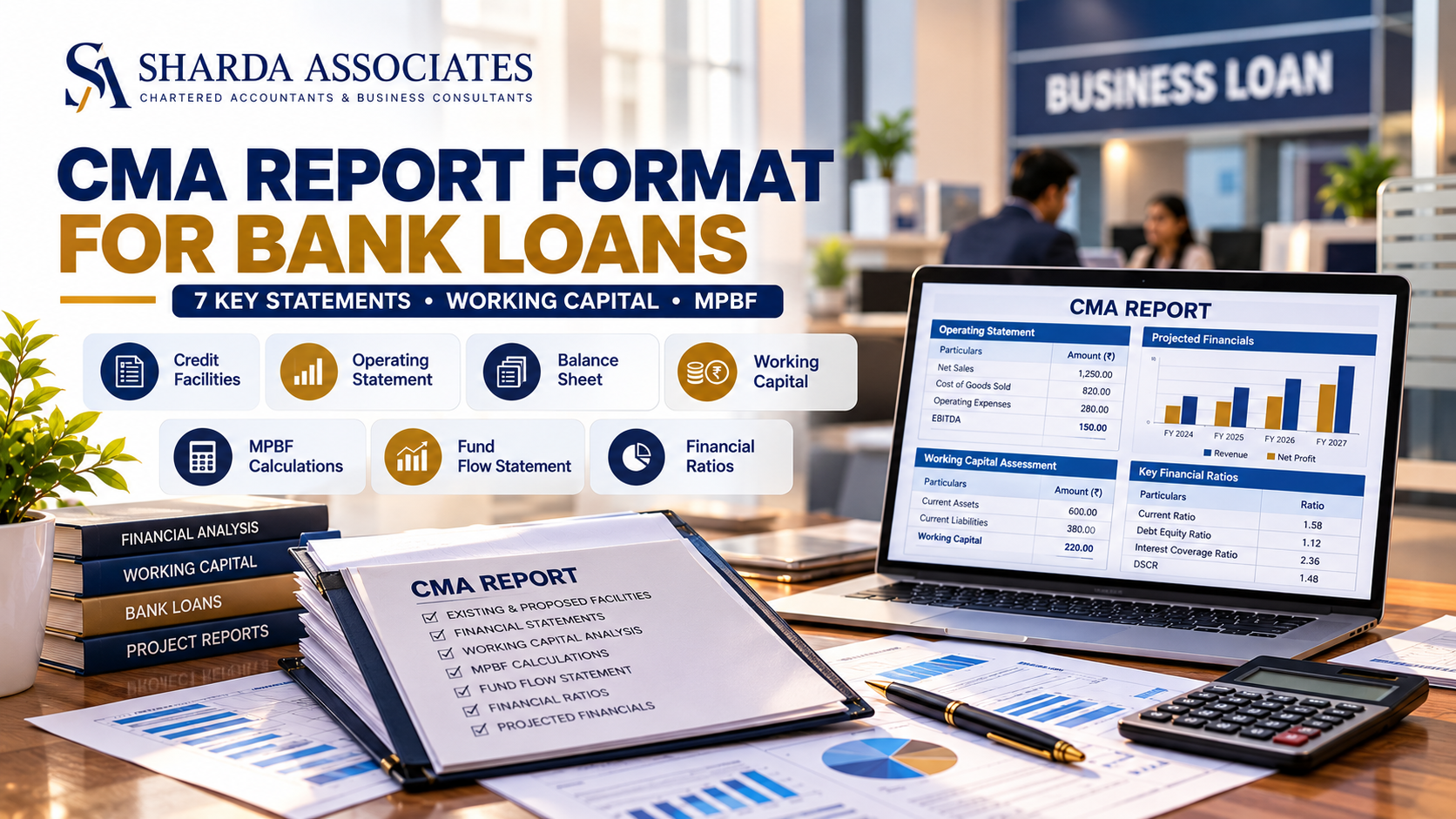
A CMA Report Format presents a business’s financial information in a structured manner for bank credit assessment. It generally includes historical financial performance, projected figures, existing and proposed bank finance, working-capital requirements, cash/fund flow and financial ratios. Banks use this information to understand the borrower’s financial position and assess whether the proposed credit requirement is reasonable.
The exact CMA format can vary depending on the bank, type of facility, business profile and lender-specific requirements. Therefore, the report should be prepared using accurate financial information and realistic business projections rather than using a generic template without modification.
Need professional financial documentation? Sharda Associates provides CMA and CA-reviewed financial reports for businesses seeking bank finance, with business-specific projections and documentation support.
What Is Included in a CMA Report?
A typical CMA Report contains several financial statements that help the lender evaluate the business’s past performance and expected future position.
The major sections generally include:
- Existing and Proposed Bank Finance – Shows current borrowing and proposed credit facilities.
- Operating Statement – Presents sales, expenses, profitability and related financial performance.
- Balance Sheet – Shows assets, liabilities and net worth.
- Current Assets and Liabilities – Provides information about inventory, receivables, creditors and other working-capital items.
- Working Capital / MPBF – Assesses the business’s working-capital requirement and proposed bank finance where applicable.
- Cash/Fund Flow Statement – Shows sources and uses of funds.
- Ratio Analysis – Provides indicators of liquidity, profitability, leverage and debt-servicing capacity.
The exact statements and presentation can differ between lenders.
7 Statements in CMA Report Format
1. Existing and Proposed Bank Finance
This section shows the business’s existing borrowing and the credit facilities being requested from the bank. It may include cash credit, overdraft, term loans and other relevant borrowings. The lender can compare existing exposure with the proposed requirement and understand how the requested facility fits into the overall financing structure.
2. Operating Statement
The operating statement presents the business’s historical and projected operating performance. It commonly includes sales, cost of operations, gross profit, operating expenses, EBITDA, depreciation, interest and profit. Comparing actual and projected figures helps the bank assess expected business growth and profitability.
3. Balance Sheet
The balance-sheet section presents the financial position of the business. It generally includes capital, reserves, loans, creditors and other liabilities along with fixed assets, inventory, receivables, cash and other assets. The projected balance sheet helps the lender understand how the business’s financial position may change over the projection period.
4. Current Assets and Current Liabilities
This section focuses on the components that influence working-capital requirements. Current assets may include inventory, receivables, cash and other current assets, while current liabilities can include trade creditors and other short-term obligations. These figures help the bank understand the operating cycle and short-term funding requirement.
5. Working Capital / MPBF
The working-capital section assesses the amount of funds required to operate the business and the portion expected to be financed through bank facilities. MPBF means Maximum Permissible Bank Finance. Where applicable, the relevant calculation depends on the lender’s methodology and current requirements.
6. Cash/Fund Flow Statement
The cash or fund-flow section explains how funds are generated and used within the business. Sources may include operating cash generation, capital introduced and borrowings, while applications may include capital expenditure, debt repayment and increases in working capital. It helps the lender understand the business’s projected funding movement.
7. Ratio Analysis
Ratio analysis provides additional indicators of financial performance and financial health. Common ratios may include the current ratio, debt-equity ratio, DSCR, net profit margin, gross profit margin, inventory turnover and debtor turnover. Banks may use these ratios along with other financial and credit information during assessment.
CMA Report Sample Format
A CMA report is normally prepared using historical and projected financial information. The following tables are illustrative examples only and are not a prescribed bank format.
Sample Operating Statement
Particulars | Actual | Projected |
Sales | ₹80 Lakh | ₹100 Lakh |
EBITDA | ₹8 Lakh | ₹11 Lakh |
Net Profit | ₹4 Lakh | ₹6 Lakh |
The bank can compare historical performance with projected turnover and profitability to understand the expected financial performance of the business.
Sample Working-Capital Statement
Particulars | Amount |
Current Assets | ₹60 Lakh |
Current Liabilities | ₹20 Lakh |
Working Capital Gap | ₹40 Lakh |
The actual calculation will depend on the business’s financial information, operating cycle and the lender’s applicable methodology.
A complete CMA format may contain additional years, detailed financial statements, borrowing information and ratio analysis.
CMA Format for Bank Loan
The CMA format used for a bank loan can vary according to the lender, loan facility and borrower profile. A working-capital facility may require greater focus on inventory, receivables, creditors and the proposed credit limit, while a term-loan proposal may require greater emphasis on projected profitability and debt-servicing capacity.
Before preparing the report, it is useful to confirm the bank’s requirements, including the financial years required, projection period, prescribed format and any certification or supporting-document requirements.
CMA Format for Working Capital / CC / OD
For Cash Credit (CC) or Overdraft (OD) facilities, the CMA format generally focuses on the business’s working capital cycle and proposed borrowing requirement.
Important information can include:
- Inventory
- Trade receivables
- Trade creditors
- Current liabilities
- Sales and projected turnover
- Operating cycle
- Existing bank finance
- Proposed working-capital limit
- Applicable margin or borrower contribution
The exact assessment depends on the lender and facility.
What Banks Check in a CMA Format
Banks may review several aspects of the CMA before assessing a credit proposal.
Accuracy
Historical figures should be supported by available financial records and relevant documents.
Historical vs Projected Figures
Projected sales, expenses and profitability should be reasonable compared with past performance and the business’s future plans.
Working Capital
Inventory, receivables, creditors and other current assets and liabilities should reasonably reflect the business’s operating cycle.
Borrowing
Existing loans and proposed facilities should be correctly presented so that the lender can understand the overall debt position.
Profitability
The bank may review projected margins, operating profit, net profit and expected changes in profitability.
Ratios
Financial ratios can provide additional information about liquidity, leverage, profitability and debt-servicing capacity.
Consistency
Figures across the operating statement, balance sheet, working-capital calculations, borrowing information and other sections should be logically consistent.
Common CMA Format Mistakes
Avoid these common mistakes while preparing CMA data:
- Unrealistic sales projections without a clear business reason.
- Incorrect inventory or receivable assumptions that do not match the operating cycle.
- Mismatch between financial statements and projected borrowing.
- Incorrect ratio calculations caused by using inconsistent figures.
- Ignoring existing loans or liabilities while calculating the proposed requirement.
- Using a generic CMA template without adapting it to the bank’s requirements.
A CMA should reflect the actual business and its financing requirement rather than simply filling figures into a standard template.
Documents Required for CMA Preparation
The exact documents depend on the bank and type of facility, but commonly required information may include:
- Previous financial statements
- Income Tax Returns
- GST returns
- Bank statements
- Existing loan details
- Loan sanction letters
- Stock details
- Debtor and creditor information
- Proposed loan requirement
- Business projections
Providing complete and accurate information helps the professional prepare more consistent financial projections.
Where to Get a CMA Report Prepared?
A CMA Report should be prepared by someone who understands financial statements, projections, working-capital requirements and bank credit documentation.
Sharda Associates helps businesses prepare CMA and financial documentation for bank finance based on their business information and proposed borrowing requirements.
Our support can include:
- CMA financial projections
- Working-capital assessment
- Financial ratio analysis
- Bank-focused documentation
- Statement reconciliation
- Professional review where applicable
Get MSME Registration and CA-certified Project Reports prepared by experts to improve loan and subsidy approval chances. Sharda Associates has delivered 45,500+ reports across India. Get accurate business documentation starting at ₹2,999 with fast 24–48 hour delivery.
Frequently Asked Questions
1. What is a CMA Report format?
A CMA Report format is a structured presentation of historical and projected financial information used by banks to assess a borrower’s financial position and credit requirement.
2. What are the 7 statements in a CMA Report?
A typical CMA includes bank finance, operating statement, balance sheet, current assets and liabilities, working-capital/MPBF assessment, cash or fund flow and ratio analysis.
3. Is there one standard CMA format for all banks?
No. Banks may have different formats and documentation requirements depending on the loan facility, borrower and internal credit-assessment process.
4. What is included in CMA data?
CMA data generally includes historical financial information, projections, borrowing details, working-capital information and financial ratios.
5. What is MPBF in a CMA Report?
MPBF stands for Maximum Permissible Bank Finance. Where applicable, it forms part of the assessment of bank finance for working-capital requirements.
6. Does CMA format include DSCR?
DSCR may be included in the financial ratio analysis, particularly where debt-servicing capacity is relevant to the proposed borrowing.
7. What documents are required for CMA preparation?
Common documents include financial statements, ITRs, GST returns, bank statements, existing loan details, stock information and business projections.
8. Can CMA data be prepared in Excel?
CMA data can be prepared using spreadsheets or other financial tools, depending on the lender’s required format. The figures should be accurate and internally consistent.
9. Who can prepare a CMA Report?
A CA, CMA/financial consultant, experienced finance professional or internal finance team may prepare CMA data, depending on the lender’s requirements and complexity of the case.
10. Does a CMA Report guarantee bank loan approval?
No. A CMA Report supports the lender’s financial assessment but does not guarantee loan approval. The final decision depends on the bank’s overall credit evaluation.