
The short answer is CTE first, always. Consent to Establish clears you to build, Consent to Operate clears you to run, and the second one legally cannot be applied for until the first is already in hand. Yet this sequence gets confused often enough that it’s one of the most common, entirely avoidable delays in setting up a new factory. CTE vs CTO First? At Sharda Associates, when we help clients sequence a project’s approvals alongside their DPR, getting this order right and timed correctly against the construction schedule is one of the first things we check.
The One-Line Difference
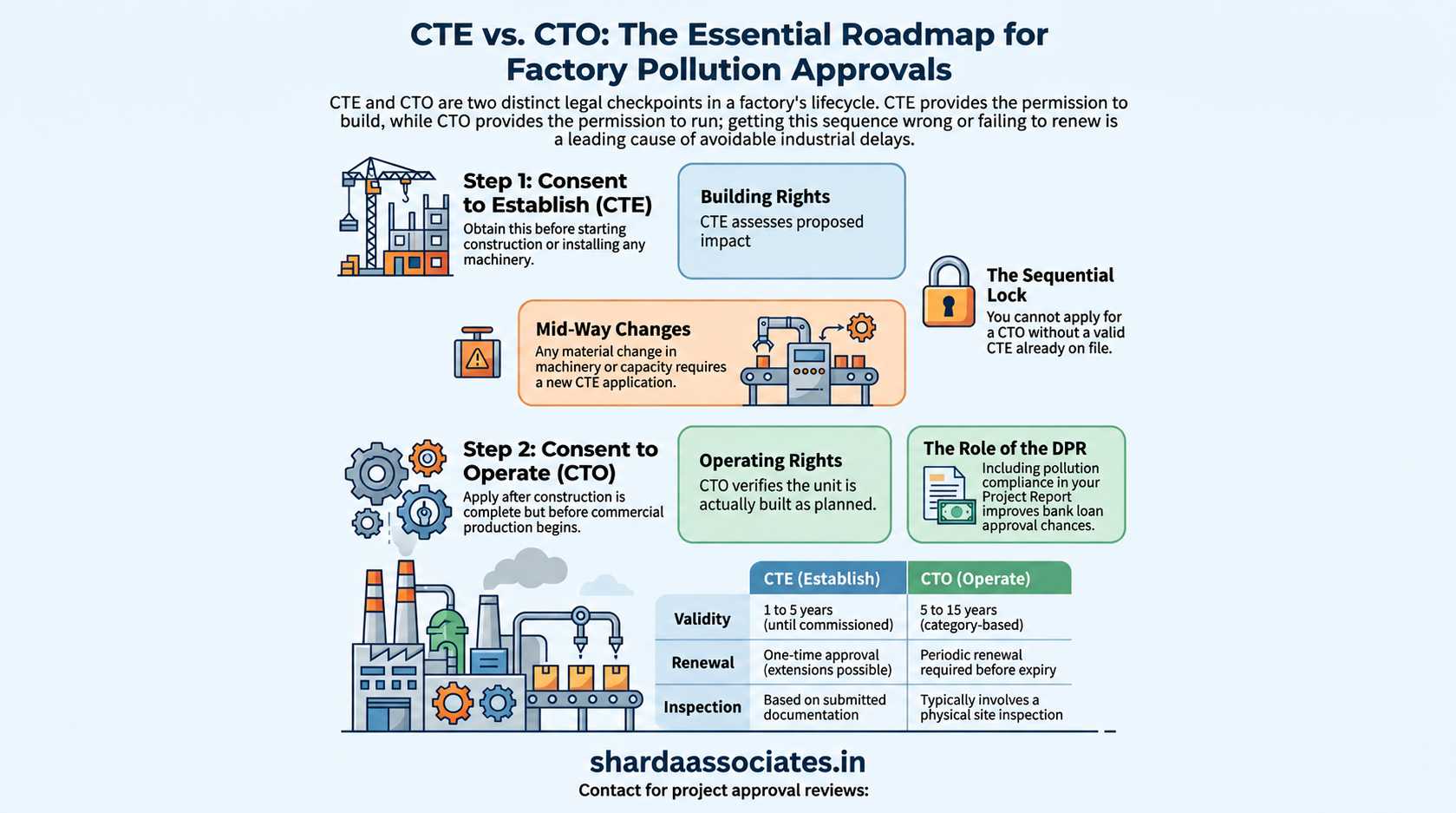
CTE allows you to build. CTO allows you to function. Everything else about these two approvals follows from that single distinction.
| Consent to Establish (CTE) | Consent to Operate (CTO) | |
| Stage | Before construction or machinery installation | After construction is complete, before production starts |
| Purpose | Assesses potential environmental impact and proposed pollution control measures | Confirms the unit is actually compliant and ready to function |
| Issued by | State Pollution Control Board (or Pollution Control Committee in Union Territories) | Same authority, at the next stage |
| Can you apply without the other? | Yes, this is the starting point | No, CTO applications require an existing CTE on file |
Why the Sequence Can’t Be Reversed
CTO isn’t just a renewal or continuation of CTE. It’s a separate verification that what actually got built matches what CTE approved. The board checks that machinery was installed according to the sanctioned CTE, that pollution control systems are physically in place and functioning, and that effluent, emissions, and waste disposal meet the standards on record. There’s nothing to verify against if CTE was never granted in the first place, which is exactly why the application portal itself won’t accept a CTO request without a valid CTE reference.
How Long Each One Actually Lasts
This is where a lot of confusion sits, since the two run on entirely different validity logic.
CTE
- Typically valid for 1 to 5 years, or until the plant is commissioned, whichever comes first
- A one-time approval for the establishment phase, not renewable in the way CTO is
- If construction overruns this window, an extension needs to be sought before it lapses
CTO
- Validity is tied to the unit’s pollution category under the CPCB framework, commonly:
- Red category: up to 5 years
- Orange category: up to 10 years
- Green category: up to 15 years
- Needs periodic renewal, applied for before the existing consent expires, not after
A factory that treats CTO like a one-time formality, the way CTE effectively is, tends to discover the renewal requirement only when it’s already overdue.
What You’ll Need for Each Application
For CTE
- Project report or DPR
- Site plan and layout plan
- Ownership or lease documents for the land
- Manufacturing process details
- Proposed pollution control measures
- Water balance details and capital investment breakup
For CTO
- Copy of the granted CTE
- Compliance report showing how CTE conditions were met
- Details of installed pollution control devices
- Test reports from an NABL-accredited lab
- Point-wise confirmation against each CTE condition
The CTO stage also typically includes a physical site inspection by the board before approval, which is a step CTE doesn’t usually involve to the same extent.
What Happens If Your Project Changes Mid-Way
A common, costly assumption is that once CTE is granted, you can adjust machinery, capacity, or layout freely as construction proceeds. Any material change, different machinery, revised capacity, altered raw materials, a changed layout, or a higher pollution load than originally assessed, generally requires a fresh CTE, not just a note in the CTO application later. Operating on the basis of an outdated CTE is a common reason a CTO application gets rejected or delayed at the final stage.
How Pollution Approvals Affect Project Planning and Loan Approval
Pollution approvals are an important part of industrial project planning because they affect project cost, implementation timeline and operational readiness.
While preparing a factory project, entrepreneurs should consider:
- Project Timeline: Approval delays can postpone construction, machinery installation and production commencement.
- Project Cost: Pollution control systems and compliance requirements should be included in the overall project cost.
- Loan Approval: Banks may review whether required approvals and compliance planning have been considered while evaluating industrial loan proposals.
A project report that includes compliance requirements gives lenders better confidence that the business plan is realistic and implementable.
A Note on Green and White Category Units
Not every business needs to treat this as a two-year approval marathon. Following ease-of-doing-business reforms, several states have moved to self-certification or deemed-approval timelines for Green and White category units, and White category units are often largely exempted from the CTO requirement altogether. Where your unit actually falls in this categorisation matters quite a bit for how heavy this process really is, so it’s worth confirming your category early rather than assuming the full Red-category process applies by default.
Role of DPR and Feasibility Report in Factory Approvals
A Detailed Project Report (DPR) and feasibility report help entrepreneurs plan industrial projects in a structured manner.
These reports help evaluate:
- Project cost and investment requirement
- Machinery and production planning
- Required approvals and compliance needs
- Financial feasibility and repayment capacity
For factory projects, including pollution approval requirements in the DPR helps avoid unexpected costs and delays. It also helps banks understand whether the proposed project is practically viable.
The Practical Sequence for a New Factory
- Confirm your pollution category (Red, Orange, Green, or White) before doing anything else, since this determines how much of the rest applies to you
- Apply for and receive CTE before finalising a construction start date
- Build according to exactly what CTE approved, and if the project changes materially, get CTE amended before proceeding, not after
- Complete construction, install pollution control measures, and prepare the compliance documentation CTO will require
- Apply for CTO only once CTE-approved conditions are demonstrably met, and expect a site inspection before it’s granted
- Track CTO’s category-based validity period and file for renewal well before expiry, not after
Common Mistakes Entrepreneurs Make While Obtaining Pollution Approvals
Many entrepreneurs focus on machinery, investment and production planning but ignore pollution compliance requirements during the early stage of a factory setup. This can create delays and additional costs later.
Common mistakes include:
- Starting project activities without CTE approval: Entrepreneurs sometimes begin factory setup without obtaining Consent to Establish, which can create compliance issues.
- Applying for CTO without proper preparation: Consent to Operate should be planned after machinery installation and pollution control arrangements are in place.
- Ignoring pollution control requirements: Required treatment systems, waste management arrangements or emission controls should be considered while planning the project.
- Not including approval timelines in the project schedule: Delays in approvals can affect machinery installation and commercial production timelines.
Proper planning of pollution approvals helps entrepreneurs avoid delays and ensures smoother factory implementation.
Conclusion
CTE and CTO aren’t two versions of the same approval; they’re two separate checkpoints answering two separate questions: can this be built, and is it actually running the way it was approved to? Getting the sequence wrong, or assuming one covers the other, is one of the more common ways a factory project loses weeks it didn’t need to lose. At Sharda Associates, we help applicants sequence these approvals correctly against their construction and financing timeline as part of preparing the project report or DPR. Call us at +91 89899 77769 to get your project’s approval sequence reviewed before you start.
Frequently Asked Questions
Q1. Do I need both CTE and CTO for every factory?
Requirements depend on your pollution category. Red and Orange category units generally need both; some Green and White category units have simplified or exempted processes.
Q2. Can I apply for CTO before receiving CTE?
No. CTO applications require a valid, existing CTE on record and cannot be processed without one.
Q3. How long does CTE remain valid?
Typically 1 to 5 years, or until the plant is commissioned, whichever happens first. It’s a one-time approval for the establishment phase and isn’t renewed the way CTO is.
Q4. Does CTO expire, and do I need to renew it?
Yes. CTO validity depends on your pollution category, commonly ranging from 5 to 15 years, and renewal must be filed before the existing consent expires.
Q5. What happens if I change my machinery or capacity after getting CTE?
A material change generally requires a fresh CTE application before you proceed. Operating outside what the original CTE approved can cause your later CTO application to be rejected or delayed.
Q6. Is a site inspection required for both CTE and CTO?
CTO typically involves a more thorough physical inspection to confirm actual compliance, while CTE approval is based mainly on the proposed plan and documentation submitted upfront.
Q7. What is the difference between CTE and CTO for a new factory?
CTE is permission to establish the factory and is obtained before construction or installation activities. CTO is permission to operate the factory after installation of machinery and required compliance systems.
Q8. Can I start construction work before getting CTE approval?
Entrepreneurs should obtain the required CTE approval before establishing the project, as starting activities without necessary consent may create compliance issue
Q9. Do pollution approvals affect factory loan approval?
Yes. For manufacturing projects, banks may review whether required approvals and compliance planning have been considered while evaluating the project’s feasibility and loan proposal.
Q10. What documents are generally required for CTE and CTO applications?
Documents may include project details, manufacturing process information, land documents, machinery details, pollution control measures and other documents required by the concerned Pollution Control Board.
Q11. Can a factory operate if the CTO application is pending?
Generally, commercial production should not begin without obtaining the required CTO approval. Starting operations without valid consent may lead to compliance action.
Q12. How does a DPR help in obtaining pollution approvals?
A DPR helps present project details such as manufacturing process, machinery, production capacity, investment and compliance requirements, making the approval planning more structured.