
Short answer: A current account transactions is not watched in isolation. Banks report certain transactions to the Income Tax Department, such as aggregate cash deposits or withdrawals of ₹50 lakh or more in a financial year in current accounts, and the department compares what it sees in AIS with your return. A notice is more likely when deposits are large, do not match your sales or GST turnover, or cannot be explained with records. Being reported does not mean the money is taxable.
For most businesses the current account is where everything meets: sales, supplier payments, loan instalments and the owner’s own transfers. That is why it is also where a mismatch is most visible.
Sharda Associates is a CA-led firm that has prepared over 45,500 CA-certified reports. When we prepare loan documents, lenders examine bank statements closely, and the same patterns that a bank notices can attract a tax query.
This guide lists the transactions that tend to draw attention, what the thresholds are, and how to keep your records ready. It is general information. Thresholds and section numbers change, and the Income-tax Act, 2025 has been in force from 1 April 2026, so confirm current rules with your CA.
What Do Banks Report from Current Account Transactions?
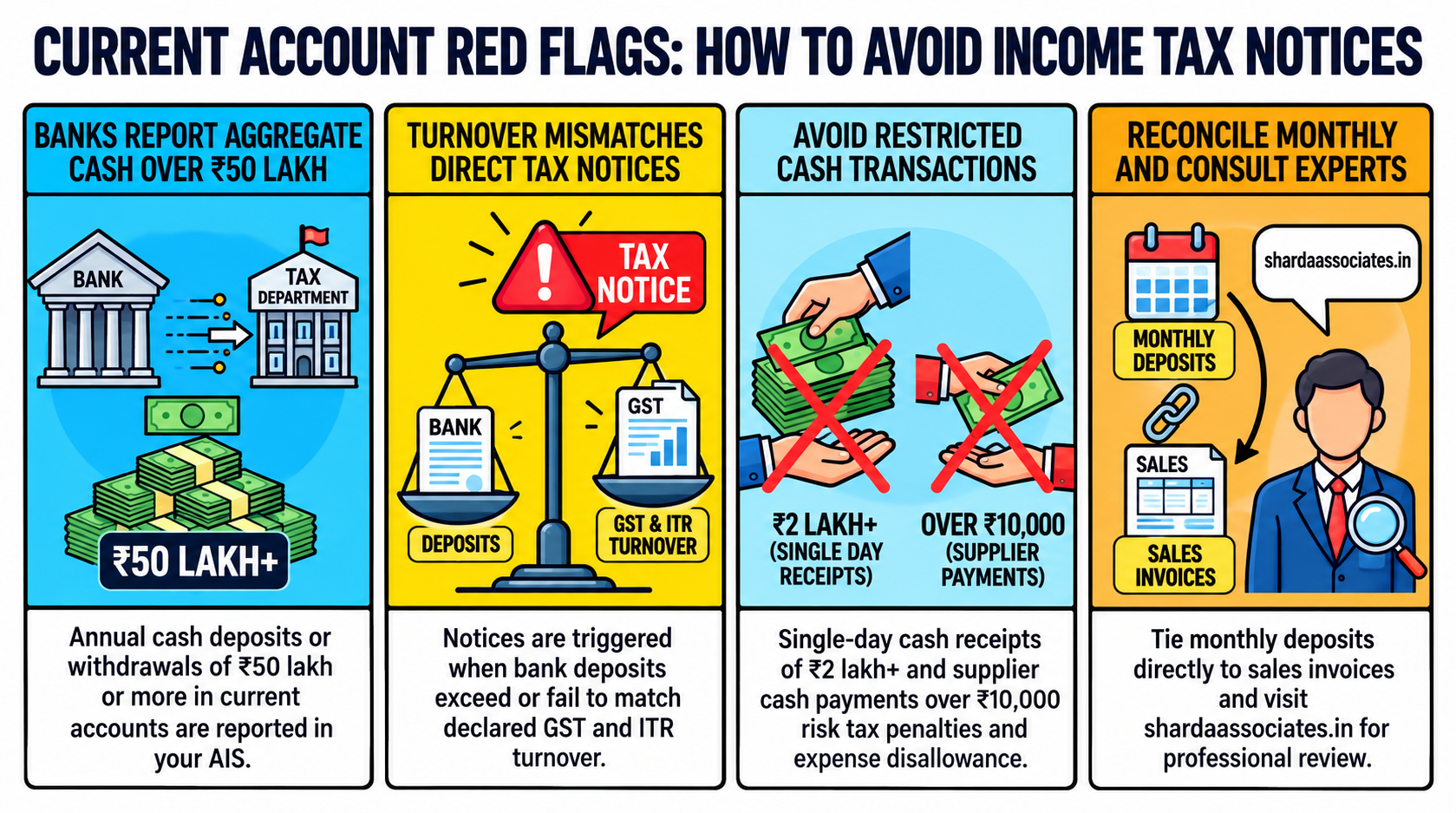
Banks file a Statement of Financial Transactions with the Income Tax Department. For current accounts, aggregate cash deposits or cash withdrawals of ₹50 lakh or more in a financial year, across one or more current accounts, are reportable. The report appears in your AIS. It is a reporting trigger, not a limit on how much you may deposit.
Which Transactions Can Draw Attention?
- Large cash deposits that cross the reporting threshold, or that look high compared with your sales
- Large cash withdrawals at or above the reporting threshold, which can also attract TDS on cash withdrawals above prescribed limits
- Deposits that do not match sales or GST turnover, especially in a year when the ITR shows lower turnover
- Cash receipts of ₹2 lakh or more from one person in a day or for one transaction, which Section 269ST of the 1961 Act restricts and which is understood to correspond to Section 186 of the 2025 Act
- Large cash payments to suppliers or others, which can lead to disallowance of the expense under Section 40A(3), generally above ₹10,000 per person per day
- Credits you cannot explain, such as transfers from relatives or third parties with no documents, which can be treated as unexplained cash credits
- Round-figure or repeated deposits just below a threshold, which can look like an attempt to avoid reporting
How Do These Compare?
| Transaction | Why it can be flagged | How to protect yourself |
| Cash deposits at or above the reporting threshold | Reported in AIS | Match to sales records and cash book |
| Deposits above declared turnover | Mismatch with ITR and GST | Reconcile deposits to turnover |
| Cash receipt of ₹2 lakh or more | Restricted under Section 269ST | Take payment by cheque or bank transfer |
| Large cash payments | Disallowance risk | Pay by banking channels |
| Unexplained third-party credits | Source not shown | Keep loan or gift documents |
How Do You Match Deposits to Sales?
Keep a monthly sheet that lists every deposit and the sales or receipts behind it: invoice, date, customer, and mode of payment. Cash sales should be recorded in the cash book and the sales register on the same day. A year-end total of deposits that you can tie to sales, loans, capital introduced and other documented sources is what a notice reply usually needs.
What Should You Avoid?
- Mixing personal and business money in the same account
- Depositing cash without a record of where it came from
- Splitting deposits to stay below a threshold, since the thresholds are on annual totals
- Accepting large cash payments from customers
- Treating a bank deposit as sales without issuing an invoice
What If You Receive a Notice?
Read the section, the year and the date. Prepare a bank-statement-wise explanation with supporting documents, and reply on time. If the amounts are large or the notice is a reassessment or scrutiny notice, take professional help before replying, since the wording matters.
How Is This Different for Savings Accounts?
The thresholds are lower for savings accounts. Aggregate cash deposits of ₹10 lakh or more in a financial year in savings and similar accounts are reportable, compared with ₹50 lakh for current accounts. Business receipts that go into a personal savings account can therefore cross the lower threshold sooner, and they mix business money with personal money, which makes explaining them harder.
If your business receives cash, use a current account for it, record each receipt against a sale and avoid routing business money through personal accounts. The reporting threshold is not the aim; clear records are.
Conclusion
A current account is a record of your business as much as of your cash. When deposits, sales, GST returns and the ITR tell the same story, a reported transaction is just a data point. When they do not, a notice is the natural result.
The simplest protection is the monthly habit of tying deposits to sales and keeping paper for any non-sales credit. It takes little time and is the first thing a CA or a bank will ask for.
If you would like your current account records reviewed before a filing or a loan application, call Sharda Associates on +91 89899 77769. Outcomes depend on the facts, so no result can be promised.
Frequently Asked Questions
1. What cash deposits in a current account are reported? Aggregate cash deposits or withdrawals of ₹50 lakh or more in a financial year are reportable in current accounts.
2. Does a reported deposit mean I will get a notice? No. Reporting is not a finding. A notice is more likely if the figures do not match your return.
3. Is there a limit on cash I can deposit? There is no cap, but reporting and other cash rules apply. Section 269ST restricts large cash receipts.
4. Is cash deposit income? Not automatically. If it comes from recorded sales or other documented sources, it is explained.
5. Why can cash payments to suppliers be a problem? Cash payments above the prescribed limit can lead to disallowance of the expense.
6. Can splitting deposits avoid reporting? No. Reporting is on annual totals, and splitting can look like an attempt to avoid it.
7. What if I have third-party credits? Keep documents such as loan agreements or gift deeds, so the source is clear.
8. Does GST turnover matter here? Yes. Deposits that exceed declared turnover invite questions.
9. How should I keep personal and business money apart? Use separate accounts and record any owner transfers as capital or drawings.
10. Where can I see what the bank reported? In your AIS on the income tax portal.