
Short answer: If the GST amount is shown separately on the invoice, deduct TDS on the amount before GST, not on the total invoice value. If GST is not shown separately, TDS is deducted on the full amount. This is the position given by the CBDT in Circular 23/2017.
The Simple Rule
Look at the invoice. If it has a separate line for GST, ignore that line when you calculate TDS. If the invoice shows only one total, TDS applies to the whole total.
How to Calculate TDS in 4 Easy Steps
- Find the base amount. This is the invoice value before GST.
- Check that GST is shown separately. It should appear as CGST and SGST, or IGST, in its own line.
- Apply the TDS rate of the relevant section (professional fee, contractor, rent and so on) on the base amount.
- Pay the supplier the invoice total minus the TDS. The GST amount is paid in full.
Example: Professional Fee
A consultant sends an invoice of ₹1,00,000 plus 18% GST.
| Item | GST shown separately | GST not shown separately |
| Fee | ₹1,00,000 | ₹1,18,000 (total only) |
| GST | ₹18,000 | Included in the total |
| TDS at 10% | ₹10,000 (on ₹1,00,000) | ₹11,800 (on ₹1,18,000) |
| Amount paid to supplier | ₹108,000 | ₹1,06,200 |
You can see why a clear invoice matters. The same bill gives a higher TDS when GST is not separated.
Example: Contractor and Rent
- Contractor bill: ₹5,00,000 plus GST. TDS at 1% or 2%, depending on whether the contractor is an individual or a company, is calculated on ₹5,00,000 only.
- Commercial rent: ₹50,000 plus GST. TDS at 10% (when the rent limit is crossed) is calculated on ₹50,000, so it is ₹5,000.
Rates and limits can change, so check the current rate for the section before you deduct.
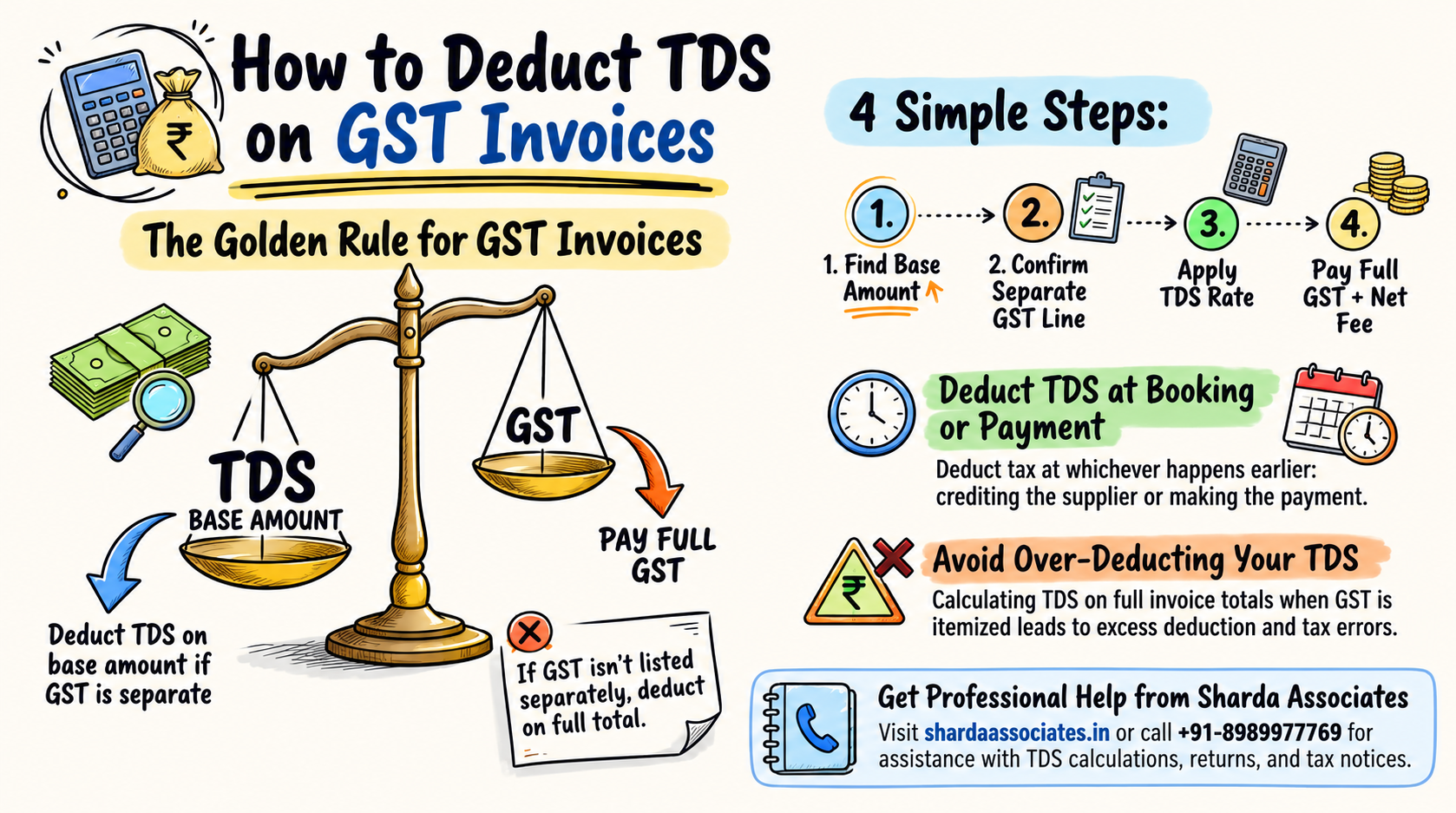
When Should You Deduct : Deduct TDS at the earlier of two moments: when you book the expense in your accounts (credit to the supplier) or when you make the payment. Do not wait until payment if you have already booked the invoice.
Common Mistakes to Avoid
- Calculating TDS on the full invoice even when GST is shown separately, which means you deduct extra.
- Forgetting to deduct TDS because the invoice looks small, even though the yearly limit for that section has been crossed.
- Deducting after payment instead of at the time of booking.
- Paying the TDS late, which leads to interest.
- Confusing income tax TDS with GST TDS. The government TDS under GST (2%) is a separate deduction, also calculated on the value without GST.
Conclusion
Calculating TDS on a GST invoice is easy once you remember one rule: if GST is shown separately, leave it out and deduct TDS on the base amount. If it is not shown separately, deduct from the whole amount.
Ask your suppliers to show GST as a separate line on every invoice, deduct TDS at the time of booking or payment, whichever is earlier, and deposit it on time. These three habits remove most TDS errors and notices.
If you want help with TDS calculation, returns or notices, call Sharda Associates on +91-8989977769. Our chartered accountants also prepare CA-certified project reports for bank loans.
Quick Questions
Q1. Do I deduct TDS on the GST amount?
No, if GST is shown separately on the invoice and the payment relates to a transaction where the applicable TDS rules permit excluding GST.
Q2. What if the invoice does not show GST separately?
If GST is not separately identifiable, TDS may apply to the full invoice amount, depending on the applicable section and transaction details.
Q3. Does this rule apply to all TDS sections?
The general approach applies to payments such as professional fees, contractor payments, and rent. However, the treatment can vary by section and circumstances, so confirm the applicable rule with your CA.
Q4. Is the supplier’s GST registration relevant?
TDS applicability primarily depends on the nature of the payment, the applicable section, and the prescribed conditions. GST registration status may be relevant to the underlying transaction but does not alone determine TDS treatment.
Q5. What if I deducted TDS on the full amount by mistake?
You may be able to correct the deduction through a revised TDS return, subject to the applicable procedures. Consult your CA to determine how to address any excess deduction and reconcile it with the supplier.
Q6. Should TDS be calculated before or after deducting discounts?
TDS is generally calculated on the amount credited or paid, as applicable under the relevant TDS section. Genuine discounts reflected in the invoice may reduce the amount subject to TDS, depending on the transaction and applicable provisions.
Q7. What happens if the invoice includes both taxable and exempt supplies?
The TDS treatment depends on the nature of the supplies, the applicable TDS section, and how the invoice amounts are documented. Keep a clear breakdown of taxable and exempt components and confirm the treatment with your CA.
Q8. Is TDS applicable when an advance payment is made?
For many TDS provisions, tax may become deductible at the time of credit or payment, whichever occurs earlier. Therefore, an advance payment can trigger TDS even before the final invoice is issued, depending on the applicable section.
Q9. How should businesses record TDS on invoices in accounting software?
Record the invoice amount, GST, TDS deduction, and net payable separately. This helps maintain accurate vendor balances, reconcile payments, and prepare TDS returns without confusing GST liabilities with TDS deductions.
Q10. What documents should businesses maintain for TDS on GST invoices?
Maintain supplier invoices showing the GST breakdown, payment records, ledger entries, TDS calculations, applicable section details, and TDS return acknowledgements. These records help support the treatment adopted during accounting reviews and tax assessments.