
Detailed Project Report for Nail Manufacturing
Nail Manufacturing Detailed Project Report provides complete information for setting up a nail manufacturing unit, including manufacturing process, machinery requirement, raw materials, project cost, plant setup, manpower requirement and financial analysis for business planning and loan requirements.
Get Your Report
₹8,999
Starting Price (DPR)
CA-Certified
Consultancy
45,500+
Reports Delivered
What Is Covered in a Nail Manufacturing Detailed Project Report?
A Nail Manufacturing Detailed Project Report provides complete information required for setting up a wire nail manufacturing unit.
The report covers technical, operational and financial aspects including manufacturing process, machinery requirement, raw materials, plant setup, investment estimation, manpower requirement and financial projections.
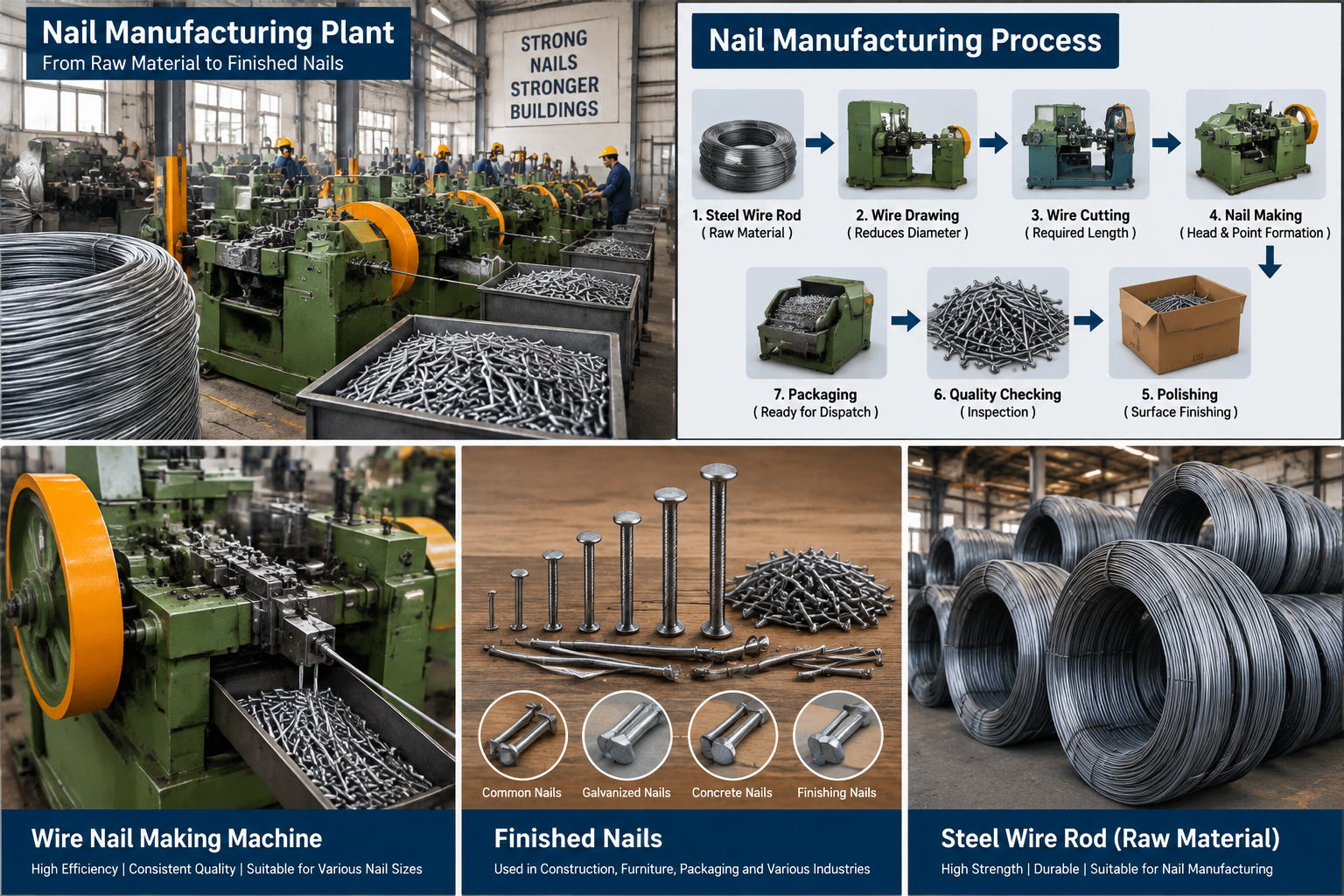
Types of Nails Covered in This Detailed Project Report
Nail manufacturing involves producing different types of nails used in construction, furniture and industrial applications. The type of nail manufactured depends on size, material, application and customer requirement.
Wire Nails
Mild Steel Nails
Galvanized Nails
Concrete Nails
Industrial Nails
Nail Manufacturing Process
- Steel Wire Rod Selection
- Wire Drawing
- Wire Cutting
- Head Formation
- Point Formation
- Polishing & Finishing
- Quality Checking
- Packaging
Explanation
- Steel wire rods are processed to obtain required diameter.
- The nail making machine cuts and forms the nail shape.
- Final finishing improves appearance and quality.
- Finished nails are checked before packaging.
Machinery Required for Nail Manufacturing Plant
| Machinery | Purpose |
|---|---|
| Wire Drawing Machine | Reduces wire diameter |
| Nail Making Machine | Forms nail body, head and point |
| Polishing Machine | Improves surface finish |
| Wire Feeding System | Continuous wire supply |
| Packing Machine | Product packaging |
Investment Required for Setting Up Nail Manufacturing Unit
The total investment depends on production capacity, machinery selection, infrastructure requirements and working capital needs.
| Cost Head | Includes |
|---|---|
| Land & Building | Factory infrastructure |
| Plant & Machinery | Nail production machines |
| Electrical Setup | Installation and power requirements |
| Working Capital | Raw material and operating expenses |
| Other Expenses | Pre-operative expenses |
What Financing Options Are Available?
From banks or NBFCs, secured against plant & machinery and structured around projected production revenue.
For ongoing raw material (MS wire) purchase and operational cycle funding.
Government subsidy of 15% to 35% for eligible rural and urban entrepreneurs, reducing the promoter’s own contribution.
Collateral-free financing options available under various MSME-focused lending schemes.
What Documents Are Required?
1
Promoter Documents
PAN, Aadhaar, address proof, financial statements
2
Land/Property Documents
Ownership/lease documents, land use permission
3
Project Documents
Machine quotations, layout plan, production process flow
4
Regulatory Approvals
BIS certification (IS 723), GST registration, Pollution Control Board (PCB) clearance
5
Financial Documents
Bank statements, existing loan details, financial track record.
What Do Banks/NBFCs Check?
- Machine specifications and production capacity
- Raw material (MS wire) sourcing plan
- Promoter’s manufacturing/trading track record
- Realistic sales volume and pricing assumptions
- BIS and Pollution Control Board compliance status
- Revenue model and product mix
- Debt-servicing capacity from projected cash flow
- Eligibility for PMEGP or MSME subsidy schemes
- Project cost estimation
- Machinery details
- Financial projections
- Profitability analysis
- Loan requirement planning
How Does Sharda Associates Prepare This Report?
Sharda Associates builds each DPR around the actual project — its machine selection, raw material plan, and production capacity — rather than a generic manufacturing template. This includes structuring the project cost from real machine quotations, building capacity-utilisation and revenue projections that reflect a realistic ramp-up, and preparing the debt-servicing analysis lenders expect for this category.
Frequently Asked Questions
A Nail Manufacturing Project Report includes details about project cost, machinery, raw materials, manufacturing process, manpower requirement, financial analysis and feasibility of the proposed nail manufacturing unit.
A nail manufacturing plant generally requires wire drawing machines, nail making machines, polishing machines and packing equipment. The machinery selection depends on production capacity and nail specifications.
The investment depends on plant capacity, machinery cost, infrastructure requirement and working capital needs. A detailed project report helps estimate the complete project investment.
Steel wire rods, mild steel wire and galvanized wire are commonly used as raw materials for manufacturing nails.
Yes, a project report helps banks evaluate project cost, technical feasibility, financial projections and repayment capacity before approving business loans.
It allows for high-speed production without heating the metal, maintaining strength and reducing energy costs.
IS 723 certification from the Bureau of Indian Standards (BIS) is required to ensure quality and load-bearing capacity.
Lenders typically look for a Debt Service Coverage Ratio (DSCR) of 1.25 or higher to ensure consistent debt repayment.