
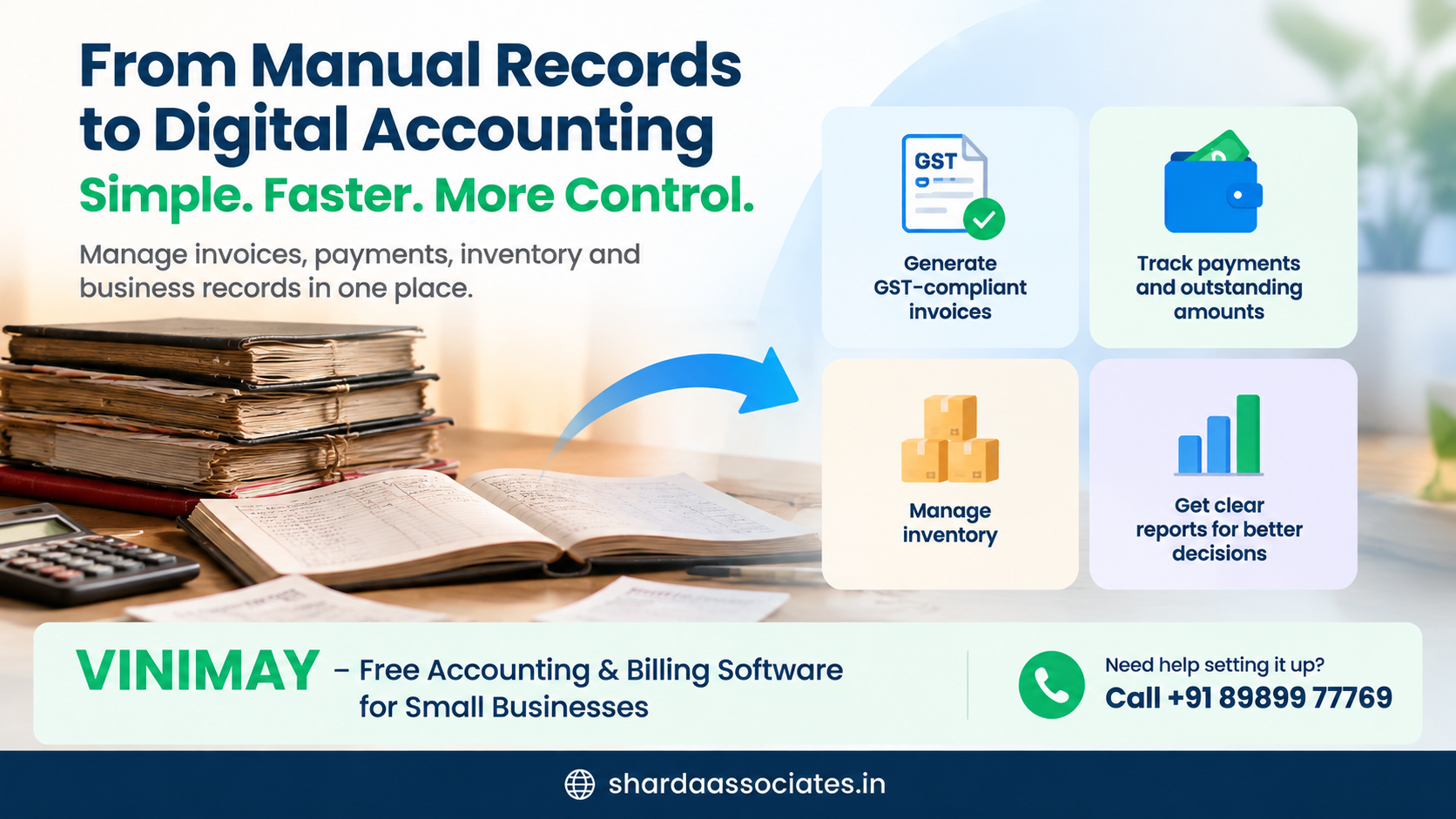
Today, businesses are moving from traditional registers and manual calculations to digital accounting solutions that make financial management faster and easier. Managing invoices, expenses, payments, inventory, and business records manually can take more time and may create chances of mistakes. Digital accounting software helps businesses maintain proper records and get better control over their daily transactions.
At Sharda Associates, we have worked with and evaluated various accounting and billing software solutions used by small businesses, startups, traders, and professionals. Based on our practical experience, we observed that many software platforms either focus mainly on invoice generation or require paid plans to access complete accounting features. Solutions like Vyapar, Zoho Books, and other accounting applications provide useful tools, but businesses often need a simple and affordable solution that can manage billing, payments, inventory, and financial records together.
VINIMAY helps businesses manage their daily operations easily. Unlike many platforms where advanced features may be restricted under premium plans, VINIMAY provides important billing and accounting features free of cost, helping startups, retailers, traders, and service providers reduce manual work, maintain accurate records, and manage their business finances more efficiently.
What Changes When Accounting Goes Digital
- Records become searchable instead of requiring physical filing and manual lookup
- Backup exists automatically, instead of depending on a single paper copy surviving
- Access is no longer tied to one physical location or one person holding the ledger
- Figures are consistent across GST filing, tax records, and internal review, since they come from the same source
Digital Does Not Automatically Mean Correct
A common misconception is that moving to any digital system fixes accuracy on its own. It does not. A spreadsheet maintained digitally can carry forward the exact same errors as a paper ledger—missed entries, wrong GST rates, inconsistent categorization—just in a different format. The real benefit comes from software built to apply rules automatically, such as GST calculation and GSTIN validation, not merely from typing numbers into a screen instead of a notebook.
What to Check Before Choosing Digital Accounting Software
- Does it apply GST correctly by HSN or SAC code, or does it still rely on manual tax entry
- Is there a genuine free option to start with, so cost is not a barrier to making the switch
- Can records be exported cleanly when a CA needs them for filing or a bank needs them for a loan
- Does it work reliably without needing constant technical support to keep running
Comparing Paper-Based and Digital Accounting
| Aspect | Paper-Based Records | Digital Accounting Software |
| Searchability | Manual, time-consuming | Instant, by date or client |
| Risk of loss | High, single physical copy | Low, stored digitally |
| GST accuracy | Fully manual | Automated by HSN/SAC code |
| Sharing with a CA or bank | Physical handover or scanning | Direct digital export |
Why Small Businesses Delay Going Digital
Cost is one reason, though genuinely free tools now remove much of that barrier. The bigger reason is often habit, a system that has worked for years feels safer than a change, even when the paper system is quietly causing problems like inconsistent GST records or lost invoices that only surface during an audit or loan application.
How This Connects to Loan and Compliance Readiness
Clean, digital records are what a CA actually wants to see when preparing CMA data or a project report, and they are what a bank wants to see during appraisal. A business reconstructing a year of transactions from paper at the last minute almost always takes longer and produces messier figures than one pulling a clean export from digital software.
Conclusion
Sharda Associates saw this gap firsthand while helping clients pull together financial history for loan applications, businesses running entirely on paper consistently took longer to document and more often had inconsistencies that needed correcting before figures could be used. Moving its own billing to Vinimay’s free digital invoicing software was partly a response to seeing how much smoother the process became for clients who had already made that switch themselves.
The change is not really about looking modern, it is about records existing somewhere reliable, searchable, and consistent, rather than depending on one physical copy surviving until someone needs it. That difference becomes obvious the first time a digital record saves you from a lost paper one.
For a business still relying entirely on paper, starting with free digital invoicing software for the billing side is a low-risk first step, before considering a fuller digital accounting system. Call +91 89899 77769 if you would like help moving your records digital or preparing documentation for a bank loan.
Frequently Asked Questions
1. Does digital accounting software automatically fix errors in existing records?
No, digital software prevents new errors through automation like GST calculation, but existing paper-based errors still need to be reviewed and corrected during the transition.
2. Is free digital accounting software reliable for GST compliance? Reputable free tools such as Vinimay apply GST calculation and GSTIN validation automatically, which is generally more reliable than manual paper-based tax working.
3. What is the biggest risk of staying on paper-based records?
Loss or damage to a single physical copy is a real risk, along with the difficulty of searching or reconstructing records quickly when a bank or CA needs them.
4. Why do small businesses delay switching to digital accounting?
Habit and comfort with an existing system are more common reasons than cost, especially since genuinely free digital options now exist.
5. Does going digital help when applying for a business loan?
Yes, clean, exportable digital records make preparing CMA data and project reports faster, and reduce inconsistencies that can slow down bank appraisal.
6. Can a business move to digital accounting gradually rather than all at once?
Yes, starting with billing and invoicing digitally, then expanding to full expense and record tracking over time, is a reasonable and common way to make the switch.
7. Does Sharda Associates help businesses transition from paper to digital records?
Yes, Sharda Associates regularly helps clients reconstruct and digitise financial history as part of preparing project report and loan documentation.