
A feasibility report is prepared by the person or business planning the project, usually with the help of a Chartered Accountant firm or a project consultant, before finalising investment, applying for a loan, or approaching investors. Unlike a basic project report, a feasibility report focuses specifically on whether the business idea is realistically viable — technically, financially, and commercially — before money is committed.
Sharda Associates, a CA-certified financial documentation provider, prepares feasibility reports for new businesses, expansion projects, and loan or subsidy applications across India.
What Is a Feasibility Report, and How Is It Different from a Project Report?
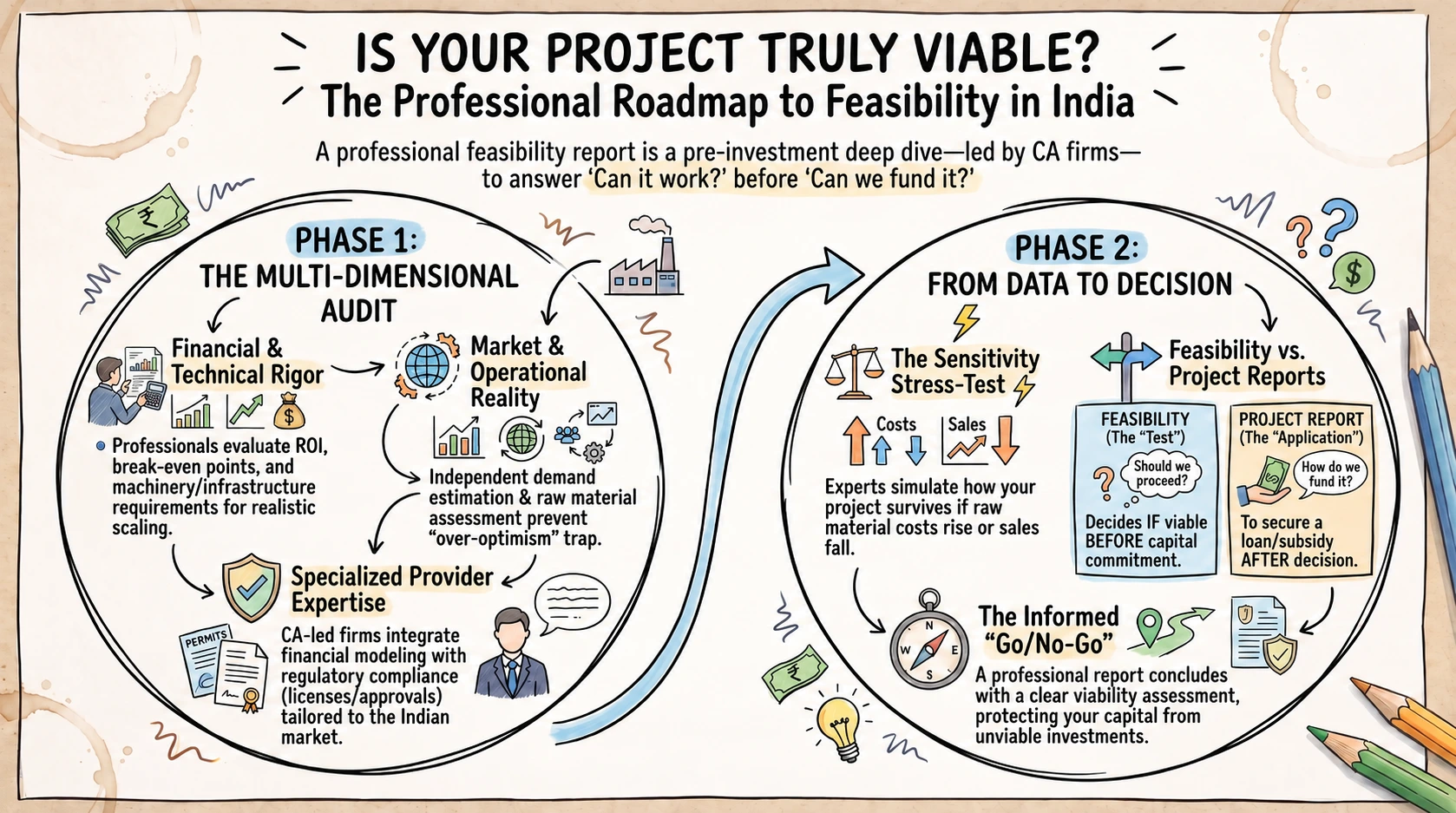
A feasibility report evaluates whether a project should go ahead at all, examining technical, financial, market, and operational viability. A project report, by contrast, is usually prepared once the decision to proceed has already been made and is structured mainly to support a loan or subsidy application. In practice, many project reports include a feasibility element, but a dedicated feasibility study goes deeper into viability testing before the project cost and financing plan are finalised.
| Aspect | Feasibility Report | Project Report |
| Purpose | Tests whether the project should proceed | Supports a loan/subsidy application, once decided |
| Timing | Before major commitment | After the decision to proceed |
| Depth | Broader — technical, market, financial, operational | Narrower — mainly financial and funding-focused |
| Typical user | Promoter deciding whether to invest | Bank/scheme evaluating a loan application |
Who Prepares Feasibility Reports?
- CA firms and financial consultants — for the financial viability component (project cost, funding, ROI, break-even, sensitivity analysis)
- Technical/sector consultants — for projects needing detailed technical feasibility (machinery selection, plant capacity, process technology), often working alongside the financial consultant
- Project report consultancies — many combine both financial and basic technical feasibility in a single deliverable for MSME-scale projects
- Market research specialists — occasionally brought in separately for large projects that need a detailed, independent demand study
For most MSME and small business feasibility studies, a CA-led provider covering both the financial and basic operational feasibility is sufficient; large industrial projects sometimes need a separate technical consultant as well.
What Does a Feasibility Report Typically Cover?
- Technical feasibility — location, infrastructure, machinery/technology, and production capacity
- Financial feasibility—project cost, funding sources, profitability, ROI, payback period, and break-even point
- Market feasibility—demand estimation, competition, and pricing viability
- Operational feasibility — manpower, raw material availability, and process practicality
- Legal/regulatory feasibility — licences, approvals, and compliance requirements specific to the sector
- Risk assessment — key risks to the project and how they could be mitigated
How Is a Feasibility Report Prepared, Step by Step?
- Defining the project scope—what exactly is being evaluated (a new unit, an expansion, a new product line)
- Market study—estimating demand, competition, and realistic pricing for the product or service
- Technical assessment — checking whether the proposed location, machinery, and process are practical and adequately scaled
- Financial modelling — building the project cost, funding plan, and profitability/ROI projections
- Sensitivity and risk analysis—testing how the numbers hold up under less favourable assumptions
- Conclusion and recommendation—a clear viability assessment, not just a data dump, so the promoter can make an informed go/no-go decision
When Is a Feasibility Report Needed?
- Before committing significant capital to a new business or expansion
- When applying for project finance from a bank, where the lender wants viability evidence beyond a standard project report
- When approaching investors or partners for funding
- For large or capital-intensive projects, before applying for industrial land allotment or a subsidy scheme
- When evaluating multiple project options and needing a comparative view of viability
- Before entering an unfamiliar sector or geography, where assumptions need independent validation
What Should a Good Feasibility Report Actually Tell You?
A genuinely useful feasibility report doesn’t just present numbers — it should give a clear answer on whether the project is viable and under what conditions. This means the report should highlight the break-even point, the minimum sales level needed for viability, and what happens if key assumptions (cost of raw material, selling price, demand) turn out to be less favourable than expected. A report that presents only the best-case outcome, without this kind of stress-testing, is of limited practical use for an actual investment decision.
Common Mistakes in Feasibility Reports
- Overly optimistic market or revenue assumptions not backed by evidence
- Skipping sensitivity analysis (what happens if costs rise or sales fall short)
- Treating the feasibility report as a formality rather than a genuine viability check
- Using generic, sector-agnostic content rather than assumptions specific to the actual project
- Confusing a feasibility report with a project report and submitting one when the bank or scheme actually needs the other
Frequently Asked Questions
1. Who provides feasibility report preparation services in India?
CA firms and financial/project consultancies such as Sharda Associates provide feasibility report preparation, covering financial, market, and basic technical viability.
2. Is a feasibility report the same as a project report?
No — a feasibility report evaluates whether a project should proceed at all, while a project report is typically prepared to support a loan or subsidy application once the decision to proceed is already made.
3. When should a business get a feasibility report done?
Ideally, before committing significant capital, applying for project finance, or approaching investors, viability is assessed before, not after, money is invested.
4. Does a feasibility report include financial projections?
Yes—financial feasibility, including project cost, funding, ROI, and break-even analysis, is a core part of most feasibility reports.
5. Is a feasibility report required for a bank loan?
Not always mandatory, but for larger or capital-intensive projects, banks sometimes ask for a feasibility study in addition to the standard project report.
6. Can a feasibility report be used for industrial land allotment applications?
Yes, many industrial land allotment authorities accept a feasibility or detailed project report that includes technical and financial viability as part of the application.
7. How is technical feasibility assessed for a manufacturing project?
It typically covers machinery/technology selection, production capacity, site suitability, and raw material availability, often prepared alongside the financial feasibility analysis.
8. What is sensitivity analysis in a feasibility report, and why does it matter?
It shows how the project’s viability changes if key assumptions — like sales volume, price, or raw material cost — turn out worse than projected, giving a more realistic picture than a single best-case scenario.
9. Can one feasibility report cover multiple project options?
Yes, when a promoter is comparing options (e.g., two possible locations or two product lines), a feasibility study can be structured to evaluate and compare each against the same criteria.
10. Do startups need a feasibility report before a project report?
It’s not mandatory, but for a first-time or capital-intensive idea, a feasibility check before finalising the project report can help avoid committing to an unviable plan early on.