
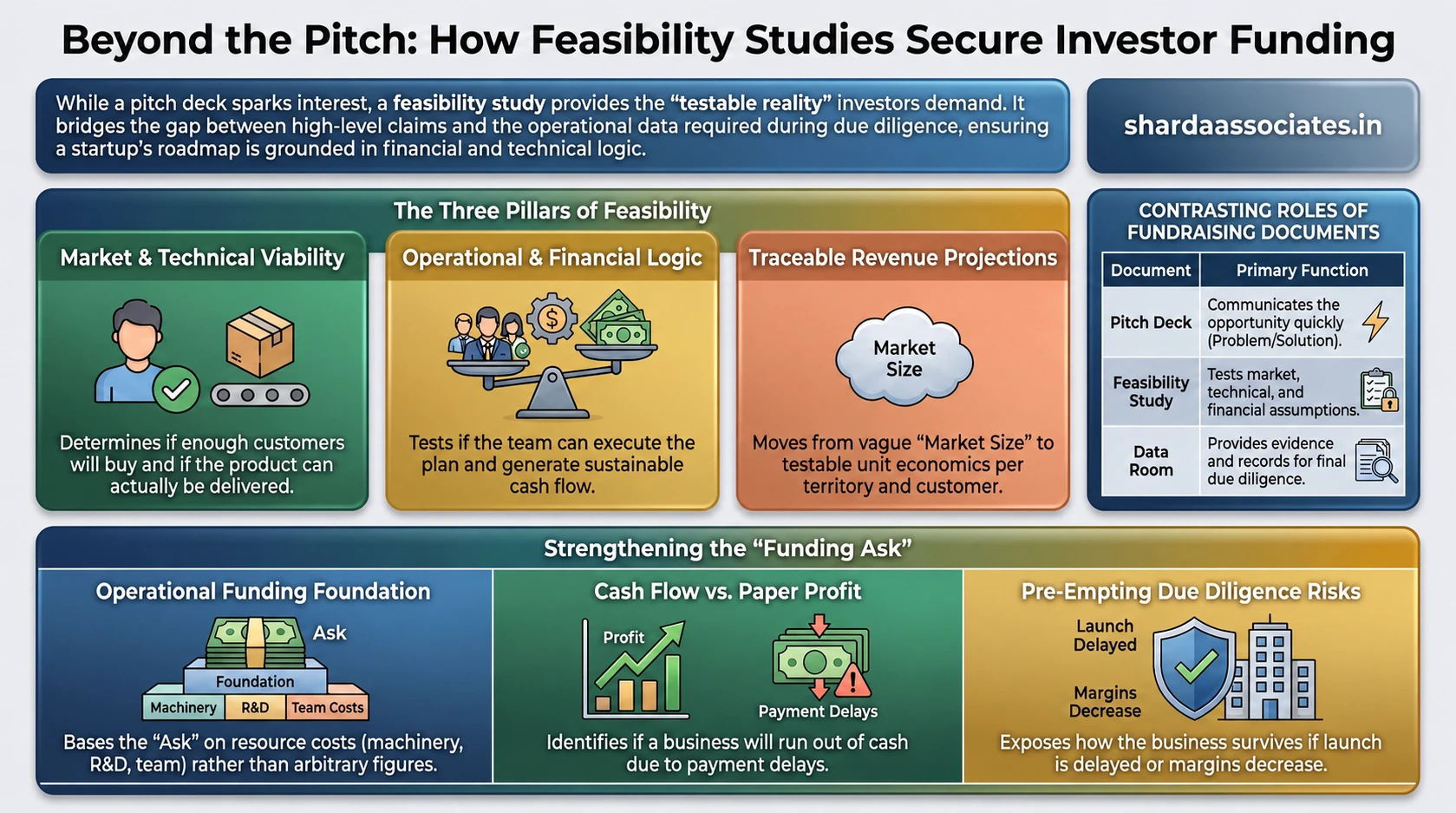
A feasibility study determines whether the assumptions underlying a company idea are plausible, while a strong investor pitches explains why the potential is appealing. While market size and growth may be of interest to investors, they also want to know if the product can be provided, whether customers will actually pay, whether the company can grow, and whether the required capital is sufficient to achieve significant milestones. Sharda Associates provides CA-expert-led financial feasibility analysis that can help founders connect revenue assumptions, project cost, cash flow, break-even and funding requirements before those figures are presented to potential investors.
Why Isn’t a Strong Pitch Deck Enough?
A pitch deck is designed to communicate an opportunity quickly.
It may show:
Problem → Solution → Market → Business Model → Traction → Financials → Funding Ask
That is useful.
But an investor eventually needs to go deeper.
Suppose a pitch says:
“We need ₹5 crore to expand into 20 Indian cities and reach ₹50 crore revenue in three years.”
The investor may ask:
- Why exactly ₹5 crore?
- What does each city cost to launch?
- How many customers are required?
- What revenue must each city produce?
- How quickly will stores or teams become operational?
- What happens if expansion is slower?
- When will additional capital be needed?
A feasibility study is where those assumptions can be tested before the pitch reaches due diligence.
Startup India’s investor guidance explicitly identifies market landscape, customers, sales forecasts, conversion, retention, financial assessment, break-even and reasonable assumptions as relevant investor considerations.
What Is an Investor-Focused Feasibility Study?
An investor-focused feasibility study should not be a generic 100-page report.
Its job is to test the business case.
Depending on the venture, it may examine four connected areas.
| Feasibility Area | Main Question |
| Market | Will enough customers buy? |
| Technical | Can the product/service actually be delivered? |
| Operational | Can the company execute the plan? |
| Financial | Can the model generate sustainable economics and cash flow? |
Technical viability may concentrate on product development and validation for an early-stage technology firm.
It might concentrate on equipment and capacity for a manufacturing startup.
Operational viability might be more crucial for a chain of restaurants.
The scope ought to be appropriate for the company.
How Does a Feasibility Study Test Market Claims in the Pitch?
One of the most common pitch-deck slides is:
TAM: ₹10,000 crore
But investors do not invest simply because a large market exists.
The feasibility question is:
Which part of that market can this specific business realistically reach?
A useful analysis may look at:
- Target customer
- Geographic reach
- Customer need
- Competition
- Price
- Distribution
- Conversion
- Repeat purchase or retention
Startup India’s pitch-deck guidance itself tells founders to explain who will buy the product, how much they would pay and the size of the addressable opportunity.
This helps prevent a common mistake:
Large market = automatically large startup revenue.
Those are not the same thing.
How Does Feasibility Improve Revenue Projections?
Consider two pitch forecasts.
Pitch A
Year 1: ₹1 crore
Year 2: ₹5 crore
Year 3: ₹20 crore
Pitch B
Year 3 revenue is based on:
50 active sales territories
× 500 customers per territory
× ₹8,000 average annual revenue
= ₹20 crore
Pitch B is not automatically correct.
But it is testable.
The investor can ask:
- Can the company reach 50 territories?
- Can each territory acquire 500 customers?
- Is ₹8,000 pricing realistic?
- What sales team is required?
- What does customer acquisition cost?
That is what feasibility adds: traceability from revenue to operations.
Why Is Technical Feasibility Important for Investor Pitches?
This is particularly crucial for companies in the fields of technology, manufacturing, healthcare, energy, and product creation.
Among the review criteria for Startup India’s Seed Fund Scheme are the product-development plan, proof-of-concept process, and the viability and reasonableness of technical claims.
Imagine a startup claiming:
“Our manufacturing process will reduce production cost by 40%.”
Before putting that statement into an investor pitch, the founder should be able to explain:
- What technology creates the saving?
- Has it been tested?
- At what production scale?
- What inputs are required?
- What machinery is needed?
- Does quality remain acceptable?
A financial projection built on an unproven technical assumption is only as strong as that assumption.
How Does Feasibility Help Determine the Right Funding Ask?
Founders often start with:
“We want to raise ₹10 crore.”
A better approach is:
What needs to be achieved → What resources are needed → What will those resources cost → How much funding is required?
For example:
Illustrative Funding Plan
| Use of Funds | Amount |
| Product development | ₹1.00 crore |
| Machinery/technology | ₹1.50 crore |
| Sales expansion | ₹1.00 crore |
| Team | ₹75 lakh |
| Working capital | ₹50 lakh |
| Contingency/other validated needs | ₹25 lakh |
| Total Requirement | ₹5.00 crore |
These numbers serve as examples.
The fact that the funding request now has an operational foundation is crucial.
A fund-utilization strategy is also a component of Startup India’s Seed Fund evaluation mechanism.
Why Should Feasibility Include Cash Flow, Not Just Profit?
Even if a firm appears profitable on paper, it may eventually run out of funding.
Let’s say your forecasted P&L indicates a profit of ₹20 lakh.
However, suppliers, marketing, and salaries must be paid right away, but customers take 90 days to pay.
The company might still require further funding.
Thus, an investor-focused feasibility model ought to link:
Revenue → Margin → Operating Expenses → Working Capital → Cash Burn/Generation → Funding Runway
This helps address a crucial query from investors:
Will the business truly reach the next milestone with this capital round?
Additionally, Startup India points out that when evaluating funding needs, financial projections should take sales, production, and development expenditures into account.
How Can Feasibility Expose Risks Before the Investor Does?
This is one of its most valuable uses.
Suppose the financial model assumes:
- 60% gross margin
- 10% annual customer churn
- 20-day sales cycle
- Launch in five cities simultaneously
Feasibility testing asks:
What evidence supports each assumption?
Then test what happens if reality is less favourable.
For example:
- Customer acquisition takes longer
- Product launch is delayed
- Selling price is lower
- Raw-material cost increases
- Customer retention is weaker
A feasibility study should not hide these risks.
It should show whether the business remains workable despite reasonable uncertainty.
Should Founders Show the Full Feasibility Report to Investors?
Not necessarily in the first pitch.
Startup India’s current pitch guidance indicates that the initial presentation should remain concise and focus on the core opportunity, business case, team and traction rather than overwhelming investors with detailed numbers.
A practical approach is:
Pitch Deck: concise story.
Financial Model: detailed assumptions.
Feasibility Study: support for important market, technical, operational and financial assumptions.
Data Room: evidence used during deeper diligence.
This creates layers of information.
The founder can answer simple questions quickly while still being prepared for detailed scrutiny.
Why Does Feasibility Matter More During Due Diligence?
A pitch attracts interest.
The outcome of many investment negotiations is determined by due diligence.
According to Startup India, VCs and angel networks conduct due diligence and may confirm statements about the team’s background, growth, market data, and previous financial actions.
Items including the business model, income streams, target customer types, significant customers, product offers, and vendor information are also requested in its published financial due diligence template.
Contradictions can therefore become an issue.
If the pitch states:
Year 3 revenue: ₹50 crore
but the financial model supports only ₹25 crore under the stated customer assumptions, the issue may surface during diligence.
Feasibility work helps identify those inconsistencies earlier.
Does Every Startup Need a Formal Feasibility Report?
No.
A small early-stage startup testing an idea may not need a large consultant-produced document.
But it still needs to test feasibility.
At an early stage, that may mean:
- Customer interviews
- Prototype validation
- Pilot results
- Pricing tests
- Basic unit economics
- Cash requirement
As the funding ask and project complexity increase, formal financial or technical feasibility work can become more useful.
The principle is proportionality:
More investment + more complexity + more uncertainty = greater need for structured feasibility analysis.
How Can CA Expertise Improve Financial Feasibility?
A CA or financial professional can help test whether the financial model tells one consistent story.
For example:
Customers → Revenue → Gross Margin → Operating Cost → Working Capital → Cash Flow → Funding Ask → Break-Even
The work’s financial viability can be supported by Sharda Associates.
However, a crucial restriction ought to be evident.
Unless they are qualified to do so, a CA should not independently certify complicated technologies, engineering output, or scientific claims.
The relevant expert should participate when specialised technical validation is required.
Final Takeaway
A feasibility study matters for an investor pitch because investors are not investing in a PowerPoint presentation.
They are investing in what must happen after the presentation.
A strong feasibility process helps founders answer:
Is the market reachable?
Can the product be delivered?
Can the company execute?
Are the projections financially connected?
Is the funding ask sufficient?
What happens if assumptions change?
The result is not a guarantee of investment.
It is something more useful: a pitch whose major claims can survive informed questioning.
Frequently Asked Questions
1. Do investors ask for feasibility studies?
Not every investor asks for a document specifically titled “Feasibility Study,” but investors commonly evaluate market, technical, operational and financial feasibility during investment assessment and due diligence.
2. Is a feasibility study the same as a pitch deck?
No. A pitch deck communicates the opportunity; a feasibility study tests the assumptions behind it.
3. Should a startup prepare feasibility before raising funds?
It can be especially useful where the funding ask is substantial, the business is capital-intensive or major assumptions remain uncertain.
4. What financial information should feasibility contain?
Relevant items can include revenue assumptions, costs, margins, working capital, cash flow, funding requirement and break-even analysis.
5. Does feasibility help with valuation?
It can strengthen the assumptions feeding financial models, but valuation depends on many additional factors and methods.
6. Can investors verify the assumptions in my feasibility study?
Yes. Investor due diligence may test financial, customer, market and business claims against supporting evidence.
7. Is technical feasibility necessary for a software startup?
It can be relevant where the product depends on unproven technology, complex development or significant technical claims.
8. Does a feasibility study guarantee investor funding?
No. Investors independently evaluate the opportunity, team, market, risks, terms and expected returns.