
Direct Answer
Financial modelling for a UAE business means building linked forecasts of costs, profit and cash flow from clear assumptions, so you can see whether the business can fund itself, repay a loan and survive weaker conditions. The usual sequence is to forecast revenue, split costs into fixed and variable, estimate working capital, then link everything into a projected profit and loss, cash flow statement and balance sheet. The most important lesson is that a profitable business can still run out of cash.
Quick summary:
- Costs: Separate fixed, variable and one-off costs before forecasting
- Profit: Revenue minus costs, but it does not show cash timing
- Cash flow: Profit adjusted for receivables, inventory, payables, tax and loan payments
- Test it: Run lower-sales and slower-collection scenarios
- Use it for: Funding decisions, loan applications, expansion and pricing
Start with the Decision, Not the Spreadsheet
A model built without a purpose becomes a pile of numbers. Before opening Excel, decide what the model must answer. It might be whether a new branch will pay back, how much funding the business needs, whether a loan can be repaid comfortably, or what happens if the biggest customer pays late.
The answer shapes the model. A lender wants repayment capacity and DSCR. An investor wants returns and risk. An owner deciding on expansion mainly wants to know how much cash the project will absorb and when.
Forecasting Costs
Costs are where most forecasts quietly go wrong, usually because something was left out. A reliable cost forecast starts by sorting costs into three groups.
Variable costs move with sales: materials, goods purchased for resale, delivery, commissions and payment processing fees.
Fixed costs stay broadly the same regardless of sales in the short term: rent, core salaries, licence fees, insurance, software and utilities.
One-off and step costs arrive in blocks: fit-out, equipment, a new warehouse once volumes pass a certain level, or an additional hire when the team reaches capacity.
For UAE businesses, remember the costs that are easy to overlook: visa and labour-related costs, licence renewals, lease terms and escalations, and VAT and corporate tax effects on pricing and returns. Rates, thresholds and requirements change, so confirm them with the relevant authority before building them into a model.
Always link costs to drivers, not flat guesses. Salaries should link to headcount, materials to sales volume and rent to the lease schedule. When costs are hardcoded, scenarios stop working because nothing responds when sales change.
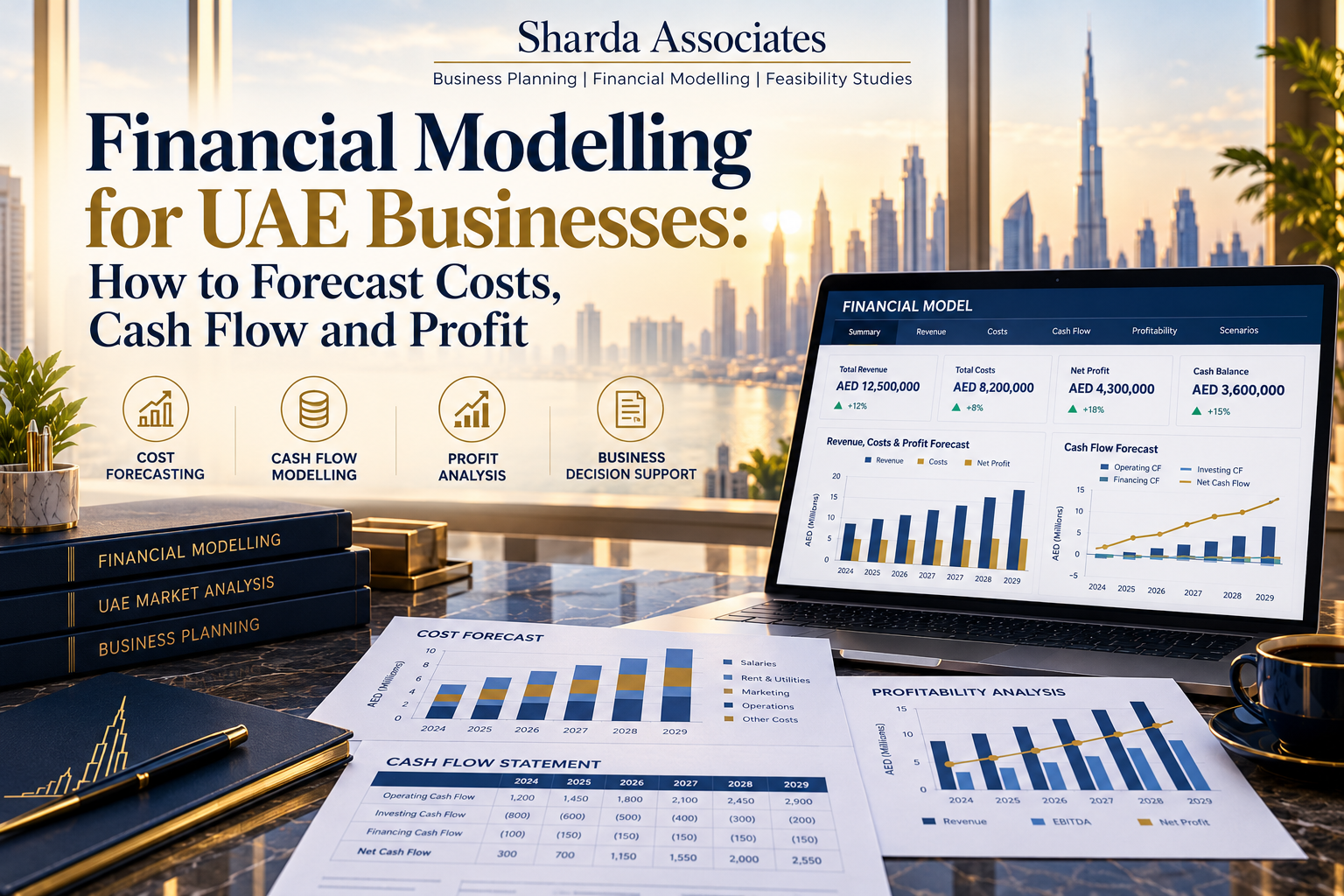
Forecasting Profit
Profit forecasting starts with revenue built from drivers such as customers, price and volume, or capacity and utilisation, not a single growth percentage applied to last year. Subtract variable costs to get gross profit, then fixed costs to get operating profit, then financing costs, depreciation and tax to reach net profit.
Profit tells you whether the business model earns more than it spends. It does not tell you whether you will have cash in the bank when bills fall due, and that is a different question.
Forecasting Cash Flow: Why Profit Is Not Cash
Cash flow adjusts profit for timing. You pay suppliers before customers pay you, you hold stock before you sell it, and you repay loan principal from cash that was never an expense on the profit and loss statement.
Here is an illustration. Consider a hypothetical Dubai distribution business in its first full year.
| Particulars | Illustrative Amount |
| Annual Revenue | AED 1,200,000 |
| Cost of Goods Sold (60%) | AED 720,000 |
| Operating Expenses | AED 300,000 |
| Operating Profit | AED 180,000 |
On paper, a healthy AED 180,000 profit. Now apply working capital, assuming customers take 60 days to pay, the business holds 45 days of stock, and suppliers allow 30 days of credit.
| Working Capital Item | Illustrative Amount |
| Receivables (60 days of sales) | AED 197,000 |
| Inventory (45 days of cost of goods) | AED 89,000 |
| Less: Payables (30 days of cost of goods) | (AED 59,000) |
| Net Working Capital Tied Up | AED 227,000 |
The business earns AED 180,000 but ties up AED 227,000 in working capital, leaving cash from operations about AED 47,000 negative in the year, before any loan repayments. The business is profitable and still needs funding.
Now stress it. If customers slow to 90 days, receivables rise to about AED 296,000, net working capital becomes about AED 326,000, and cash from operations falls to roughly AED 146,000 negative. The same profit, but a very different cash position.
All figures are hypothetical and rounded. Operating profit is before financing costs, depreciation and tax. Assumes a growing business building up working capital from a low starting point.
This is why lenders look at cash flow and DSCR rather than profit alone, and why a model without working capital can mislead you badly.
Linking It Together
A proper model connects three statements. The projected profit and loss feeds net profit into the balance sheet. The balance sheet carries receivables, inventory, payables, fixed assets, loans and equity. The cash flow statement reconciles the two, and its closing cash must match the balance sheet. If the balance sheet does not balance, something is wrong, and a good model includes a check that flags it.
Add a loan schedule showing interest and principal, and calculate DSCR, which compares cash available for debt service against the repayments due.
Common Modelling Mistakes
Forecasting revenue as one growth percentage with no link to customers or capacity. Ignoring working capital. Hardcoding numbers so scenarios cannot flow through. Forgetting tax, lease escalations or replacement of equipment. Showing only the best case. Building statements that do not tie together. And presenting a forecast with no recorded reasoning, so nobody, including you, can explain it six months later.
Scenario Testing
Run at least three versions: a base case, a downside case with lower sales and slower collections, and a cost-pressure case with higher costs. Look at what happens to cash, not just profit, and at the lowest cash point during the year, which is what determines whether you need a credit line.
Getting a Model Built
Sharda Associates is a CA-led firm with experience in project reports, CMA data and bank loan consulting. We build financial models with documented assumptions, linked statements, working capital and DSCR, and we test downside scenarios before presenting results. We support preparation and documentation. Approval of any loan or investment remains the decision of the lender or investor.
Frequently Asked Questions
- What is financial modelling for a business?
It is building linked forecasts of revenue, costs, profit, cash flow and the balance sheet from stated assumptions to support decisions on funding, expansion and repayment.
2. Why can a profitable business run out of cash?
Because cash timing differs from profit. Money can be tied up in unpaid customer invoices, stock and loan repayments even when the business earns a profit.
3. How far ahead should a UAE business forecast?
It depends on the purpose. A budget may cover one year, while project or loan forecasts often cover several years. Confirm the period your lender or investor expects.
4. What is DSCR and why does it matter?
Debt Service Coverage Ratio compares cash available for debt payments with the repayments due. Lenders use it to judge repayment capacity.
5. Can a financial model guarantee loan approval?
No. It helps present your numbers clearly, but approval remains the lender’s decision.