
A startup in its first year has one accounting job that matters more than any other: knowing where the money is at any given moment, what came in, what went out, and what is still owed. Free accounting software can help new businesses manage these essential financial tasks without adding unnecessary software costs. Every other accounting feature – forecasting, multi-entity consolidation, advanced analytics – is built for a business that already has a finance team, not a founder juggling accounting between everything else. For a new business with no revenue to spare on software, free accounting software that gets the basics right is worth far more than paid tools with features that will not be used for years.
Sharda Associates works closely with startups on incorporation, compliance, and fundraising documentation, and the pattern that comes up again and again is founders who are genuinely building a good business but cannot produce clean financial statements when an investor, bank, or tax authority asks for them. The firm has used Vinimay’s free invoicing and accounting tools for its own operations, and the same logic holds for a startup: get the fundamentals right for free before paying for anything else.
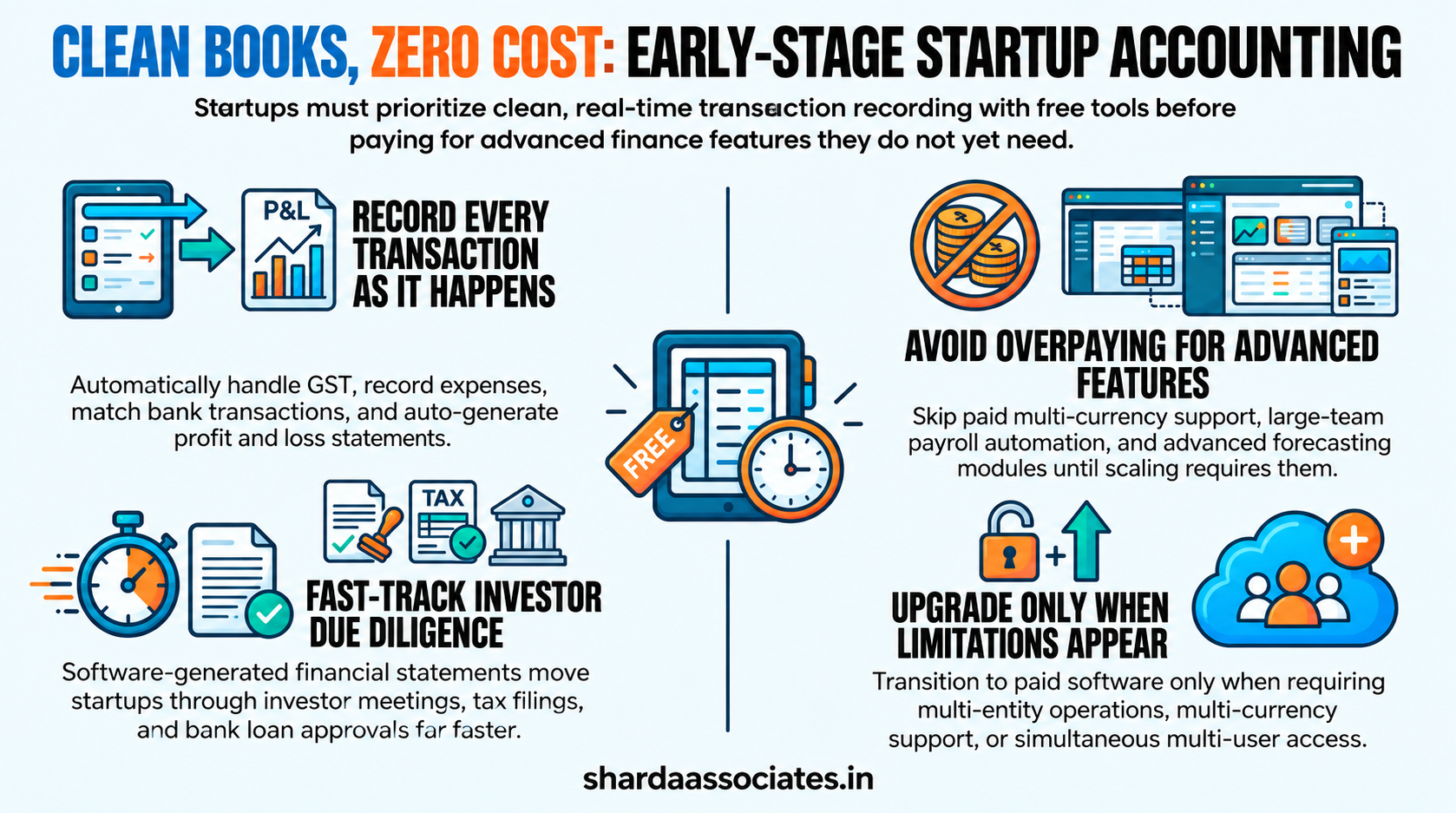
What a Startup’s Books Need to Do From Day One
- Every invoice raised and every expense paid should be recorded as it happens, not reconstructed later
- Bank transactions should be easy to match against recorded entries, so nothing gets missed
- The software should produce a basic profit and loss and balance sheet without manual compilation
Why Clean Records Matter Earlier Than Most Founders Expect
Investors, banks, and tax authorities all eventually ask for financial statements, and a startup with a full year of unreconciled transactions cannot produce these quickly or accurately. Free accounting software that records transactions as they happen removes the need for a founder to reconstruct a year’s worth of activity from bank statements and memory when it is suddenly needed.
What Free Accounting Software Should Cover for a Startup?
- Invoice generation with GST or applicable tax handled correctly and automatically
- Expense recording, ideally with receipt capture, tied to the right category
- A basic profit and loss statement, generated automatically from recorded transactions
- Bank reconciliation, so recorded entries can be matched against actual bank activity
What Startups Should Not Overpay For Early On
Multi-currency consolidation, payroll automation for large teams, and advanced financial forecasting modules are genuinely useful once a startup scales but add cost and complexity that a pre-revenue or early-revenue business usually does not need yet. Free software covering invoicing, expenses, and basic statements is often the right starting point until a specific limitation actually appears.
Comparing Free Accounting Options for Startups
| Option | Setup Time | Statement Accuracy | Cost |
| Spreadsheet tracking | Minimal | Manual, error-prone | Free, but time-costly |
| Free accounting software (e.g., Vinimay) | Low | Automatic, reconciled | Free |
| Paid accounting suite with add-ons | Higher | Automatic, plus forecasting and multi-entity support | Ongoing cost |
Signs a Startup Has Outgrown Free Accounting Software
Once the business needs multiple team members entering transactions at the same time, operates across more than one entity or currency, or requires detailed departmental cost tracking, free software built for a single small operation starts to reach its limit. That is the point of evaluating a paid step-up, not before.
Conclusion
Sharda Associates sees the value of clean, consistent books most clearly when a startup raises its first round of funding or applies for working capital; businesses with accurate, software-generated financial statements move through due diligence far faster than those trying to assemble records from scratch.
The firm’s own reasoning with Vinimay applies just as directly to a startup: get the books right and consistent for free first, and only add paid complexity once a genuine limitation, not a nice-to-have, actually shows up.
For a startup still tracking finances on spreadsheets or in a founder’s head, moving to free accounting software that handles tax correctly and produces a clean profit and loss is a low-risk first step that pays off well before your first investor meeting or loan application. Call +91 89899 77769 if you would like help setting up accounting for your startup or preparing fundraising and compliance documentation.
Frequently Asked Questions
1. Is free accounting software enough for a startup’s first year?
Yes, for most early-stage businesses with a modest volume of transactions, free accounting software handles invoicing, expenses, and basic statements well.
2. Does free accounting software produce accurate financial statements?
Good free tools generate a profit and loss and balance sheet automatically from recorded transactions, which is far more reliable than compiling statements manually from spreadsheets at year-end.
3. What should a startup avoid paying for early on?
Multi-currency consolidation, payroll automation for large teams, and advanced forecasting are usually unnecessary until the business has scaled enough to need them.
4. When does a startup need to move beyond free accounting software?
Once multiple team members need to enter transactions simultaneously, the business spans multiple entities or currencies, or detailed departmental cost tracking becomes necessary, free software starts to reach its limit.
5. Do clean financial records help when raising funding or applying for a loan?
Yes, accurate, software-generated statements are far easier for investors and lenders to review than records reconstructed from spreadsheets or bank statements alone.
6. Can free accounting software handle GST correctly for a startup?
Yes, tools like Vinimay apply GST automatically on invoices, reducing errors compared to manual tax calculation.
7. Can Sharda Associates help a startup set up its accounting and compliance documentation?
Yes, Sharda Associates assists startups with incorporation, compliance filings, and financial documentation for fundraising, using their existing accounting and billing records.