
Applying for a government business scheme, subsidy or MSME loan does not always lead directly to approval. An application may remain pending because of missing documents, eligibility issues, incorrect project costs, weak financial projections, verification delays, bank appraisal or unanswered queries.
A pending application does not automatically mean rejection. Government schemes can involve several stages such as eligibility screening, document verification, departmental scrutiny, bank appraisal, physical verification and final approval.
The most important step is therefore to identify exactly where the application is stuck and correct the issue at that particular stage.
Government’s myScheme platform also advises applicants to check the individual scheme’s eligibility conditions, benefits, required documents and application process because requirements vary from scheme to scheme.
What Does “Application Pending” Actually Mean?
When a government scheme portal displays a status such as Pending, Under Verification, Forwarded to Bank, Under Scrutiny or Awaiting Clarification, it does not necessarily indicate rejection.
The application may be waiting for:
- Document verification
- Eligibility confirmation
- Departmental approval
- Bank appraisal
- Additional documents
- Applicant clarification
- Physical inspection
- Credit assessment
- Correction of application details
Before submitting another application, first determine the last completed stage.
1. Incorrect Scheme Selection
One of the most common mistakes occurs before the application is even submitted.
Government schemes are usually created for specific applicants, industries, project sizes, geographical areas or business stages.
Eligibility may depend on factors such as:
- Applicant age
- Business activity
- New or existing enterprise
- Location
- Investment amount
- Applicant category
- Promoter contribution
- Previous government assistance
- Business registration
- Project cost
Being an MSME does not automatically make a business eligible for every MSME-related scheme.
Applicants should therefore check the current official guidelines rather than relying only on general information found online.
2. Missing or Incorrect Documents
Government applications often get delayed because a document is missing, expired, unclear or inconsistent with another document.
Common examples include:
- Aadhaar/PAN mismatch
- Different applicant names
- Incorrect business address
- Wrong bank account information
- Missing Udyam Registration
- Expired certificates
- Incorrect quotations
- Missing project report
- Incomplete declarations
Even a small mismatch can trigger another verification cycle.
The application should therefore be reviewed as one complete file, rather than checking every document separately.
3. Project Report Does Not Match the Application
For many business loan and subsidy-linked schemes, the project report is an important part of the proposal.
Problems arise when the figures in the project report are different from those entered in the scheme application.
For example:
Application Project Cost: ₹20 lakh
Project Report: ₹24 lakh
Machinery Quotations: ₹15 lakh
Loan Requested: ₹18 lakh
The authority or lender now has several different figures for the same project.
That creates a need for clarification and can stop the application from moving ahead.
4. Unrealistic Financial Projections
A project report should not simply show high revenue and profits to make the project appear attractive.
The projections should logically connect:
Production Capacity → Sales → Expenses → Profit → Cash Flow → Loan Repayment
Banks may question:
- Unrealistically high sales
- Very high profit margins
- Low operating costs
- Inadequate working capital
- Incorrect depreciation
- Wrong interest calculations
- Weak cash flow
- Poor DSCR
- Unrealistic capacity utilisation
The financial model should explain how the business is expected to generate enough cash to operate and service its debt.
5. Project Cost Is Not Properly Supported
Project costs normally need supporting calculations or quotations.
Depending on the business, project cost may include:
- Plant and machinery
- Equipment
- Furniture
- Building or civil work
- Electrical installation
- Preliminary expenses
- Working capital
- Other eligible project expenses
If the applicant claims machinery expenditure of ₹10 lakh while quotations support only ₹6 lakh, the lender may seek clarification.
The same applies when the total project cost entered on the portal does not match the DPR.
6. Promoter Contribution and Loan Requirement Do Not Reconcile
Most project-finance proposals explain how the total project will be financed.
For example:
Total Project Cost: ₹25 lakh
Promoter Contribution: ₹5 lakh
Bank Loan: ₹15 lakh
Eligible Assistance/Subsidy: ₹5 lakh
Total: ₹25 lakh
If these numbers do not reconcile across the DPR, scheme application and bank proposal, processing can be delayed.
A professionally prepared financing structure should clearly explain where every part of the project funding is coming from.
7. Government Scheme Approval Does Not Guarantee Bank Sanction
This is especially important for credit-linked schemes.
Eligibility under a government scheme does not necessarily force a bank to approve the loan.
For example, official PMEGP guidelines state that the bank appraises projects and takes its own credit decision based on the viability of each project.
The bank may independently consider:
- Credit history
- Existing loans
- Promoter contribution
- Project viability
- Cash flow
- Banking behaviour
- Business experience
- Repayment capacity
- Supporting documents
Therefore:
Scheme Eligibility ≠ Automatic Loan Approval
8. Application Is Waiting at the Bank
Sometimes the scheme-side processing is complete but the file is pending with the lender.
The credit team may require clarification regarding:
- Project cost
- Machinery
- Business premises
- Financial projections
- Existing liabilities
- Applicant contribution
- Credit history
- Quotations
- Repayment capacity
For MSME loan applications, RBI guidance states that banks should provide an indicative checklist of required documents and communicate the principal reasons when a loan application is rejected.
If your file is pending at the bank, ask for the specific pending requirement instead of repeatedly asking only for approval status.
9. Verification or Inspection Is Still Pending
Certain government schemes require verification of information submitted by the applicant.
Depending on the scheme, this could include verification of:
- Business premises
- Machinery
- Applicant identity
- Business activity
- Investment
- Supporting invoices
- Certificates
- Project implementation
Applicants should therefore retain organised copies of quotations, invoices, registrations and other supporting documents even after the application is submitted.
10. Applicant Has Not Responded to a Query
Sometimes the application is not waiting for the government at all.
It is waiting for the applicant.
Queries may arrive through:
- Scheme portal
- SMS
- Bank
- Department
- Implementing agency
A request might ask for one corrected document, explanation or declaration.
If the applicant fails to respond, the application may remain pending even though most of the appraisal is complete.
Regularly monitor all registered communication channels.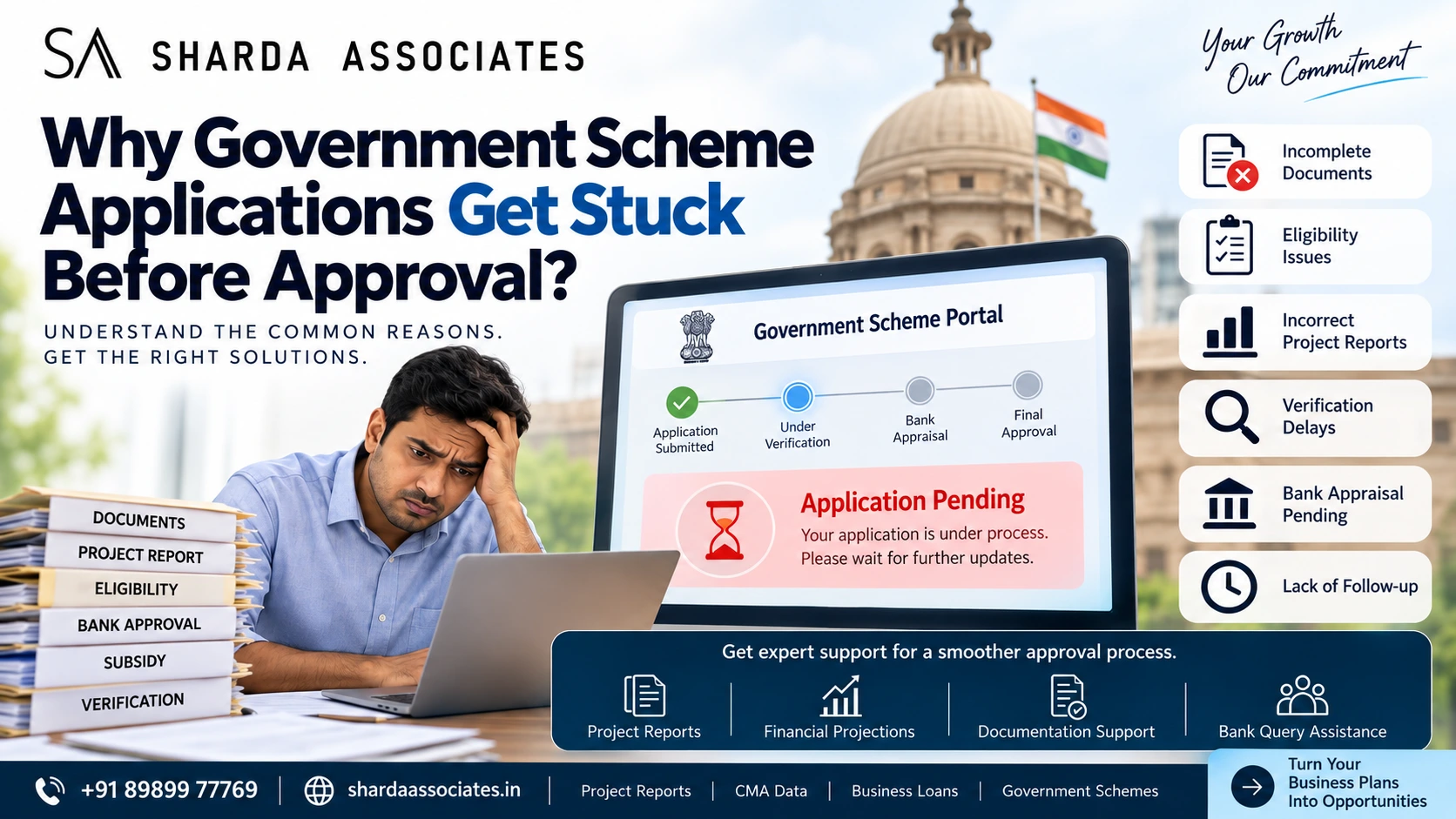
How to Find Out Why Your Government Scheme Application Is Stuck
Follow this sequence:
Step 1 — Check the current application status
Identify whether the application is with the department, implementing agency or bank.
Step 2 — Check portal notifications
Look for any query, deficiency or additional-document request.
Step 3 — Recheck eligibility
Confirm that the business and applicant satisfy the latest scheme conditions.
Step 4 — Review all documents together
Check names, addresses, project cost, loan amount and business activity.
Step 5 — Reconcile the project report
The DPR, quotations, application and financing requirement should use consistent figures.
Step 6 — Identify the exact bank query
If the lender has raised a question, respond specifically to that question.
Step 7 — Correct genuine errors
Do not manipulate documents merely to satisfy a scheme requirement.
Step 8 — Follow up with the appropriate authority
Contact the organisation currently responsible for the pending stage.
Avoid These Mistakes When Your Application Is Delayed
Do not immediately submit another application simply because the first one is pending.
Avoid:
- Filing duplicate applications unnecessarily
- Changing financial figures without justification
- Creating false quotations
- Inflating project costs
- Showing unrealistic sales
- Submitting inconsistent documents
- Ignoring bank queries
- Assuming subsidy approval equals loan approval
- Paying unofficial agents promising guaranteed sanction
- Using outdated scheme conditions
For schemes involving CGTMSE, applicants should also understand that CGTMSE itself does not directly grant business loans or subsidies. Eligible businesses approach lending institutions, while the guarantee mechanism operates through eligible member lending institutions.
How Sharda Associates Helps With Government Scheme Applications
A large number of avoidable application problems arise because the . financial projections, quotations, project cost and loan requirement have been prepared separately and do not reconcile with each other.
Sharda Associates provides CA-led financial and project documentation support for entrepreneurs applying for business loans, subsidies and eligible government schemes.
Depending upon the scheme and project, Sharda Associates can assist with:
1. Scheme Eligibility Review
We help examine the proposed business, applicant profile, project size and financing requirement against the applicable scheme conditions before financial documentation is prepared.
2. Detailed Project Report (DPR)
A professionally prepared project report may include:
- Business profile
- Industry overview
- Project cost
- Means of finance
- Plant and machinery
- Working capital
- Sales assumptions
- Profitability
- Cash flow
- Break-even analysis
- DSCR
- Repayment assumptions
3. Project Cost Verification
We help ensure that machinery quotations, working-capital requirements, project cost and proposed funding structure tell the same financial story.
4. Financial Projections
Our CA-led team prepares realistic projected:
- Profit & Loss Statements
- Balance Sheets
- Cash Flow Statements
- Working Capital Calculations
- Break-Even Analysis
- DSCR
- Repayment schedules
5. CMA Data
Where required by the bank, Sharda Associates can assist in preparing CMA data for credit appraisal and working-capital assessment.
6. Documentation Consistency Review
We can identify inconsistencies between the application, DPR, quotations, financial statements and loan requirement before submission.
7. Bank Query Support
Where the lender raises a financial or project-report-related query, our team can help examine the figures and prepare appropriate supporting explanations or revisions.
8. Existing Pending Application Review
If your application is already stuck, we can review the financial and project-documentation side to identify whether inconsistent project costs, projections, funding structure or documentation may be contributing to the query.
Important: Sharda Associates does not guarantee government approval, subsidy release or bank sanction. Final decisions remain with the relevant government authority, implementing agency or lending institution.
For project report and government scheme documentation assistance, call or WhatsApp Sharda Associates at +91 89899 77769.
Frequently Asked Questions
1. Why is my government scheme application still pending?
An application may remain pending because document verification, eligibility screening, bank appraisal, physical verification or clarification is incomplete. Check the portal status and determine which authority currently holds the application.
2. Does a pending government scheme application mean rejection?
No. A pending status generally means that some stage of processing has not yet been completed. A rejected application normally has a separate status or decision.
3. Can incorrect documents delay government scheme approval?
Yes. Missing documents, outdated certificates, unreadable copies and mismatched names, addresses or financial figures can lead to additional verification and delay.
4. Can an incorrect project report cause my application to get stuck?
Yes. If the DPR contains inconsistent project costs, unrealistic projections or figures that do not match the application and quotations, the bank or authority may request clarification.
5. Why is my scheme application pending with the bank?
The lender may still be assessing project viability, credit history, promoter contribution, financial projections, documents or repayment capacity. Government-scheme eligibility does not automatically result in loan sanction.
6. Can I submit another application if my first government scheme application is pending?
You should first identify why the existing application is pending. Submitting a duplicate application may not resolve the original issue and may create additional complications.
7. How can I check which government scheme is suitable for my business?
You can review scheme-specific eligibility, benefits, documents and application procedures through official portals such as myScheme and the website of the relevant implementing authority.
8. Does a good project report guarantee government scheme approval?
No. A good project report can help present the project’s cost, viability, funding and repayment assumptions clearly, but approval depends on the scheme authority and, where applicable, the lender.
9. How long does government scheme approval take?
There is no single processing period for all government schemes. Timelines depend on the scheme, authority, completeness of documentation, verification requirements and, for credit-linked schemes, the lender’s appraisal process.
10. How can Sharda Associates help if my government scheme application is stuck?
Sharda Associates can review the project’s financial documentation and assist with DPR preparation, project-cost analysis, financial projections, CMA data, cash-flow analysis, DSCR, documentation consistency and responses to finance-related bank queries. The objective is to remove avoidable financial and documentation problems; final approval remains with the government authority or lender.