
A GST-based business loan is built around one simple idea: if your business files GST returns regularly, that data alone can tell a lender most of what it needs to know about your turnover and repayment capacity — without demanding years of audited financials first. Since GST returns are standardised, digitally verifiable, and hard to inflate, banks and NBFCs increasingly treat them as a faster, more reliable underwriting input than traditional paperwork. At Sharda Associates, we regularly help GST-registered businesses put together financial documentation that actually strengthens a lender’s confidence in this data, so this guide walks through exactly who qualifies for a GST-based loan, what documents you’ll need, how much you can realistically borrow, and the step-by-step process to apply.
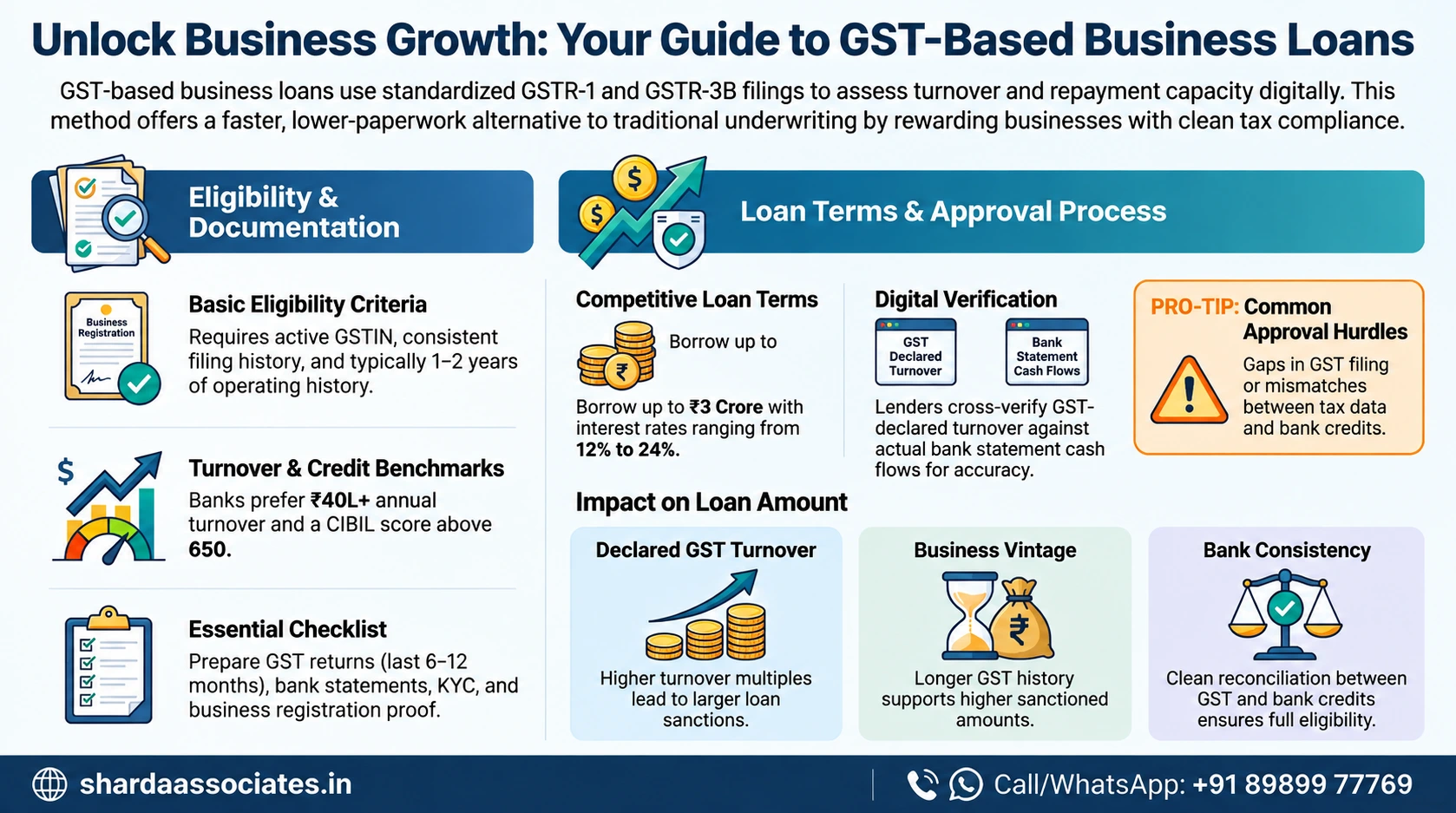
Who Is Eligible for a GST-Based Business Loan?
Eligibility criteria differ by lender, but most GST-based loan products look for:
- Valid, active GST registration with a GSTIN — this is the baseline requirement across virtually every lender.
- Regular and consistent GST return filing — GSTR-1 and GSTR-3B filed on time, without long gaps.
- Business structure — sole proprietorships, partnership firms, LLPs, and private/public limited companies engaged in trading, manufacturing, or services are all generally eligible.
- Minimum annual turnover — most banks set this between ₹40 lakh and ₹1 crore, though NBFCs and fintech lenders are often more flexible, sometimes starting from businesses with turnover above ₹10 lakh.
- Business vintage — typically at least 1–2 years of GST-registered operating history, though this varies by lender.
- Credit score — a CIBIL score of 650–700 or above is commonly preferred, with better scores unlocking lower interest rates.
Documents Required for a GST-Based Business Loan
| Document | Purpose |
| GST registration certificate & GSTIN | Confirms active GST status |
| GST returns (GSTR-1, GSTR-3B — last 6–12 months) | Primary basis for turnover assessment |
| KYC documents (Aadhaar, PAN) | Identity verification |
| Business registration proof (Udyam, incorporation certificate, partnership deed) | Confirms the business is legally registered |
| Bank statements (last 6–12 months) | Cross-verifies GST-declared turnover against actual cash flow |
| ITR (where available) | Additional income verification, though not always mandatory |
| Photographs and duly filled application form | Standard application requirement |
Exact documentation can vary based on the loan amount and whether the facility is secured or unsecured, so it’s worth confirming the specific checklist with your chosen lender before applying.
How Much Loan Amount Can You Get?
GST-based business loans in India typically range from around ₹1 lakh at the lower end to ₹3 crore at the upper end, depending on the lender, though the amount actually offered to you depends on your specific business profile. Here’s how it’s generally sized:
| Factor | How It Affects the Loan Amount |
| Declared GST turnover | Lenders apply a multiple or percentage of your average monthly/annual turnover to arrive at an eligible amount |
| Business vintage | Longer, more consistent GST history generally supports a higher sanctioned amount |
| Credit score | A stronger score often supports both a higher amount and a better interest rate |
| Existing debt obligations | High existing EMIs reduce your assessed additional borrowing capacity |
| Secured vs. unsecured | Unsecured GST loans are typically capped lower; offering collateral can support a larger amount |
| Bank statement consistency | Turnover that reconciles cleanly with bank credits supports the full eligible amount; mismatches often lead to a reduced offer |
Interest rates on GST-based business loans commonly range from around 12% to 24% per annum, with tenures typically extending up to 36 months for term-loan structures, though this varies by lender and loan type.
Step-by-Step Application Process
- Ensure your GST filings are current. File any pending GSTR-1/GSTR-3B returns before applying — gaps in filing history directly reduce your eligibility.
- Check your eligibility online. Most banks and NBFCs offer a quick GSTIN-based eligibility check before you commit to a full application.
- Compare lenders. Banks generally offer lower interest rates with more documentation; NBFCs and fintech lenders often process faster with lighter paperwork — match this to how quickly you need funds.
- Gather your documents. KYC, GST returns, business registration proof, and recent bank statements, as listed above.
- Submit the application. This can typically be done online through the lender’s portal/app or offline at a branch.
- Go through verification. The lender cross-checks your GST-declared turnover against your bank statement activity and may ask for clarification on any discrepancy.
- Review the sanction letter. Check the loan amount, interest rate, tenure, processing fee, and any prepayment charges carefully before accepting.
- Receive disbursement. Funds are typically credited directly to your business account, often faster than a traditional term loan given the lighter documentation process.
What Can Reduce Your Approved Amount or Delay the Process
- Inconsistent or gapped GST return filing history.
- A mismatch between GST-declared turnover and actual bank statement credits.
- Existing high-value EMIs or credit card dues that reduce assessed repayment capacity.
- Irregular banking activity, including frequent cheque bounces.
- A business vintage shorter than the lender’s minimum requirement.
Conclusion
A GST-based business loan rewards businesses that have kept their tax compliance clean and consistent, turning routine GST filing into a genuinely faster route to working capital.
If your GST-declared turnover, bank statements and overall financial documentation need reconciling before you approach a lender — or you want your file to look as strong as possible on paper before a credit officer sees it — you can get your business financials and project report reviewed by Sharda Associates before you apply.
Call or WhatsApp our CA team at +91 89899 77769 and send us what you have, and we’ll tell you plainly what needs to change before you put the application back in.
Frequently Asked Questions
1. Is GST registration compulsory to get this type of loan?
Yes — an active GSTIN and a reasonable filing history are the foundation of how these loans are assessed.
2. What is the minimum turnover required?
Most banks look for ₹40 lakh to ₹1 crore in annual turnover, though NBFCs and fintech lenders are often more flexible and may consider smaller businesses.
3. What is the maximum amount I can borrow under a GST-based loan?
Loan amounts commonly range up to ₹3 crore depending on the lender, though your actual eligible amount depends on your turnover, credit profile and existing obligations.
4. Do I need collateral for a GST-based business loan?
Not necessarily — many GST-based loans are unsecured, though offering collateral can support a larger loan amount or better terms.
5. How is the loan amount actually calculated from my GST data?
Lenders typically apply a multiple or percentage to your average monthly or annual turnover as shown in recent GST returns, then adjust based on bank statement verification and existing debt.
6. How long does approval typically take?
GST-based loans are generally faster to process than traditional term loans since GST data is standardised and easier to verify quickly, though exact timelines vary by lender.
7. Can a business with irregular GST filings still qualify?
It’s harder — irregular or gapped filings reduce lender confidence in your turnover data, so improving filing consistency first is advisable.
8. Is my personal credit score still relevant if my GST data is strong?
Yes — most lenders continue to weigh your CIBIL score alongside GST data, particularly for determining the interest rate offered.
9. Can I use the loan for any business purpose?
Typically yes — funds are generally usable for working capital, inventory, expansion or equipment, subject to the specific lender’s terms.
10. What if my GST-declared turnover doesn’t match my bank statements?
This is one of the most common reasons for a reduced sanction or delay, so reconciling both figures before applying is strongly advisable — and where a professional review of your financials can help.