
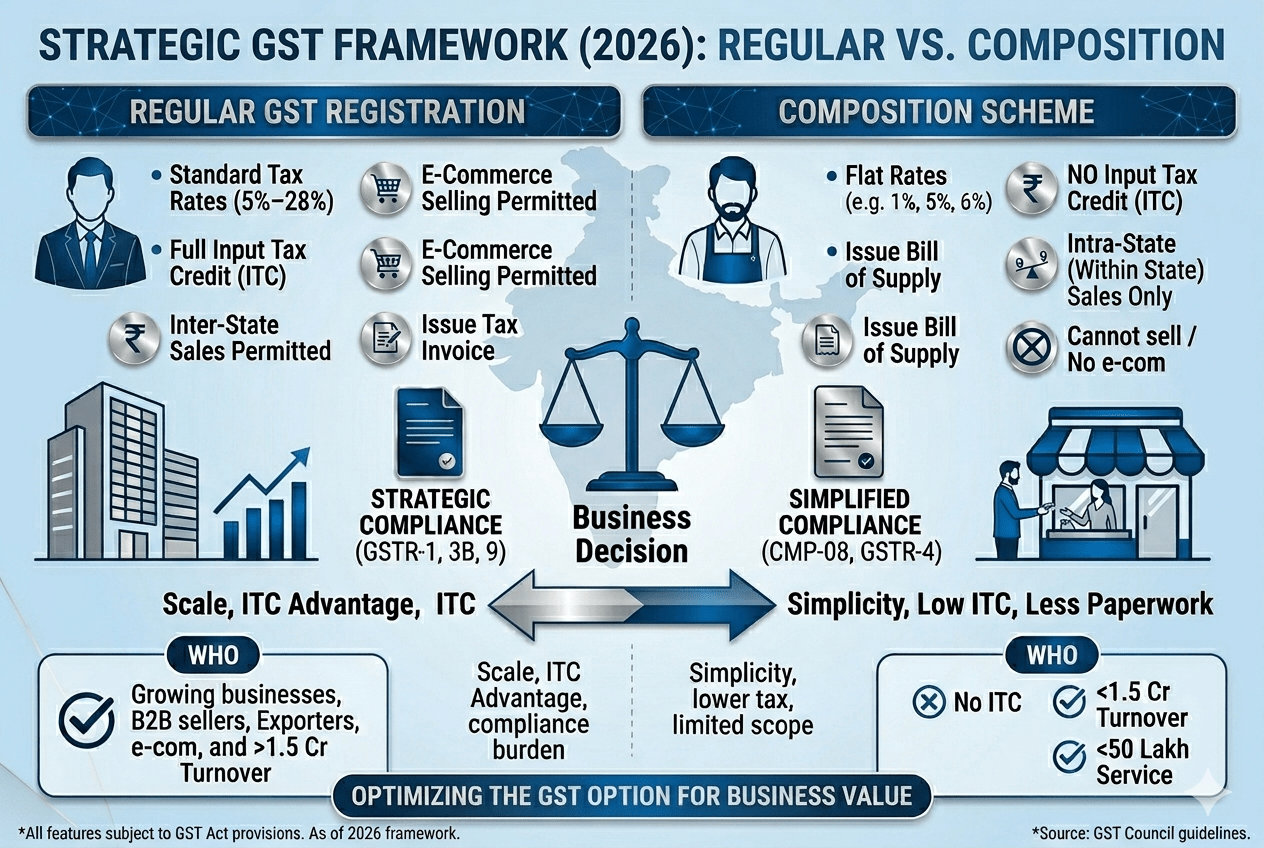
Under GST, businesses can choose between the Regular Registration scheme and the Composition Scheme based on their turnover and compliance needs. The Regular Scheme allows businesses to claim input tax credit (ITC), issue GST invoices, and operate without turnover restrictions, but requires detailed return filing. In contrast, the Composition Scheme is designed for small taxpayers, offering lower tax rates and simplified compliance, but restricts ITC claims and interstate sales. While the Regular Scheme suits growing businesses, the Composition Scheme is ideal for small traders seeking minimal compliance. Sharda Associates helps businesses choose the right GST structure based on their growth and compliance requirements.
GST Act Compliant
When a business crosses the GST threshold, one of its first and most consequential decisions is choosing between Regular GST Registration and the Composition Scheme. Both have distinct rules, tax rates, compliance burdens, and strategic advantages. Picking the wrong one can mean higher taxes, missed ITC, or unnecessary paperwork. This guide breaks it all down—clearly, honestly, and without jargon.
IN THIS ARTICLE
1. The Fundamentals: What Each Scheme Is
2. Eligibility & Threshold Limits
3. Head-to-Head Comparison Table
4. Pros & Cons of Each Scheme
5. The ITC Advantage — A Game Changer
6. Compliance & Return Filing Burden
7. The Verdict: Which Is Better for You?
1. The Fundamentals
Before comparing, it’s important to understand what each option actually means for your business operations and tax liability.
OPTION A
Regular GST Registration
Standard registration under the GST Act. You collect GST from customers, pay GST on inputs, and claim Input Tax Credit (ITC) on your purchases. Tax is charged at standard rates (5%, 12%, 18%, 28%).
OPTION B
Composition Scheme
A simplified tax scheme for small businesses. You pay a flat, lower tax rate on your turnover — but you cannot collect GST from customers or claim ITC. Designed to reduce compliance burden.
2. Eligibility & Threshold Limits
Not every business can opt for the Composition Scheme. Here are the key eligibility criteria and thresholds as per the current GST framework:
Composition Scheme — Who Can Apply?
A registered taxpayer can opt for the Composition Scheme if they meet ALL of the following:
- Annual aggregate turnover does not exceed Rs 1.5 Crore (Rs 75 Lakh for special category states like NE states & Uttarakhand)
- Business is a manufacturer, trader, or restaurant (not a service provider, with exceptions for Section 10(2A) — small service providers up to Rs 50 Lakh)
- Does not supply goods through an e-commerce operator who is required to collect TCS
- Does not supply non-taxable goods under GST (e.g., alcohol, petroleum)
- Does not make inter-state outward supplies
Regular GST Registration, by contrast, is mandatory for any business whose aggregate turnover exceeds Rs 40 Lakh (Rs 20 Lakh for services; Rs 10 Lakh for special category states). There is no upper limit — it applies to businesses of any size.
3. Head-to-Head Comparison
The table below gives you a comprehensive, parameter-by-parameter breakdown of both schemes:
| PARAMETER | Regular GST | Composition Scheme |
| Turnover Limit | No upper limit | Up to Rs 1.5 Cr (goods); Rs 50 L (services) |
| Tax Rate | Standard rates: 5%, 12%, 18%, 28% | 1% (traders), 2% (manufacturers), 5% (restaurants), 6% (services) |
| Input Tax Credit (ITC) | Allowed | Not Allowed |
| Inter-State Supply | Permitted | Not Permitted |
| E-Commerce Sales | Permitted | Not Permitted |
| GST Charged to Customer | Yes — collected from buyer | No — borne by taxpayer |
| Returns to File | GSTR-1, GSTR-3B (monthly/quarterly) + Annual GSTR-9 | CMP-08 (quarterly) + GSTR-4 (annual) |
| Issue of Tax Invoice | Full Tax Invoice | Bill of Supply only |
| Reverse Charge Mechanism | Applicable | Applicable (must pay from own pocket) |
| Compliance Burden | High — multiple returns, reconciliation | Low — simplified quarterly filing |
| Suitable For | All businesses, especially B2B exporters | Small B2C local businesses |
| Penalty for Non-Compliance | Higher — complex reconciliation risk | Lower — simpler to comply with |
4. Pros & Cons of Each Scheme
Regular GST Registration
Advantages
- Complete Input Tax Credit for Expenses and Purchases
- Can supply across state borders freely
- Able to sell on e-commerce sites like Amazon and Flipkart
- Registered buyers prefer GST invoices for their own ITC
- No turnover cap—scale without switching
- Export benefits: LUT, IGST refund, zero-rated supply
Disadvantages
- Higher compliance burden — multiple monthly returns
- Reconciliation of GSTR-1, 2A, 2B, 3B required
- GST audit risk and notice exposure is higher
- Working capital tied up until ITC is credited
- Prices appear higher to end-consumers (tax added)
Composition Scheme
Advantages
- Very low effective tax rate (as low as 1% on turnover)
- Minimal compliance — only 4 returns/year
- No need to maintain detailed invoice-wise records
- Cash-friendly for small, local, B2C traders
- Lower chance of scrutiny or audit notices
Disadvantages
- No Input Tax Credit — GST on purchases is a sunk cost
- Cannot supply outside the state
- Cannot sell through e-commerce operators
- B2B customers cannot claim ITC — lose business from GST buyers
- Cannot issue a tax invoice — perceived as less credible
- Strict turnover ceiling — must exit if crossed
5. The ITC Advantage — A Game Changer
“The right to Input Tax Credit is more than simply a tax benefit; it is a critical price advantage in the B2B ecosystem.”
— GST Council Circular, 2017
Input Tax Credit (ITC) permits firms based on Regular GST to credit the GST paid on purchases against the GST received on sales. This basically implies that you only pay GST on the value you add, not your whole revenue.
Example: A manufacturer buys raw materials for Rs 10,00,000 and pays Rs 1,80,000 in GST (18%). Under regular GST, this Rs 1,80,000 can be deducted from the GST collected on final items sold. Under the Composition Scheme, Rs 1,80,000 becomes a dead cost, severely reducing profit margins for input-intensive enterprises.
ITC Break-Even Analysis
ITC matters most when your input expenditures are high relative to your output value. Here’s a simple rule of thumb:
- If your inputs are heavily taxed (e.g., manufacturing, construction) — Regular GST is almost certainly better
- If your inputs are minimal or untaxed (e.g., pure services, food, small retail) — Composition’s flat rate may be more cost-effective
- If you primarily serve B2B clients — Regular GST is essential, as your buyers need your ITC
- If you primarily serve end-consumers (B2C) locally — Composition may keep prices competitive
6. Compliance & Return Filing Burden
Compliance is often the deciding factor for small business owners who lack dedicated accounting staff. Here is how the two schemes compare on the paperwork front:
REGULAR GST — RETURNS REQUIRED
Monthly / Quarterly
• GSTR-1: Monthly (or quarterly under QRMP)
• GSTR-3B: Monthly tax payment & summary
• GSTR-9: Annual return
• GSTR-9C: Audit/reconciliation (if T/O > Rs 5 Cr)
Total: 13-26+ filings per year
COMPOSITION SCHEME — RETURNS REQUIRED
Quarterly / Annual
• CMP-08: Quarterly challan-cum-statement
• GSTR-4: Annual return only
Total: 5 filings per year
The difference in compliance burden is dramatic. For a small kirana store or local manufacturer, filing 5 returns a year versus 26 is a significant operational advantage — and directly translates to lower accounting costs
7. The Verdict: Which Is Better for You?
There is no universal answer — the “better” scheme depends entirely on your business profile. Here is a structured decision framework:
Choose Regular GST if…
You Need Full GST Capability
▸ Turnover exceeds or will exceed Rs 1.5 Crore
▸ You supply goods or services across states
▸ Your clients are businesses that claim ITC
▸ You sell on Amazon, Flipkart or other e-com platforms
▸ You have significant taxable input costs (manufacturing, construction)
▸ You export goods or services
▸ You want to build a scalable, growing enterprise
Choose a Composition Scheme if…
You Want Simplicity & Low Tax
▸ Turnover is below Rs 1.5 Crore (goods) or Rs 50 Lakh (services)
▸ You sell primarily to end consumers (B2C), not businesses
▸ Operations are local / within one state
▸ You have low input costs — minimal ITC advantage
▸ You want minimal accounting overhead
▸ You run a restaurant, small shop, or local service
▸ You want to reduce tax notice and litigation risk
OUR ANALYSIS
Neither Scheme is Universally Superior
Regular GST wins on flexibility, ITC benefits, and scalability. Composition Scheme wins on simplicity, lower compliance cost, and predictable flat-rate taxation.
For most growing businesses with B2B clients or inter-state operations, Regular GST is the strategic long-term choice. For local, B2C small businesses wanting to minimize paperwork and overheads, the Composition Scheme is a pragmatic and legally advantageous option.
Frequently Asked Questions.
1. What is the Composition Scheme’s maximum turnover limit?
For manufacturers and traders, the limit is Rs 1.5 crore (Rs 75 lakh in Uttarakhand and the Northeastern states). According to the specific announcement for services, the cap for service providers is Rs 50 lakh.
2. What is the restriction on “Input Tax Credit” (ITC)?
The ability to deduct tax paid on purchases from tax received on sales is referred to as ITC. You are not eligible for this credit under the Composition Scheme; any GST you pay to your suppliers becomes a direct expense for your company.
3. What kind of invoice is required from a composition dealer?
It is not possible to issue a “Tax Invoice.” A “Bill of Supply,” which informs the customer that you are a composition taxable person and are not collecting any GST from them, must be issued.
4. What happens if the turnover of a composition dealer is above the Rs 1.5 crore threshold in the middle of the year?
The firm loses eligibility for the program the day the cap is exceeded. To leave the plan, you must submit an intimation and begin adhering to regular GST regulations (issue tax invoices and collecting ITC) right away.
5. What is the main advantage of selecting Regular GST in spite of the paperwork?
Scalability is the principal advantage. You may post your goods on international e-commerce platforms, sell to anyone in India, and draw in big business clients that need ITC to keep their own expenses down.
6. Is it possible for me to convert from the Composition Scheme to Regular GST at any point?
Yes. You have to migrate to regular GST if your turnover is above the threshold ($1.5 crore for goods or $50 lakh for services). If you want to begin interstate sales or submit an ITC claim, you can also choose to voluntarily opt out at any point throughout the year. However, returning to composition from the regular is often only permitted at the start of a new fiscal year.
7. Does “No Input Tax Credit” imply that I don’t have to pay GST on my purchases?
No. When you purchase products or services, you continue to pay your suppliers the regular GST rates (5%, 12%, 18%, etc.). Because of the “No ITC” provision, you are unable to deduct that tax from your personal tax obligation; instead, it becomes a corporate expenditure rather than a credit.
8. If I have a Composition Registration, may I sell to a consumer from another state?
No. One of the fundamental limitations of the Composition Scheme is the inability to make interstate outbound shipments. Your sales must be confined to the state where you are registered. However, you may purchase things from other states.
9. Do I have to provide a correct Tax Invoice under the Composition Scheme?
No, composition dealers cannot issue a “Tax Invoice” since they do not collect GST from their clients. Instead, they must provide a “Bill of Supply” that clearly states: “Composition taxable person, not eligible to collect tax on supplies.”
10. What happens to GST paid on purchases (Inputs) under the Composition Scheme?
The GST paid on purchases is considered an “irrecoverable cost.” Unlike the Regular Scheme, where you receive an ITC to offset your tax bill, a Composition dealer must absorb the tax as a business expenditure, which can impair overall profitability.