
GST mistakes rarely announce themselves. A missed registration, an ITC claim that does not match GSTR-2B or an unpaid reverse charge can sit quietly for months, then arrive as a notice with tax, 18% interest and a penalty. For a startup with thin cash, one such notice can eat the runway. The seven GST Traps below are the ones founders most often fall into, with simple ways to avoid each.
At Sharda Associates, our Chartered Accountants (CA) help startups avoid these traps through GST registration, monthly reconciliation and return filing, and also prepare CA-certified project reports for bank loans and funding. A project report built on correct GST treatment, with the right tax in costs and sales and realistic credit, gives lenders numbers that hold up.
Banks and investors also compare your GST returns with your financial statements. If the two disagree, funding slows down. If you plan to raise money soon, ask a CA to review your GST position before you submit your project report or share your data room.
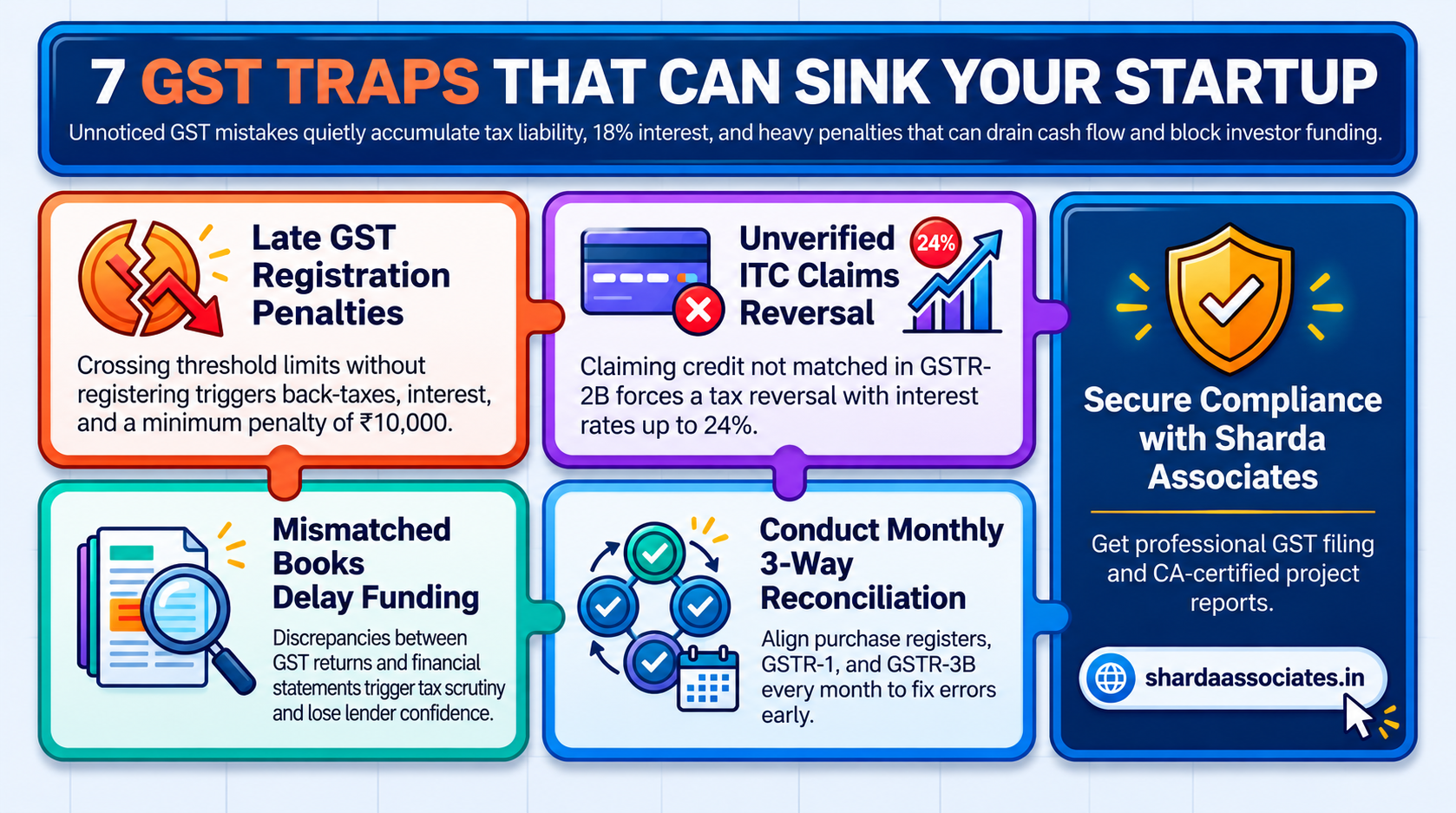
Trap 1: Crossing the Limit Without Registering
What happens: Registration is mandatory once turnover crosses ₹20 lakh for services or ₹40 lakh for goods (lower in special category states), and in some cases at any turnover, such as inter-state supply of goods or most e-commerce selling. If you miss it, you owe the tax from the date you became liable, plus interest, and a penalty of up to 10% of the tax due, with a minimum of ₹10,000.
How to avoid it:
- Track aggregate turnover every month across all your businesses under the same PAN.
- Apply within 30 days of becoming liable.
- Check whether your supply type needs registration regardless of turnover.
Trap 2: Claiming ITC You Are Not Entitled To
What happens: ITC claimed without the supplier’s invoice in GSTR-2B, or on blocked items such as personal expenses, gets reversed with interest at 18% a year, and 24% on excess claims in some cases.
How to avoid it:
- Match your purchase register with GSTR-2B before every GSTR-3B.
- Do not claim credit on personal or blocked items.
- Keep invoices and payment proofs for each claim.
Trap 3: Forgetting Reverse Charge on Foreign and Notified Services
What happens: Cloud, software and advertising bills from foreign vendors attract GST under reverse charge. Some domestic services, such as certain legal services and goods transport, do too. If you do not pay it, you owe the tax with interest, and your ITC on it is also at risk.
How to avoid it:
- List all foreign vendors and notified services at month’s end.
- Pay the tax in cash through GSTR-3B, then claim ITC if you are eligible.
- Keep a self-invoice and payment record for each case.
Trap 4: Treating Exports as Tax-Free Without the Conditions
What happens: Export of services is zero-rated only if conditions are met, including payment in convertible foreign exchange. Without a valid LUT, you must pay IGST first and claim a refund later, which blocks your cash.
How to avoid it:
- File an LUT every financial year before your first export invoice.
- Keep bank realisation certificates for every payment received.
- Confirm the place of supply is outside India.
Trap 5: Ignoring Tax on Advances
What happens: For services, GST is payable when you receive the advance, not when you deliver. Many startups only account for it at the final invoice and are short on tax in the earlier month.
How to avoid it:
- Issue a receipt voucher for every advance for services.
- Report the advance in GSTR-1 and pay tax in GSTR-3B of that month.
- Adjust it against the final invoice.
Trap 6: Filing Returns Late or Skipping Them
What happens: Late returns attract a daily late fee and interest at 18% a year on unpaid tax. Missed returns can also block e-way bill generation, hold up your ITC and, if returns stay unfiled for long, lead to cancellation of your registration.
How to avoid it:
- Set calendar reminders before each due date.
- File nil returns when there are no sales.
- Consider the quarterly QRMP scheme if you are eligible.
Trap 7: Letting GST Returns and Books Drift Apart
What happens: If sales in GSTR-1 and GSTR-3B do not match your books or your income tax return, the department can issue a scrutiny notice, and lenders or investors lose confidence in your numbers.
How to avoid it:
- Reconcile books, GSTR-1 and GSTR-3B every month.
- Correct errors in the next return and pay any short tax with interest.
- Tie GST turnover with the financial statements before the annual return and ITR.
The Seven Traps at a Glance
| Trap | Likely cost | Quick fix |
| Not registering on time | Tax, interest and penalty (minimum ₹10,000) | Track turnover monthly, apply within 30 days |
| Wrong ITC claim | Reversal and interest at 18% to 24% | Match with GSTR-2B before claiming |
| Missed reverse charge | Tax and interest | Monthly list of foreign and notified services |
| Export without LUT or realisation proof | IGST blocked or payable | File LUT yearly, keep bank proofs |
| Tax on advances ignored | Short tax and interest | Receipt voucher for every service advance |
| Late or missed returns | Late fee, interest, blocked e-way bills | Reminders, nil returns, QRMP if eligible |
| Books and returns mismatch | Notices, delayed funding | Monthly three-way reconciliation |
A Simple Monthly GST Routine
- Compare sales in books, GSTR-1 and GSTR-3B.
- Match purchases with GSTR-2B before claiming ITC.
- List reverse charge items and pay the tax.
- Check advances received and receipt vouchers issued.
- File returns before the due date.
- Save a one-page reconciliation for your records.
Conclusion
GST traps are rarely dramatic. They are small gaps in registration, credit claims, reverse charge, exports, advances and filing that add up to a large bill. Each one can be avoided with a monthly routine and a regular check from a CA.
Use the table above as a monthly checklist, and fix any gap the moment you find it. For GST registration, compliance, notice replies and CA-certified project reports for loans and investors, call Sharda Associates on +91-8989977769.
Frequently Asked Questions
Q1. What is the most common GST mistake for startups?
Claiming ITC that does not appear in GSTR-2B, closely followed by late filing.
Q2. What is the penalty for not registering for GST?
Generally 10% of the tax due, subject to a minimum of ₹10,000, along with tax and interest.
Q3. Do I pay GST on foreign software subscriptions?
Yes, under reverse charge, and you can usually claim it as ITC.
Q4. What is an LUT? A
Letter of Undertaking that lets you export without paying IGST, filed every financial year.
Q5. Is GST payable on advances?
Yes for services, when received. Not for goods.
Q6. What happens if I miss GST returns?
Late fee, interest, blocked ITC and e-way bills, and eventually possible cancellation of registration.
Q7. How can I reduce the risk of a GST notice?
Reconcile monthly, file on time and keep invoices and proofs ready.
Q8. Can a CA help with my startup’s GST?
Yes, with registration, reconciliation, filing, notices and project reports for funding.