
Understanding the difference between GSTR-1 and GSTR-3B is essential for accurate GST return filing and monthly GST compliance. Sharda Associates provides professional GST consultancy in Bhopal, helping traders, manufacturers, startups and service providers with GST registration, return filing, ITC reconciliation, and GST notice assistance.
GSTR-1 and GSTR-3B serve different purposes under GST. GSTR-1 reports outward supplies and sales invoices, whereas GSTR-3B summarises tax liability and eligible Input Tax Credit (ITC). Errors or mismatches between these returns can lead to GST notices, additional tax liabilities and filing complications.
This guide explains the key differences between GSTR-1 and GSTR-3B, their filing process, due dates and common mistakes businesses should avoid to maintain accurate GST records.
This guide explains the differences, due dates, late fees and the common mistakes.
Quick Answer: GSTR-1 reports your outward supplies (sales) invoice by invoice, and no tax is paid when you file it. GSTR-3B is a summary return in which you claim input tax credit and pay the net GST. For monthly filers, GSTR-1 is due on the 11th and GSTR-3B on the 20th of the next month. QRMP filers (turnover up to ₹5 crore) file GSTR-1 by the 13th after the quarter and GSTR-3B by the 22nd or 24th. Late fee is ₹50 per day (₹20 for nil returns) and interest is 18% a year on unpaid tax.
GSTR-1 vs GSTR-3B at a glance
| Point | GSTR-1 | GSTR-3B |
| Purpose | Details of sales | Summary of sales, ITC and tax payment |
| Detail level | Invoice-wise | Consolidated |
| Tax payment | No | Yes |
| ITC claim | No | Yes |
| Monthly due date | 11th | 20th |
| QRMP due date | 13th (quarterly) | 22nd or 24th (quarterly) |
| Who must file | All regular taxpayers | All regular taxpayers |
You must file both returns every period, even when there is no activity, as nil returns. If you are new to GST, start with our GST registration and services page.
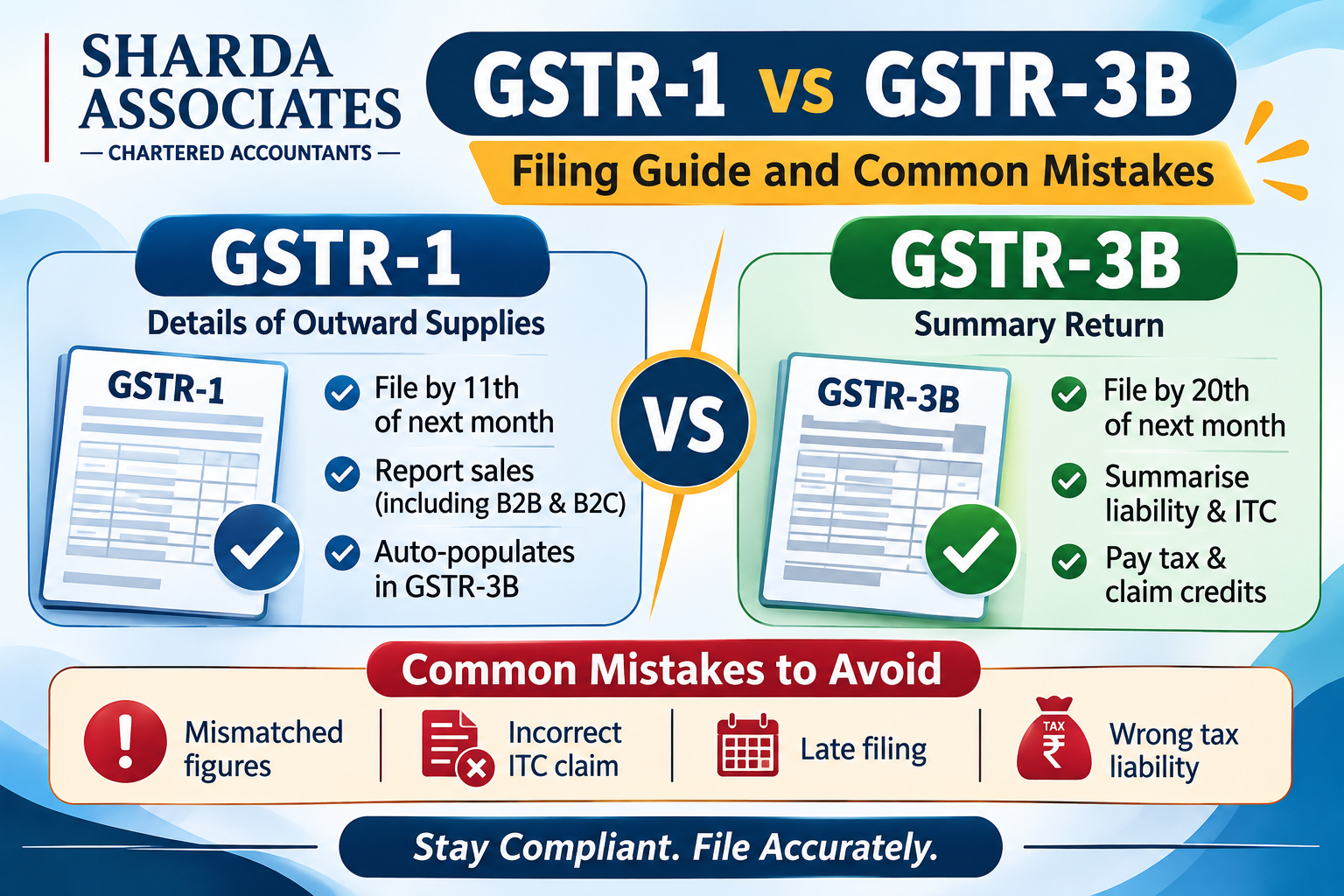
What does GSTR-1 contain?
It includes all your B2B and B2C sales, exports, credit and debit notes and advances received. Your buyers’ GSTR-2B is built from your GSTR-1, so a missing invoice here means your customer does not get credit. That is why buyers keep asking suppliers to “file the return”.
What does GSTR-3B contain?
It shows your total outward tax, the ITC you claim, reverse charge liability, and the net tax you pay in cash. Since the July 2025 tax period, the outward liability in GSTR-3B is filled automatically from GSTR-1, GSTR-1A or IFF and cannot be edited. In effect, “the number in GSTR-1 is the number in GSTR-3B”.
Filing sequence
- Finish your sales entries and file GSTR-1 by the 11th.
- Wait for GSTR-2B on the 14th, which shows the ITC available to you.
- Match your purchase books with GSTR-2B.
- File GSTR-3B by the 20th and pay the tax.
Good billing helps a lot here. See our guides on free GST billing software and GST billing software for retail shops.
Due dates and late fee
| Item | Rule |
| Late fee, normal return | ₹50 per day (₹25 CGST + ₹25 SGST), capped at ₹10,000 per return |
| Late fee, nil return | ₹20 per day |
| Interest on unpaid tax | 18% per year, from the original due date |
| Return time limit | Returns for periods from July 2025 cannot be filed after 3 years from the due date |
Lower late-fee caps apply to smaller taxpayers, so check the current notification for your turnover band.
Mismatch notices: DRC-01B and DRC-01C
If the tax in GSTR-1 is higher than the tax paid in GSTR-3B, the portal can issue Form DRC-01B under Rule 88C. You have 7 days to pay the difference with interest or explain it. If you ignore it, your next GSTR-1 can be blocked. If you claim ITC above what GSTR-2B shows, DRC-01C under Rule 88D follows, with the same time limit.
Common mistakes behind mismatches
- Entering the right figure in the wrong table of GSTR-3B.
- Missing or duplicated invoices between the two returns.
- Wrong tax head, such as IGST entered as CGST and SGST.
- Not carrying GSTR-1 amendments into the next return.
- Filing GSTR-3B before GSTR-2B is available.
- Ignoring a notice for more than 7 days.
- Typing figures manually from the billing system.
How to avoid them
- Use one billing system and export data to both returns.
- Reconcile sales and ITC monthly, not at year end. Our accounting and bookkeeping service does this for you.
- Use GSTR-1A to correct the same period’s GSTR-1 before you file GSTR-3B.
- Keep your records tidy. Read how to organise billing and payment records.
- Pair it with TDS and income tax planning through our taxation team.
Conclusion
GSTR-1 and GSTR-3B are closely connected GST returns. While GSTR-1 reports your outward supplies, GSTR-3B summarises your tax liability and eligible Input Tax Credit (ITC). Differences between these returns can trigger GST notices, additional tax demands and compliance issues.
Businesses should reconcile sales invoices, taxable turnover and tax liability every month before filing returns. Filing GSTR-1 and GSTR-3B accurately and responding to GST portal notices within the prescribed deadlines can help avoid late fees, interest and unnecessary complications.
Need professional assistance with GST return filing, GSTR-1 and GSTR-3B reconciliation, or GST compliance? Contact Sharda Associates at +91 79870 21896 or +91 89899 77769, or contact our GST consultancy team for expert guidance.
Frequently asked questions
1. What is the main difference between GSTR-1 and GSTR-3B?
GSTR-1 is the invoice-wise sales return with no payment. GSTR-3B is the summary return where you claim ITC and pay tax.
2. Which should I file first?
GSTR-1 first, then GSTR-3B. Since the outward liability is auto-filled in GSTR-3B, filing GSTR-1 first is essential.
3. What are the due dates?
Monthly filers: GSTR-1 by the 11th and GSTR-3B by the 20th. QRMP filers: GSTR-1 by the 13th after the quarter and GSTR-3B by the 22nd or 24th, depending on the state.
4. What is the late fee?
₹50 per day (₹20 for nil returns), with a cap of ₹10,000 per return for normal filers, plus 18% interest on unpaid tax.
5. Do I file a nil return if I made no sales?
Yes. Both returns are due every period, even with no activity.
6. What is DRC-01B?
A notice from the portal when the tax declared in GSTR-1 exceeds the tax paid in GSTR-3B. You have 7 days to pay or explain.
7. Can I edit the sales figures in GSTR-3B?
Not for periods since July 2025, because they are auto-filled. Correct them through GSTR-1 or GSTR-1A.
8. What is the QRMP scheme?
The Quarterly Return Monthly Payment scheme for taxpayers with turnover up to ₹5 crore. You file returns quarterly and pay tax monthly.