
To resolve a GSTR-2B vs GSTR-3B mismatch, reconcile your purchase records with GSTR-2B before filing GSTR-3B each month. Claim Input Tax Credit (ITC) only when it is supported by GSTR-2B and satisfies the conditions of Section 16. Hold back invoices that have not appeared, and maintain separate records for items legitimately outside GSTR-2B, such as reverse charge transactions. If a discrepancy has already been reported in a filed return, correct it through a subsequent return or payment, as applicable, rather than waiting for a notice.
Every month the same question comes up at filing time: GSTR-2B shows one figure for ITC, your books show another, and GSTR-3B has to be filed by the due date. Many businesses solve it by claiming what their books say. That is where mismatches begin.
Sharda Associates is a CA-led firm that has prepared over 45,500 CA-certified reports. Banks and lenders compare GST figures with financial statements, so a habit of claiming ITC without reconciling can become a problem well beyond the GST portal.
This guide gives a simple monthly method, explains how to treat each kind of difference, and shows what to do if a mismatch is already in a filed return. It is general information, so confirm the treatment for your case with a CA.
What Are GSTR-2B and GSTR-3B?
GSTR-2B is an auto-generated statement of ITC available to you for a month, built from what your suppliers report. GSTR-3B is the return in which you declare your tax liability and the ITC you actually claim. A mismatch means the ITC you claim is not the same as the ITC shown as available to you.
Why Do the Two Figures Differ?
A gap is not always a mistake. Common causes are:
- The supplier has not filed or filed late, so the invoice is not in GSTR-2B yet
- Timing, such as an invoice you received this month but the supplier reports next month
- Reverse charge purchases, whose ITC you claim but which do not appear in GSTR-2B
- Ineligible or blocked credit, which may appear in GSTR-2B but should not be claimed
- Supplier errors, such as a wrong amount or rate
- Credit notes and amendments recorded in a different month
What Should You Do with Each Type of Difference?
| Type of difference | What to do |
| Invoice not in GSTR-2B (supplier not filed) | Do not claim for now, follow up, claim when it appears within the Section 16 time limit |
| Reverse charge ITC | Keep a separate working and claim it as eligible |
| Ineligible or blocked ITC (Section 17(5)) | Do not claim, even if it appears in GSTR-2B |
| Supplier reported a different figure | Ask the supplier to amend, claim only what is supported |
| Credit note or amendment timing | Record it in the correct period and note the reconciliation. |
What Is a Simple Monthly Reconciliation Method?
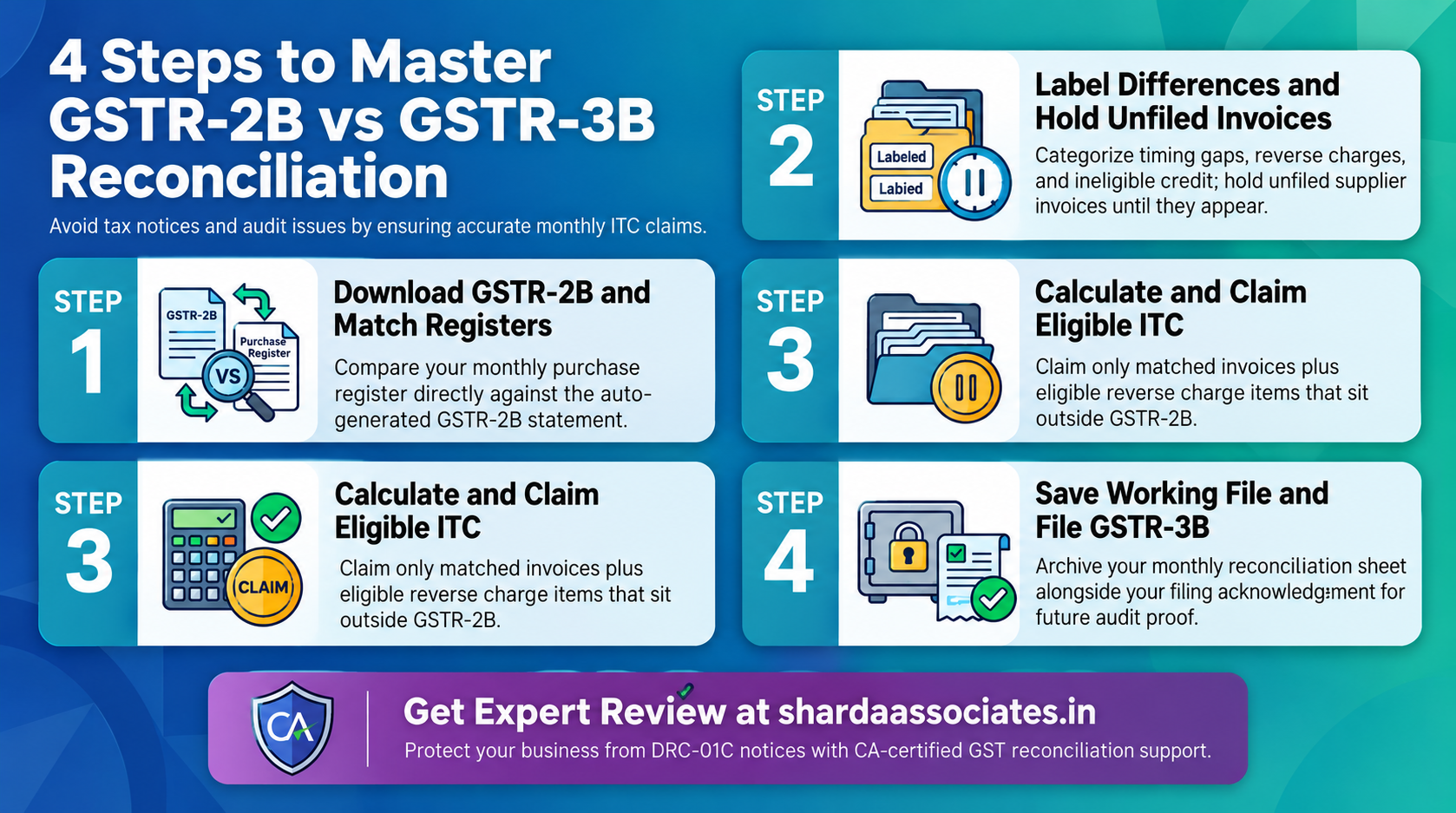
- Download GSTR-2B for the month after it is generated.
- Match each invoice in your purchase register against it.
- Mark each difference with its reason from the list above.
- Decide the ITC you will claim: matched invoices plus eligible items outside GSTR-2B.
- Keep the reconciliation file with your return working.
- File GSTR-3B and save the acknowledgement.
What If You Have Already Claimed More Than GSTR-2B?
If the excess is a mistake, correct it early. Depending on the facts, businesses reverse the excess in a later GSTR-3B or pay it through a voluntary DRC-03, with interest where the law requires. Interest under Section 50(3) applies to ITC that was wrongly availed and utilised, so check whether the excess was actually used. Follow the route that matches your situation, and confirm it with a CA.
What Happens If the Mismatch Is Large?
The system can send an intimation in Form DRC-01C under Rule 88D when the excess crosses the prescribed limit, with 7 days to reply. See our guide on how to manage ITC mismatch notices for the reply steps.
A Worked Example of a Monthly Reconciliation
Here is an illustration with made-up figures. Your purchase register shows ITC of ₹5,20,000. GSTR-2B shows ₹4,60,000. The difference of ₹60,000 is made up of ₹30,000 of reverse charge ITC that is eligible but does not appear in GSTR-2B, ₹25,000 on invoices of a supplier who has not filed, and ₹5,000 where the supplier reported a wrong rate. You claim ₹4,60,000 from GSTR-2B plus ₹30,000 of reverse charge ITC, a total of ₹4,90,000, and you hold back ₹30,000 until the supplier fixes the filing. The reconciliation sheet shows each of these lines, so an officer or a lender can follow it in a minute.
What About ITC? You Reversed for Non-Payment?
If you have not paid a supplier within 180 days of the invoice date, the credit has to be reversed with interest. You can claim it again once you pay, and the time limit in Section 16(4) does not apply to re-claiming credit that was reversed earlier. Keep a separate list of these reversals so they do not get mixed with mismatch items.
Conclusion
A GSTR-2B vs GSTR-3B difference is something you can manage in the same month it appears. A fifteen-minute reconciliation before filing is far cheaper than a notice, an interest calculation or a lender’s question later.
The method is simple: match, label, claim what is supported, and keep the file. Most gaps are timing items or reverse charges, which you can explain in one line.
If you want your ITC reconciliation reviewed or a past mismatch looked at, call Sharda Associates on +91 89899 77769. Outcomes depend on the facts, so no result can be promised.
Frequently Asked Questions
1. Can I claim ITC that is not in GSTR-2B?
ITC is generally expected to be supported by GSTR-2B, with exceptions such as reverse charge. Check the conditions of Section 16 and the current rules.
2. Why is my GSTR-3B ITC higher than GSTR-2B?
Common reasons are reverse charge, invoices claimed from earlier periods, supplier errors or an over-claim.
3. What if my supplier has not filed GSTR-1?
Do not claim it now, follow up, and claim when it appears in GSTR-2B within the time limit.
4. Can I correct excess ITC after filing GSTR-3B?
Yes, businesses correct it through reversal in a later return or by payment, as the facts require.
5. Is interest always payable on excess ITC?
Section 50(3) applies to ITC wrongly availed and utilised. Whether it was utilised depends on the credit ledger position, so check with a CA.
6. What is DRC-01C?
An intimation under Rule 88D when ITC claimed exceeds GSTR-2B beyond the prescribed limit, with 7 days to reply.
7. How often should I reconcile?
Every month, before filing GSTR-3B.