
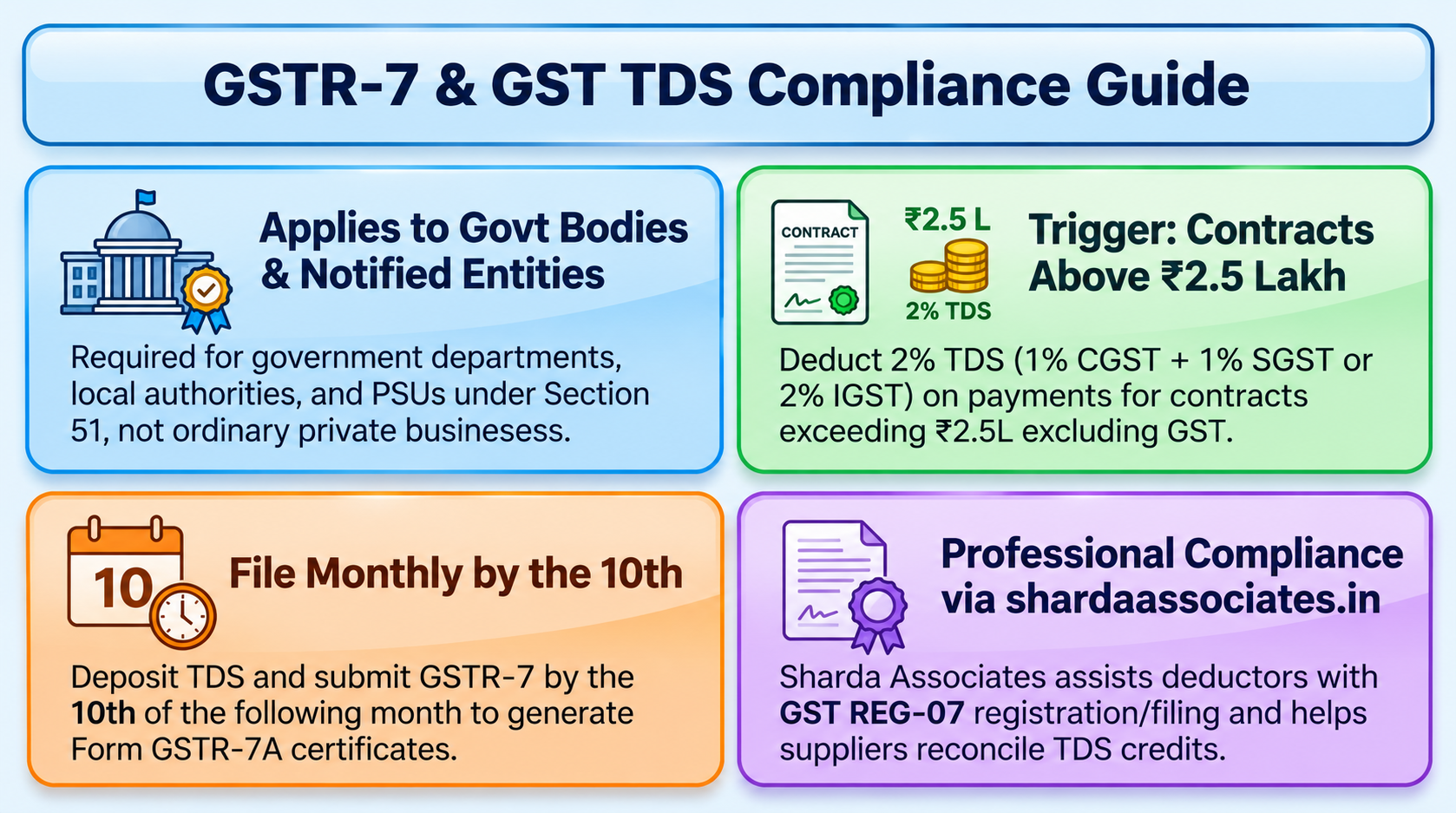
Short answer: GSTR-7 is the monthly return filed by a person who is required to deduct TDS under GST. It applies to government departments, local authorities, government agencies and other notified persons, such as public sector undertakings, when they pay a supplier under a contract worth more than ₹2.5 lakh. The due date is the 10th of the following month.
Key points
- Who files: only registered TDS deductors under Section 51 of the CGST Act, not ordinary businesses.
- Trigger: a taxable supply under a contract value above ₹2.5 lakh.
- Rate: 2% of the payment, excluding GST (1% CGST and 1% SGST, or 2% IGST).
- Due date: return and tax payment by the 10th of the next month.
- Certificate: the deductor issues Form GSTR-7A to the supplier.
Most small businesses never need GSTR-7, which is why the form causes confusion. If you supply goods or services to a government body, you may see 2% held back from your payment, and that deduction is reported by the paying office in GSTR-7. If you work in an accounts or finance team of a government entity, the responsibility to file it lies with you.
At Sharda Associates, our Chartered Accountants (CA) help suppliers reconcile TDS credits received from government customers, and help deductor offices with registration and monthly filing. We also prepare CA-certified project reports for bank loans, where receivables from government clients are checked closely.
Who Must Deduct TDS Under GST?
Section 51 of the CGST Act lists the persons who must deduct tax at source. They are:
- a department or establishment of the Central Government or a State Government;
- a local authority, such as a municipal body;
- governmental agencies; and
- other persons or categories notified by the government, such as public sector undertakings, authorities or boards set up by law and societies established by the Government.
Who Deducts and Who Does Not
| Person or situation | Deduct TDS under GST? | Remarks |
| Central or State Government department | Yes | If the contract value exceeds ₹2.5 lakh |
| Local authority | Yes | Same condition |
| Government agency | Yes | Same condition |
| Notified PSU, authority, board or society | Yes | Only if covered by a notification |
| Private company, firm or trader | No | Not a notified deductor |
| Payment for supply under reverse charge | No | Tax is paid by the recipient directly |
| Supplier located and supplying in a different State from the recipient | Generally no | Section 51 has a State-based condition |
| Contract value up to ₹2.5 lakh | No | Below the threshold |
How Does the ₹2.5 Lakh Limit Work?
The limit applies to the total value of the contract for taxable supplies, not to each invoice. Once a contract is worth more than ₹2.5 lakh, TDS applies on every payment under it, calculated on the value excluding GST. The deductor should check the contract value, and not only the bill in hand.
Registration for TDS Deductors
A deductor must register in Form GST REG-07, even if it does not make taxable supplies. There is no turnover limit for this registration. The TDS registration is separate from any normal GST registration the entity may hold.
What Does GSTR-7 Contain?
GSTR-7 reports the supplier-wise TDS deducted during the month, the amounts paid to the government and any corrections to earlier months. Once filed, the deducted amount is credited to the supplier’s electronic cash ledger, and the supplier can use it to pay GST liability.
Due Dates, Interest and Late Fee
- Deposit and return: TDS must be deposited and GSTR-7 filed by the 10th of the following month.
- Interest: delayed deposit attracts interest, generally at 18% a year.
- Late fee for GSTR-7: Section 47 provides a late fee for each day of delay under each Act, subject to a cap, so check the current amounts before filing late.
- Certificate: failure to issue Form GSTR-7A on time can attract a late fee for each day.
What Should a Supplier Do?
Suppliers should check the GST portal every month for TDS credits, match them with payment advices and use the amount to pay tax. If the deductor files late or reports a wrong amount, ask the office to correct it, because your credit depends on their filing. Mismatches are among the most common issues in government billing.
Conclusion
GSTR-7 is an important GST return for persons or entities required to deduct Tax Deducted at Source (TDS) under GST. Timely filing helps ensure that the deducted tax is deposited with the government and the details are reflected correctly in the deductee’s GST records. Businesses and government departments should maintain accurate transaction records and comply with the applicable filing deadlines to avoid late fees and other consequences.
How Sharda Associates Can Help: Sharda Associates assists businesses with GST compliance, tax planning, documentation, and accounting support to help maintain accurate records and meet applicable GST requirements.
FAQ
Q1. Who has to file GSTR-7?
Persons required to deduct TDS under Section 51, namely government departments, local authorities, government agencies and notified persons.
Q2. Is GSTR-7 applicable to a private company?
No, unless the company is a notified deductor, which is rare.
Q3. What is the rate of TDS under GST?
2% of the payment value excluding GST, split as 1% CGST and 1% SGST for intra-state supplies, or 2% IGST for inter-state supplies.
Q4. What is the contract value limit for TDS?
TDS applies when the total contract value exceeds ₹2.5 lakh.
Q5. What is the due date for GSTR-7?
The 10th of the month following the month of deduction.
Q6. Is a separate registration needed for TDS?
Yes. A deductor registers in Form GST REG-07.
Q7. What is GSTR-7A?
It is the TDS certificate issued to the supplier after the deductor files GSTR-7.
Q8. Can a supplier use the TDS amount?
Yes. It is credited to the electronic cash ledger and can be used to pay GST liability.
Q9. Is TDS deducted on reverse charge supplies?
No. When tax is payable under reverse charge, TDS under Section 51 does not apply.
Q10. What if the deductor files GSTR-7 late?
The deductor pays interest and late fee, and the supplier’s credit gets delayed until the return is filed.