
One of the most common questions business owners ask when applying for a loan is: how long will this actually take?
The honest answer is — it depends. It depends on which bank you are applying to, which loan scheme you are applying under, how complete your documentation is, and how well-prepared your project report is.
What most business owners do not realize is that the single biggest factor controlling loan approval time is documentation quality — specifically, the quality of your project report and CMA data. A complete, CA-certified application can cut processing time by weeks.
This guide gives you exact timelines for every major loan type in India in 2026 — and tells you specifically what causes delays and how to avoid them.
Get Your Feasibility Report →.
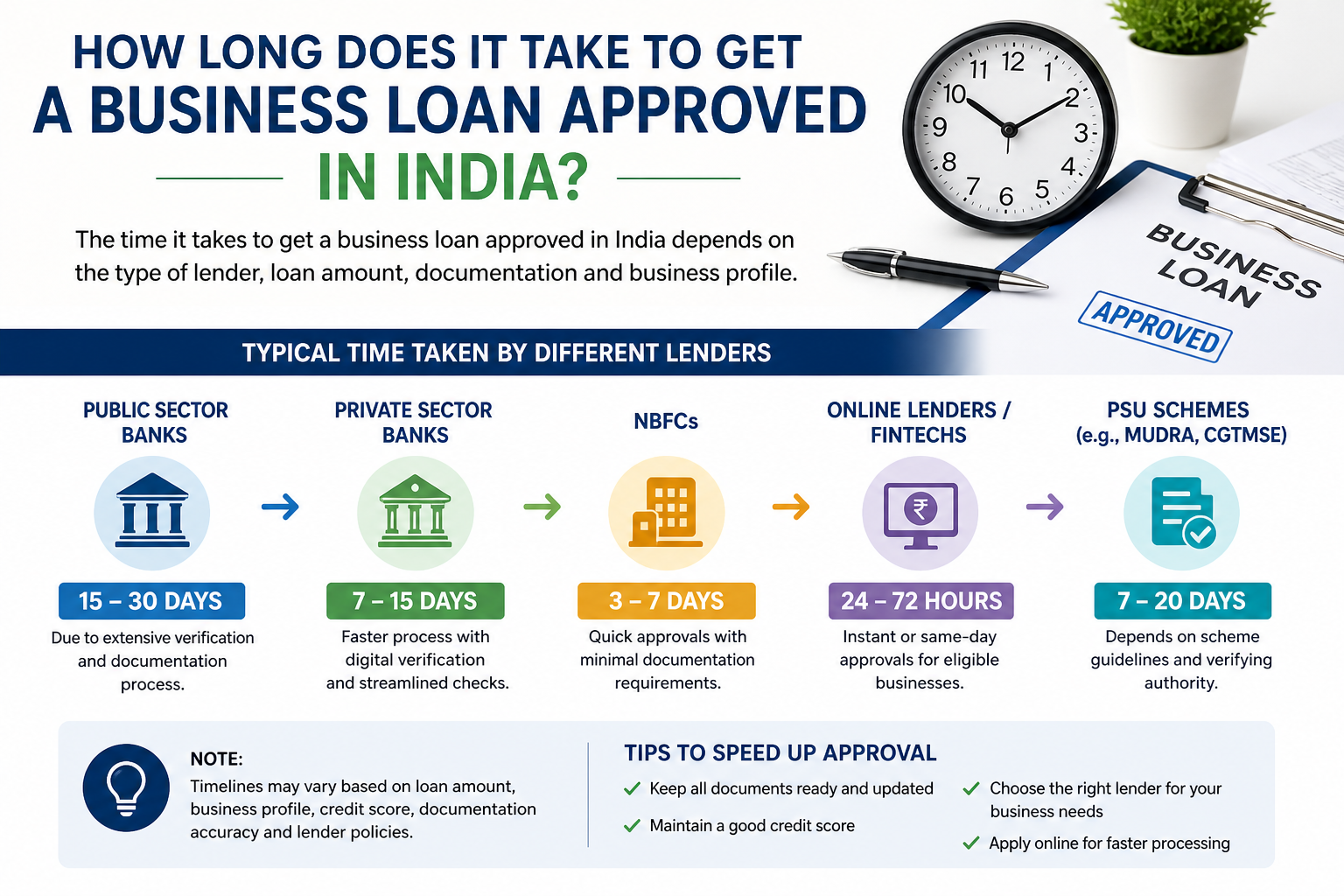
Business Loan Approval Timeline
| Loan Type | Typical Approval Time | Fast-Track Possible? |
| MUDRA Shishu (up to ₹50,000) | 7 to 15 working days | Yes — with complete documents |
| MUDRA Kishore (₹50,000 to ₹5 lakh) | 15 to 30 working days | Yes |
| MUDRA Tarun (₹5 lakh to ₹10 lakh) | 20 to 45 working days | Yes |
| PMEGP loan (up to ₹50 lakh) | 45 to 90 working days | Partial — scheme has fixed stages |
| CMEGP loan (Madhya Pradesh) | 45 to 75 working days | Partial |
| MSME term loan — PSU bank | 30 to 60 working days | Yes |
| MSME term loan — private bank | 15 to 30 working days | Yes |
| SBI business loan | 30 to 60 working days | Yes |
| HDFC business loan | 10 to 20 working days | Yes |
| CGTMSE-backed loan | 45 to 75 working days | Partial |
| Stand-Up India loan | 45 to 90 working days | Partial |
These are standard timelines for complete, well-prepared applications. Incomplete applications — missing documents, poor project report, CMA errors — can double or triple these timelines.
How the Business Loan Approval Process Works — Stage by Stage
Understanding what happens inside the bank after you submit your application helps you understand where delays actually occur.
Stage 1 — Application Submission and Initial Screening
Typical time: 2 to 5 working days
When you submit your loan application, the first thing the bank does is an initial document check. A junior officer or relationship manager reviews whether all required documents are present and whether the application is complete enough to move forward.
This is where a large number of applications — particularly those with missing documents, no CA-certified project report, or incorrect CMA data — are returned immediately.
A returned application does not just lose 2 to 5 days. It loses weeks — because you then have to prepare the missing elements, resubmit, and go through the initial screening again.
What causes delays at this stage:
- Missing project report or unacceptable report format
- Absent CA certification or stamp
- Missing annexures — Udyam certificate, GST registration, ITR copies
- Mismatch between documents submitted
Stage 2 — Field Investigation and Site Visit
Typical time: 5 to 15 working days
After the initial screening passes, the bank conducts a field investigation. A bank officer visits your business location, verifies your infrastructure, checks existing operations if any, and confirms that the information in your application matches physical reality.
For new businesses without a fixed location yet — this stage may involve verification of the proposed site and discussions with the promoter.
Delays at this stage happen when:
- The business location is not as described in the application
- The promoter is not available for the site visit
- Infrastructure or equipment does not match what was stated
Stage 3 — Financial Appraisal and Credit Assessment
Typical time: 10 to 25 working days
This is the longest and most critical stage. The bank’s credit team conducts a detailed financial appraisal of your application — reviewing your project report, CMA data, financial projections, DSCR, bank statements, ITR, GST returns, and CIBIL score.
They are looking for:
- Consistency between all financial documents
- Realistic and achievable financial projections
- DSCR above 1.25 in all projection years
- Clean CIBIL score — typically 700 or above
- No significant GST-ITR mismatch
This stage takes the longest — and it is where a professionally prepared, CA-certified project report makes the biggest difference. A complete, well-structured project report with accurate CMA data gives the credit officer everything they need in one place. A poorly prepared report generates queries — and every query adds days to the timeline.
Stage 4 — Sanction Committee Approval
Typical time: 5 to 15 working days
After the financial appraisal is complete, the credit officer prepares an internal appraisal note and presents it to the loan sanction committee. The committee reviews the appraisal and either approves, rejects, or asks for additional information.
For larger loans, multiple levels of committee approval may be required — branch level, regional level, and sometimes head office level.
Stage 5 — Sanction Letter and Documentation
Typical time: 3 to 7 working days
Once the committee approves the loan, a sanction letter is issued. You review and accept the sanction terms. Legal documentation is then prepared — loan agreement, mortgage documents if collateral is involved, guarantee documents.
Stage 6 — Loan Disbursement
Typical time: 3 to 10 working days after documentation
After all documentation is executed, the loan is disbursed — either as a lump sum or in tranches depending on the project and loan type.
For project loans, disbursement often happens in stages linked to project milestones — first disbursement on civil work completion, second on machinery installation, and so on.
Loan-Specific Timelines Explained
MUDRA Loan — How Long Does It Take?
MUDRA loans are processed by the same banks — SBI, PNB, Bank of Baroda, cooperative banks, microfinance institutions — but under a specific government scheme framework.
- Shishu loans up to ₹50,000 — typically 7 to 15 working days with complete documents
- Kishore loans ₹50,000 to ₹5 lakh — typically 15 to 30 working days
- Tarun loans ₹5 lakh to ₹10 lakh — typically 20 to 45 working days
MUDRA loans are theoretically faster because they are meant for micro enterprises with simpler needs. In practice, delays happen because applicants submit incomplete documentation or a project report that does not meet the bank’s minimum standard.
PMEGP Loan — How Long Does It Take?
PMEGP — Prime Minister’s Employment Generation Programme — has a multi-stage government approval process that makes it inherently slower than standard bank loans.
The PMEGP loan process:
| Stage | Time |
| Application submission to KVIC/DIC | Week 1 |
| Initial screening by KVIC/DIC | 2 to 3 weeks |
| Bank appraisal and field visit | 3 to 4 weeks |
| Sanction committee approval | 2 to 3 weeks |
| Subsidy claim processing | 4 to 8 weeks |
| Total typical timeline | 45 to 90 working days |
PMEGP timelines are longer because of the additional government body involvement — KVIC and DIC must review and forward the application before the bank even begins appraisal. A strong project report specifically formatted for PMEGP requirements reduces delays at the bank appraisal stage significantly.
SBI Business Loan — How Long Does It Take?
SBI processes business loans through a structured internal credit assessment process. Timelines depend on the loan amount and branch.
- Loans up to ₹25 lakh — typically 30 to 45 working days for complete applications
- Loans above ₹25 lakh — typically 45 to 60 working days
- Loans requiring regional or head office approval — 60 to 90 working days
SBI has a specific preference for project reports prepared in their internal format. Submitting a report that does not match SBI’s expected structure generates additional queries — which adds 10 to 20 days to the timeline.
HDFC and Private Bank Business Loans — How Long Does It Take?
Private banks — HDFC, ICICI, Axis, Kotak — process business loans significantly faster than PSU banks because of more streamlined internal credit processes and better digital infrastructure.
- Standard MSME loans — typically 10 to 20 working days
- Larger term loans — typically 20 to 35 working days
Private banks compensate for faster processing with stricter eligibility criteria — typically requiring CIBIL scores of 750 or above and stronger financial documentation.
What Causes Loan Approval Delays — And How to Avoid Them
Delay Cause 1 — Incomplete or Rejected Project Report
The most common cause of delay across all loan types. When the bank returns your application for a better project report — you lose 2 to 6 weeks minimum.
How to avoid: Submit a CA-certified project report with complete CMA data from day one.
Delay Cause 2 — Missing or Mismatched Documents
A missing Udyam certificate, expired GST registration, or ITR-bank statement mismatch triggers a document query from the bank. Every query adds 5 to 15 days.
How to avoid: Use a complete document checklist specific to your loan type and bank before submitting.
Delay Cause 3 — CIBIL Score Below Threshold
If the bank discovers your CIBIL score is below their minimum threshold during appraisal — your application is effectively paused until you address it. This can add months.
How to avoid: Check your CIBIL score before applying. Do not apply if your score is below 700 for PSU banks or below 750 for private banks.
Delay Cause 4 — GST-ITR Mismatch
Banks now use automated systems to cross-verify GST turnover with ITR income. A large mismatch generates an internal red flag and triggers additional scrutiny — adding 15 to 30 days.
How to avoid: Reconcile your GST, ITR, and bank statements before applying. Address discrepancies with your CA first.
Delay Cause 5 — Field Investigation Issues
If the bank officer visits your site and finds the location, equipment, or operations do not match what was stated in the application — the application is paused for re-verification.
How to avoid: Ensure everything in your application accurately reflects the current reality of your business.
Delay Cause 6 — Applying to Multiple Banks Simultaneously
Every bank loan application triggers a hard credit inquiry. Multiple inquiries lower your CIBIL score — which then causes problems when the bank runs their credit check.
How to avoid: Apply to one bank at a time. Research the right bank for your loan type before applying.
How to Speed Up Your Business Loan Approval
Following these steps consistently reduces approval time significantly:
Before submitting:
- Check CIBIL score — minimum 700
- Reconcile GST, ITR, and bank statements
- Get a CA-certified project report with complete CMA data prepared
- Collect all annexures in advance — do not wait for the bank to ask
When submitting:
- Submit two complete copies of everything — one for the bank, one for your records
- Organize documents in the exact order the bank requests
- Attach a document index listing every item submitted
After submitting:
- Follow up with your branch loan officer every 5 to 7 working days
- Respond to any bank queries within 24 hours
- Maintain a record of every communication with the bank
Conclusion
There is no fixed date on which your business loan will be approved. But there is a range — and where your application falls within that range depends almost entirely on how well-prepared it is.
A complete application with a CA-certified project report, clean CMA data, all documents in order, and a strong CIBIL score will always move faster through a bank’s approval process than an incomplete one.
The 2 to 3 days it takes to get a CA-certified project report prepared is not a cost — it is an investment that reduces your total loan approval timeline by weeks.
At Sharda Associates, we prepare CA-certified project reports starting at ₹2,999 — delivered in 2 to 3 working days with free revision until your bank approves.
📞 Call: +91 79870 21896 💬 WhatsApp: +91 89899 77769
Get Your Feasibility Report → Get Your Project Report → Get Your DPR → Get Your CMA Report →
Frequently Asked Questions
Q1: What is the fastest way to get a business loan approved in India?
Submit a complete application with a CA-certified project report, all required documents, and a CIBIL score above 700 to a private bank for a loan under ₹25 lakh. This combination gives you the best chance of approval within 15 to 20 working days.
Q2: Why is my business loan taking so long?
The most common reasons are an incomplete project report, missing documents, CIBIL score below the bank’s threshold, or a GST-ITR mismatch that triggered additional scrutiny. Contact your bank relationship manager to find out exactly where your application is in the process.
Q3: Can a PMEGP loan be approved faster than 45 days?
PMEGP has mandatory stages involving KVIC and DIC that cannot be skipped. However, a strong project report that passes bank appraisal quickly — without generating queries — can significantly reduce the overall timeline. Applications with weak project reports add 3 to 6 weeks of back-and-forth to the PMEGP process.
Q4: Does a CA-certified project report actually speed up loan approval?
Yes — significantly. A CA-certified project report with complete CMA data and accurate financial projections reduces queries at the financial appraisal stage. Every query the bank raises adds 5 to 15 days to the timeline. A complete project report eliminates most of these queries.
Q5: How long does SBI take to approve a business loan?
SBI typically takes 30 to 60 working days for complete applications. Loans requiring regional or head office approval can take up to 90 working days. A project report prepared in SBI’s preferred internal format reduces processing time at the branch level.
Q6: What happens if my loan is rejected — can I reapply immediately?
Do not reapply immediately. Identify the reason for rejection, fix it — whether that means a better project report, improved CIBIL score, or corrected documentation — and wait at least 3 months before reapplying. Multiple applications in a short period lower your CIBIL score and signal financial desperation to banks.
Q7: Does loan amount affect approval time?
Yes. Larger loans require approval from higher levels within the bank’s hierarchy — branch, regional, and sometimes head office. Loans above ₹1 crore almost always requir