
Agricultural income has had a unique position in India’s tax system for many years; it is mostly exempt but frequently misinterpreted. The same issue is often asked by farmers, landowners, and even salaried people who have a side income from farming: is my agricultural income truly tax-free, and might it still impact my overall tax liability? This tutorial explains how Indian law taxes (or does not tax) agricultural revenue.
With a track record of 45,500+ project reports issued and CA-certified project reports starting at just ₹2,999, Sharda Associates has assisted thousands of people and organizations in navigating precisely this type of tax intricacy. Our CA team can assist you with generating papers for a farm-based loan or comprehending your agricultural income tax position.
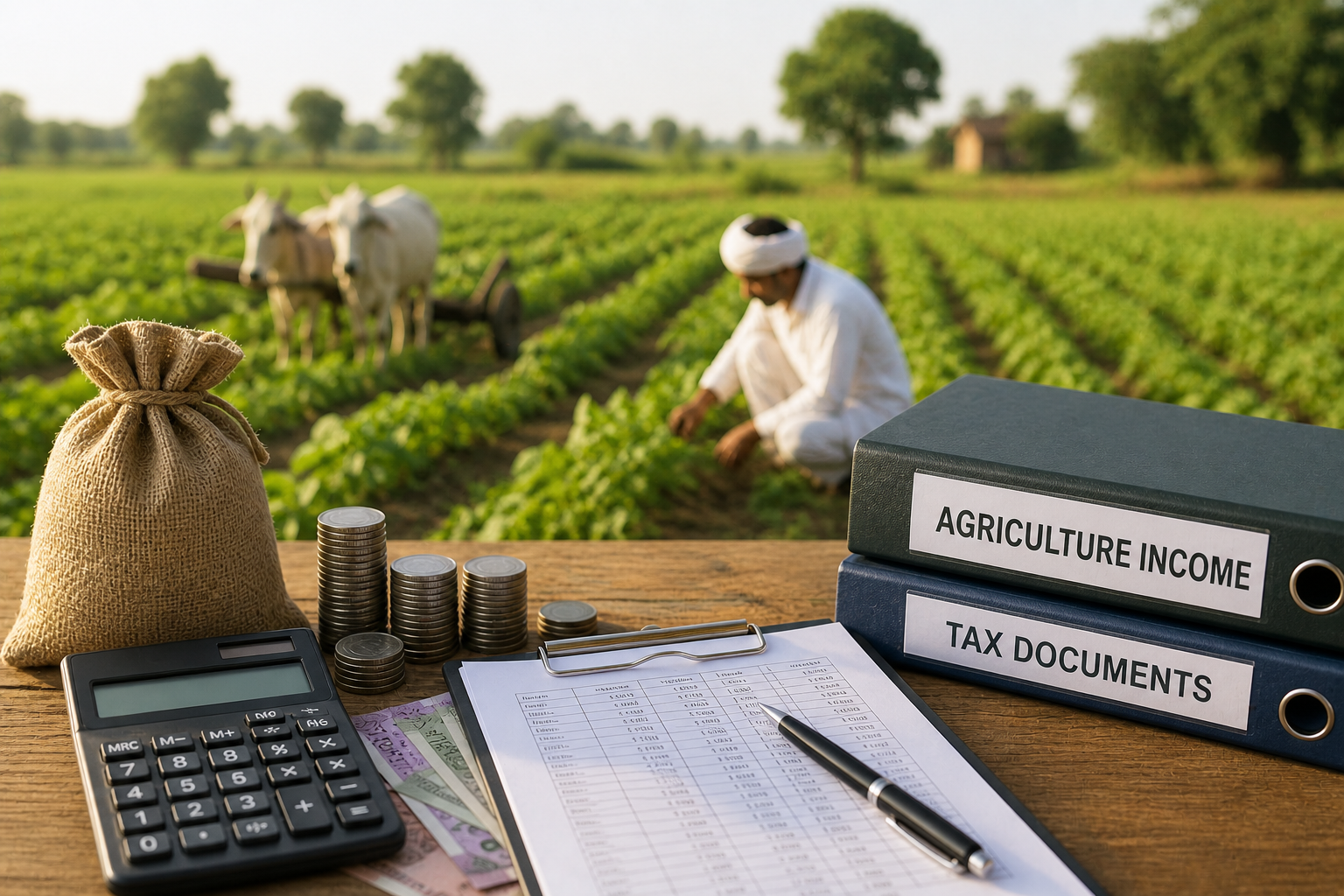
What Qualifies as Agricultural Income Under Section 10(1)
Sections 2(1A) and 10(1) of the Income Tax Act define agricultural income as:
- Rent is revenue gained from land located in India and utilized for agriculture
- Income from agricultural operations—sowing, cultivation, harvesting, and basic processing that a cultivator normally conducts to make the product marketable.
- Income from a farm building built on or near agricultural property and used for living, storage, or similar agricultural uses
- Income from saplings or seedlings cultivated in a nursery is recognized as agricultural income regardless of where the original cultivation took place.
Conditions That Must Be Met for Exemption
Not every rupee tied to agriculture is immediately eligible for exemption. Three conditions must generally be met together:
- Land location — The land must be in India; agricultural income earned outside of India is fully taxable.
- Genuine agricultural use – The land must be used for agricultural activities rather than leased out for non-farming purposes such as warehousing or solar installations.
- Nature of processing — If produce is processed, it must be confined to what a cultivator would normally do (cleaning, drying, grading); once it becomes manufactured (canning, roasting, branded packaging), the value-added portion becomes taxable business revenue.
What is NOT Considered Agricultural Income
Many taxpayers mistakenly assume anything connected to a farm is exempt. The following are not treated as agricultural income and are fully taxable:
|
Activity |
Tax Treatment |
|
Poultry farming, dairy, or beekeeping |
Taxable as business income |
|
Sale of naturally grown trees/fruits without cultivation |
Taxable |
|
Rent from land leased for non-agricultural use (e.g., warehouse, event venue) |
Taxable |
|
Sale of processed/branded products like jam, pickles |
Taxable (processing beyond ordinary cultivator activity) |
|
Royalty from mining on agricultural land |
Taxable |
|
Income from transfer/sale of agricultural land itself |
Not agricultural income (may attract capital gains tax) |
Special Rules for Plantation Crops: Tea, Coffee, and Rubber
Certain plantation crops require both cultivation and manufacturing; hence, the legislation imposes fixed apportionment criteria between exempt farm income and taxable business income:
|
Crop |
Agricultural (Exempt) |
Business (Taxable) |
|
Tea (grown and manufactured in India) |
60% |
40% |
|
Rubber (grown and manufactured) |
65% |
35% |
|
Coffee (grown and cured only) |
75% |
25% |
|
Coffee (grown, cured, roasted, and ground) |
60% |
40% |
How Partial Integration Affects Your Tax Slab
Even while agricultural income is exempt, it might nevertheless have an impact on how much tax you pay on non-agricultural income. This occurs by a mechanism known as partial integration, which applies when both of the following requirements are met:
In the fiscal year, net agricultural income surpasses ₹5,000, but non-agricultural income exceeds the basic exemption limit (₹2.5 lakh for those under 60 and ₹3 lakh for seniors).
How partial integration is calculated:
- Add agricultural and non-agricultural income and calculate tax on the whole at the applicable slab rate.
- Calculate the tax on agriculture income and the basic exemption limit individually.
- Subtracting the second sum from the first yields the real tax payable on non-agricultural income.
This strategy assures that higher-income taxpayers cannot use agricultural income to cut their overall tax rate while retaining the agricultural income itself tax-free.
Reporting Agricultural Income in Your ITR
- Net agricultural income of up to ₹5,000 can be recorded in ITR-1.
- If your agricultural income exceeds ₹5,000, utilize ITR-2 to declare it.
- Even if your agricultural income is exempt, you must disclose it on your return; failure to do so may result in scrutiny or notices.
- Companies and the majority of non-individual entities are not eligible to claim the agricultural income exemption in the same way that individuals and HUFs are.
Why Choose Sharda Associates
- CA-certified project reports and tax documents are trusted by banks, NBFCs, and financial institutions.
- Our professional project reports start at ₹2,999 and have been given to over 45,500 MSMEs, startups, farmers, and agri-businesses.
- Expert advice for agricultural income tax exemptions, ITR filing, and partial integration calculations.
- Support for farm-based loans, subsidy schemes, and agricultural project reports
- Experienced Chartered Accountants provide quick turnaround and personalized advice via phone and email across India.
Conclusion
Agricultural income remains one of the most important tax breaks available in India, but the regulations governing partial integration, plantation crop apportionment, and what exactly qualifies as “agricultural” are simple to misunderstand. Getting this properly—and recording it accurately—might help you avoid tax notices and easily receive agri-based funding. Sharda Associates offers CA-certified project reports starting at ₹2,999 and has delivered over 45,500 reports. They can guide you through your tax and financial documentation needs.
Call us now at +91 8989977769 for experienced CA advice on your agricultural income tax and project reports.
Frequently Asked Questions
- Is agricultural income totally tax exempt in India?
Yes, agricultural income coming from land in India is completely free from central income tax under Section 10(1), while state governments may collect their own agricultural tax in certain instances.
- Will agricultural income still increase my tax liability?
Yes, indirectly. If your net agricultural income exceeds ₹5,000 and your non-agricultural income exceeds the basic exemption limit, your tax rate is calculated by partial integration, potentially putting you in a higher bracket.
- Is income from dairy, poultry, and fisheries considered agricultural?
No, these activities are not considered agricultural income under the Income Tax Act and are taxed as business income.
- Do I need to record agricultural income on my ITR even though it is exempt?
Agricultural income must be stated in your income tax return, either in ITR-1 for up to ₹5,000 or in ITR-2 for more than that amount.
- Is agricultural income earned outside of India exempt?
No, only agricultural income from land located within India is eligible for exemption under Section 10(1).
- Are incomes from tea, coffee, and rubber plantations totally exempt?
No, these are subject to unique apportionment regulations; for example, tea income is classified as 60% agricultural (exempt) and 40% business income (taxable).
- Can businesses claim the agricultural income tax exemption?
In general, only individuals and Hindu Undivided Families (HUFs) can claim agricultural income exemption in the way indicated in Section 10(1); companies are normally taxed differently.
- Is rent from agricultural land always exempt?
Rent is only deductible if the land is really utilized for agriculture; renting it out for non-agricultural purposes, such as a warehouse or event site, results in taxable revenue.
- Does the sale of agricultural land constitute agricultural income?
No, revenue from the sale or transfer of agricultural land is not considered agricultural income and may be subject to capital gains tax, depending on the land’s classification.
- How can Sharda Associates help with agricultural income tax issues?
Sharda Associates offers CA-certified advice on agricultural income tax exemptions, ITR filing, and project reports for agri-based firms; call +91 8989977769 to get started.