
Managing invoices is not only about creating bills; it is also about knowing which customers have paid, which payments are pending, and how money moves through the business. Many small businesses still rely on manual records or separate billing and payment tracking systems, which can lead to missed follow-ups, calculation mistakes, and difficulty in maintaining proper accounts.
At Sharda Associates, we have worked with different billing and accounting platforms used by businesses for invoice software and payment management. We found that several invoice applications provide basic billing features, but businesses often need additional tools to maintain customer balances, payment history, GST records, and complete transaction details.
VINIMAY’s biggest advantage is its simplicity and accessibility. Small businesses do not need advanced accounting knowledge to manage their billing operations, as it provides essential features like invoice generation, outstanding payment tracking, and financial record management in one place. With free access to important billing and accounting tools, VINIMAY helps startups, retailers, traders, and service providers reduce manual efforts, maintain organized business records, improve payment tracking, and efficiently manage their everyday billing requirements.
Why Invoicing and Payment Tracking Are Not the Same Thing
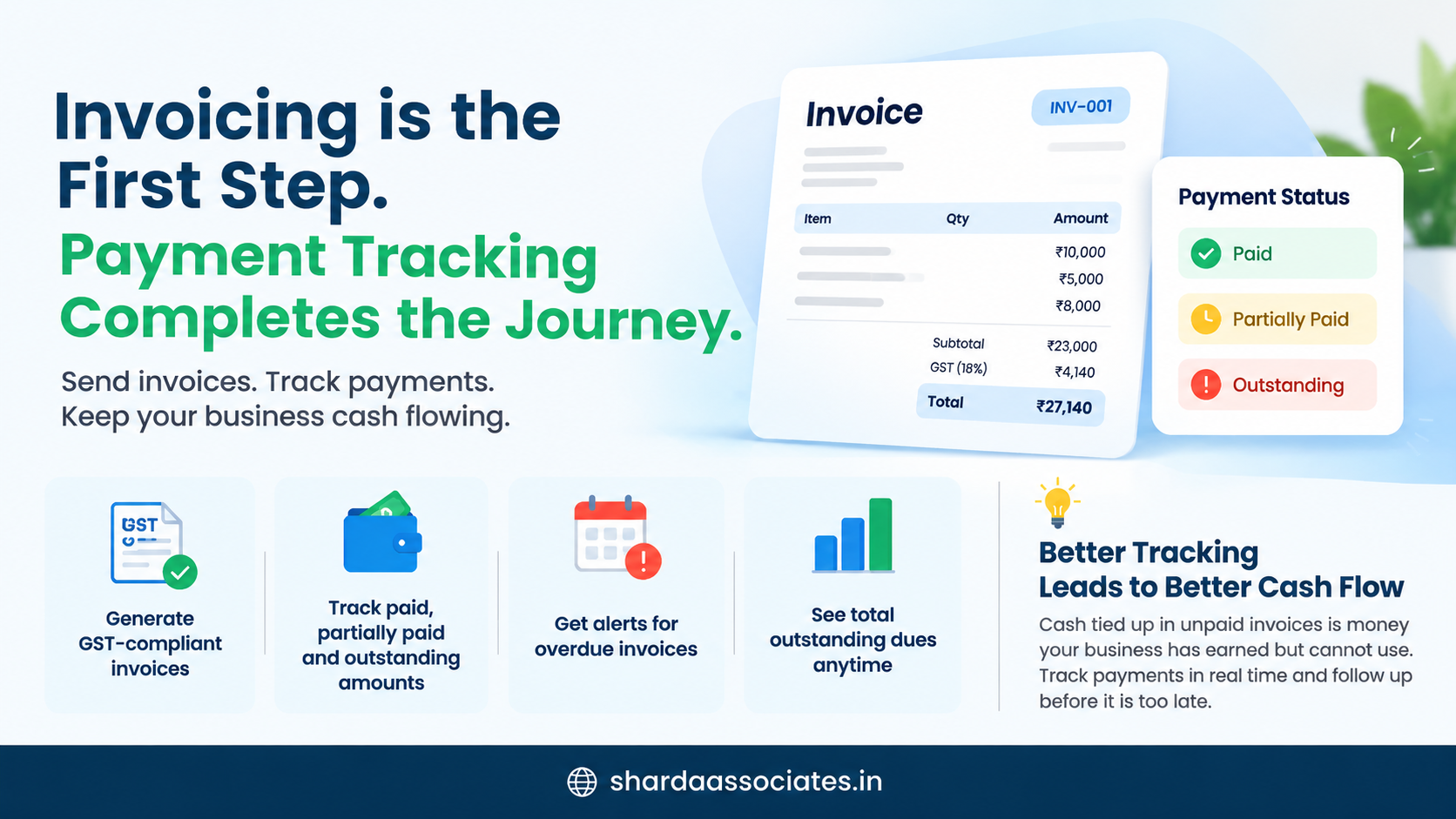
Generating a GST-compliant invoice is one task. Knowing whether that invoice has actually been paid, partially paid, or is overdue is a separate, ongoing task, and many small businesses handle the first well while the second slips through the cracks entirely.
What Invoice Software Should Do for Payment Management
- Mark each invoice as paid, partially paid or outstanding, updated as payments come in
- Show a running total of outstanding receivables at any point, not just at month-end
- Flag invoices that have crossed their due date, so follow-up happens before it is forgotten
- Keep a searchable history, so a client’s payment pattern is visible over time
Common Payment Tracking Mistakes Small Businesses Make
- Treating an invoice as settled once it is sent, without confirming payment actually arrived
- Following up on overdue payments only when cash flow gets tight, rather than on a regular schedule
- Not distinguishing between partial payments and full settlement, which distorts the real outstanding amount
- Losing track of which client has a pattern of late payment, and continuing to extend the same terms regardless
How Real-Time Tracking Changes Collection Behaviour
Without real-time tracking, overdue invoices are often noticed only when a business owner happens to review old records, by which point follow-up feels awkward and collection becomes harder.
With real-time tracking: an overdue invoice is visible the day it crosses its due date, which makes a timely, low-friction follow-up far more natural than a delayed, uncomfortable one.
Comparing Payment Tracking Approaches
| Approach | Visibility of Outstanding Dues | Follow-Up Timing | Best Suited For |
| Memory or scattered notes | Very low | Reactive, often late | Very small, informal operations only |
| Manual spreadsheet | Moderate | Depends on manual updates | Businesses willing to update it consistently |
| Invoice software with payment status (e.g. Vinimay) | High | Proactive, based on due dates | Small businesses wanting reliable, low-effort tracking |
Why This Matters More Than It Seems
Cash tied up in unpaid invoices is money the business has technically earned but cannot use, and for a small business, this gap is often the actual cause of a cash crunch, not a lack of sales. Proper payment tracking does not create new revenue, but it makes sure existing revenue actually gets collected on time.
Conclusion
Sharda Associates dealt with exactly this friction before switching its own client billing to Vinimay; invoices were sent on time, but tracking who had actually paid meant manually cross-checking bank entries against a mental list that was never fully reliable.
Since moving billing onto Vinimay’s free software, outstanding amounts are visible without needing to reconstruct them from memory, and that alone has made follow-up on unpaid invoices noticeably less of a chore than it used to be. It is a small operational change, but one that removed a genuine, recurring source of friction.
For a small business still relying on memory or scattered notes to track who owes what, starting with invoice software that shows payment status clearly is a reasonable first step before considering any more advanced accounting system. Call +91 89899 77769 if you would like help setting up better payment tracking or preparing financial records for a loan application.
Frequently Asked Questions
1. Why do small businesses lose track of unpaid invoices?
Without a system that shows payment status clearly, tracking relies on memory or scattered notes, which becomes unreliable as the number of clients grows.
2. Does invoice software actually reduce late payments?
It does not eliminate late payments on its own, but visible due dates and outstanding amounts make timely follow-up much easier, which in practice improves collection.
3. Can free invoice software track partial payments?
Good free tools, including Vinimay, allow invoices to be marked as partially paid so the real outstanding amount stays accurate rather than assumed to be fully settled or fully unpaid.
4. How does poor payment tracking affect cash flow?
Money owed but not collected on time is often the actual cause of a cash crunch, even when sales themselves are healthy, which is why tracking matters as much as invoicing itself.
5. Is a spreadsheet good enough for tracking payments?
A spreadsheet can work if updated consistently, but it requires manual discipline that invoice software with built-in payment status removes.
6. Does payment tracking help when preparing documents for a bank loan?
Yes, clear records of receivables and collection patterns support cleaner financial statements, which banks look at more favourably than inconsistent or reconstructed figures.
7. Can Sharda Associates help set up better invoicing and payment tracking?
Yes, Sharda Associates advises small businesses on their billing systems and prepares the financial documentation that clean payment records make faster to put together.