
Quick answer: A loan from director should be recorded in a separate unsecured loan account under borrowings from related parties, with a written declaration that the money is not borrowed from others. A loan from a partner should be shown in a partner’s loan account, separate from the partner’s capital account. Both loans must be received through banking channels and supported by proper documents.
At Sharda Associates, our Chartered Accountants (CA) maintain books, prepare financial statements, file ROC and income tax returns, conduct tax audits and handle notices for companies, LLPs and firms, and also prepare CA-certified project reports for bank loans and business funding. Correct presentation of promoter loans helps you pass audit, loan review and tax assessment smoothly.
Why Does Presentation of These Loans Matter?
Promoter funding is common in small businesses, but the department and auditors look at it closely. A loan that is wrongly shown as capital or income, or one without proof of source, can be treated as unexplained credit under Section 68 of the Income Tax Act. For companies, rules on deposits under the Companies Act also apply, so the entry must match the legal position.
Presentation Guide
| Entity | How to show the loan | Key requirement |
| Private or public company, loan from director | Under borrowings, as loans from related parties, in a separate director’s loan account | Written declaration from the director that funds are not borrowed from others, and related party disclosure |
| Partnership firm, loan from partner | Under unsecured loans, in the partner’s loan account separate from capital | Partnership deed clause on loans and interest |
| LLP, loan from partner | Under unsecured loans, with the partner’s contribution kept separate | LLP agreement terms and proper disclosure |
| Proprietorship, money put in by the owner | Not a loan; it is shown as capital introduced | Proprietor cannot lend to himself |
Accounting Treatment: Journal Entries
- Loan received: debit Bank account and credit Director’s (or Partner’s) Loan account.
- Interest provided: debit Interest expense and credit Interest payable or the loan account, with TDS recorded where applicable.
- Interest paid: debit Interest payable and credit Bank account.
- Loan repaid: debit Director’s (or Partner’s) Loan account and credit Bank account.
Keep the loan account separate from remuneration, capital and current accounts, so that each balance can be explained.
Rules for Company Loans from Directors
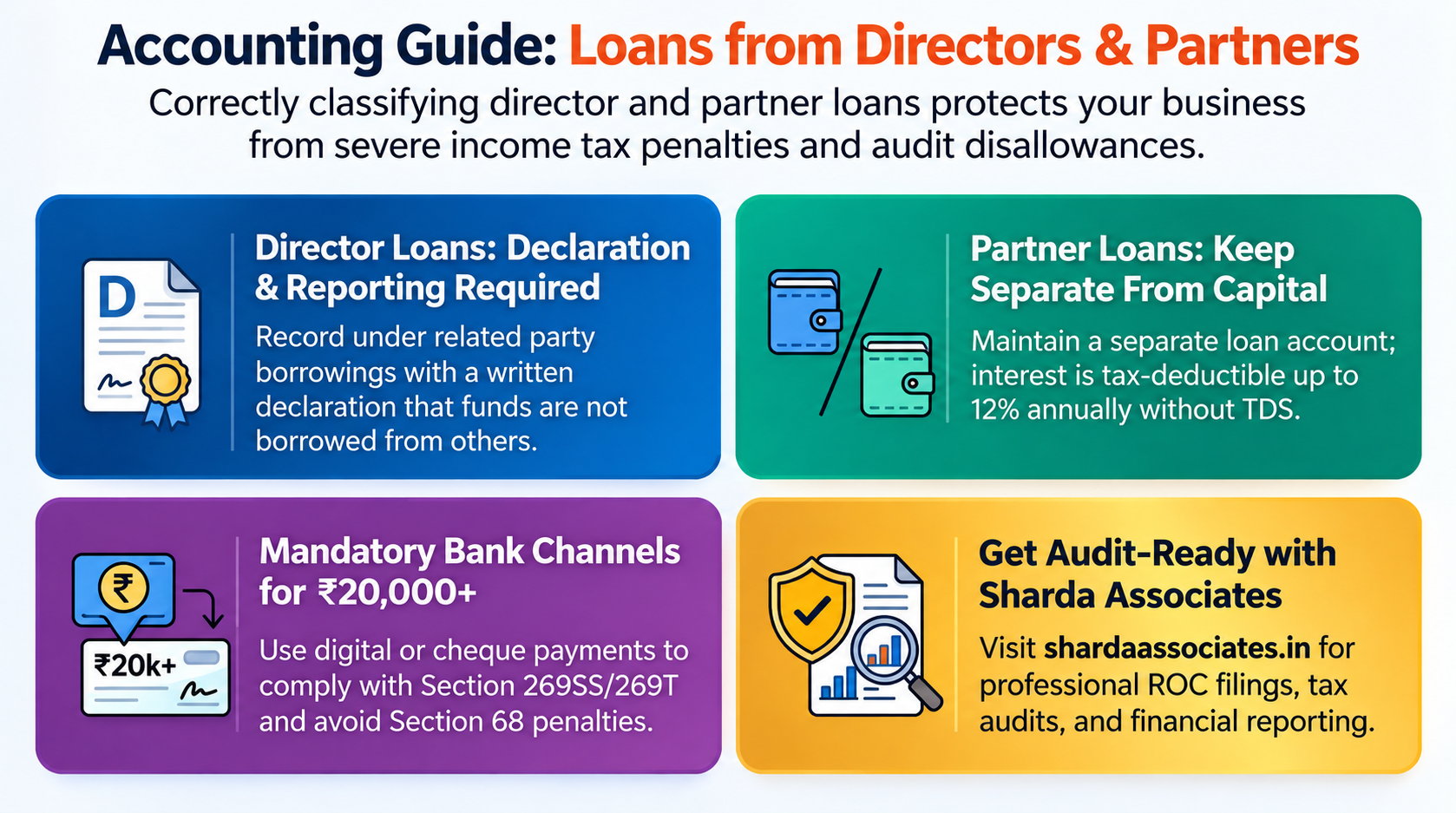
Under the Companies (Acceptance of Deposits) Rules, 2014, money received from a director is not treated as a deposit if the director gives a written declaration, at the time of giving the money, that it is not out of funds borrowed or accepted from others. The company must disclose such amounts in its financial statements, and the outstanding amount is reported in the annual return of deposits in Form DPT-3, where required. In the balance sheet, the amount is shown under borrowings from related parties, and details also appear in the related party disclosures under the applicable accounting standard.
Rules for Loans from Partners
A partnership deed should say whether partners can lend money to the firm and at what rate of interest. Interest paid to partners on capital or loans is allowed as a deduction only up to the limit under Section 40(b), currently 12% simple interest per year, and only if the deed authorises it. The firm does not deduct TDS on interest paid to its partners under Section 194A.
Income Tax Compliance Points
- Banking channels only. Under Section 269SS, loans of ₹20,000 or more must be accepted by account payee cheque, draft or electronic mode, and repayment must follow Section 269T. Violations can attract penalty equal to the amount.
- Prove the source. Keep the lender’s bank statement, income tax return and loan confirmation to show identity, creditworthiness and genuineness.
- TDS on director interest. A company paying interest to a director generally deducts TDS at the applicable rate, and deposits it on time.
- Report in tax audit. The CA reports loan acceptance and repayment details in Form 3CD.
Common Mistakes
Businesses often credit promoter loans without any agreement or declaration, or mix them with capital and salary accounts. Some accept cash, skip the source proof or pay excessive interest. Others forget to report the loan in DPT-3 or disclose it in the notes. Review all promoter balances before the audit begins.
Conclusion
Loans from directors and partners must be shown as separate loan accounts, supported by agreements, declarations, and bank proof. Companies must follow deposit rules, and firms must follow the partnership deed and interest limits.
Record every receipt and repayment through banking channels, keep source documents, and disclose related party balances properly. This protects your books during audit, assessment, and bank review.
For accounting, ROC and income tax compliance, tax audit and CA-certified project reports, contact Sharda Associates at +91-8989977769.
Frequently Asked Questions (FAQs)
1. Where is a director’s loan shown in the balance sheet?
Under borrowings, as loans and advances from related parties, with proper disclosure.
2. Is a declaration needed for a director’s loan?
Yes. The director should give a written declaration that the funds are not borrowed from others.
3. Can a partner give a loan to the firm?
Yes, if the partnership deed allows it, and the loan is kept separate from the capital account.
4. What is the maximum interest allowed to partners?
Interest is allowed as a deduction up to 12% simple per year, if the deed authorises it.
5. Is TDS deducted on interest paid to a partner?
No. A firm does not deduct TDS on interest paid to its partners under Section 194A.
6. Can I accept a director’s loan in cash?
No. Loans of ₹20,000 or more must come through banking channels under Section 269SS.
7. What proof should I keep for the loan?
A loan agreement, bank statements, the lender’s ITR, a confirmation letter and the declaration.
8. Can the loan be treated as unexplained income?
Yes. If the lender’s identity, capacity and genuineness are not proved, Section 68 can apply.