
Short Answer
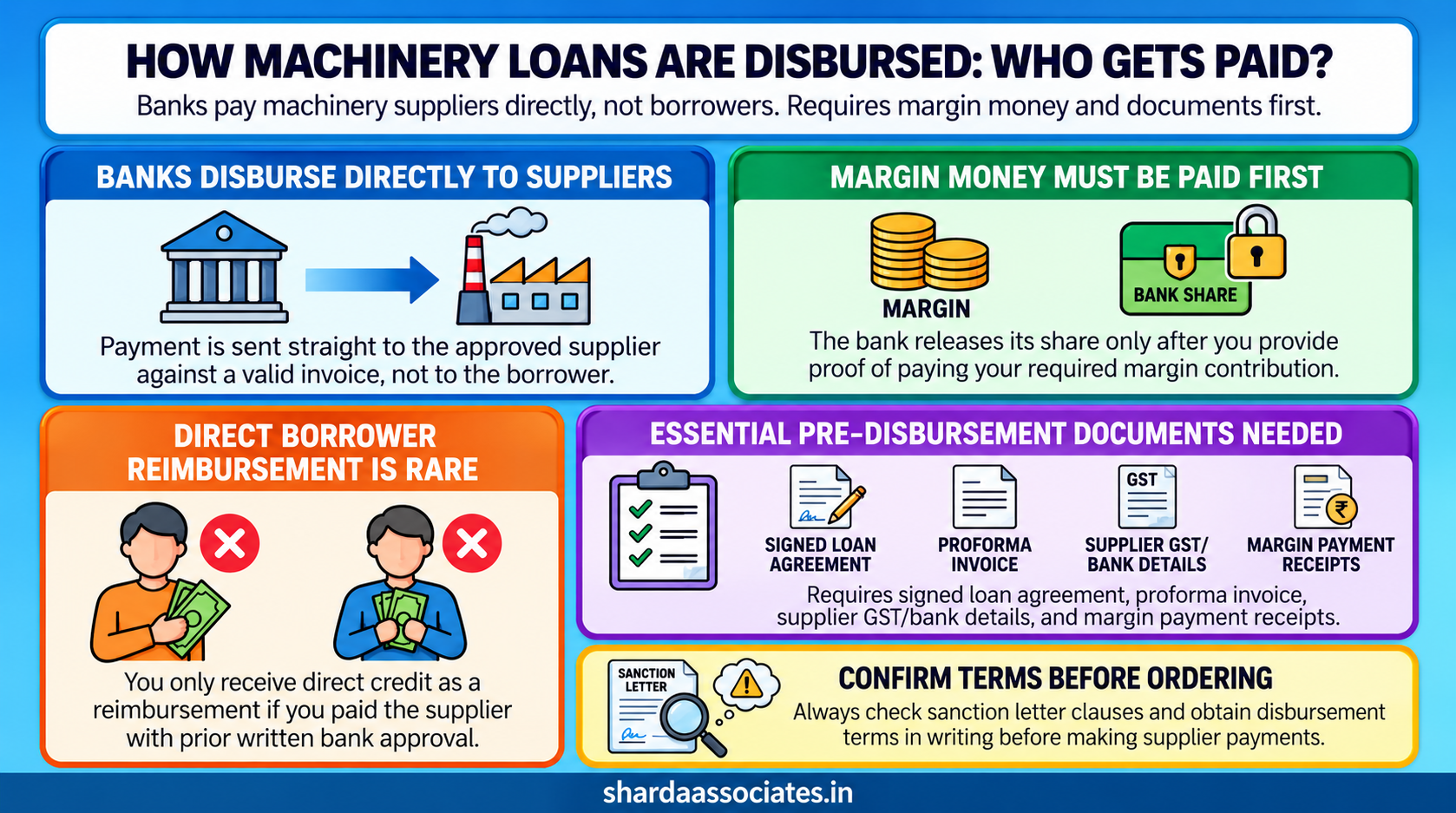
In most cases, a bank disburses a machinery term loan directly to the supplier, not to the borrower. Payment is usually released against a valid invoice or proforma invoice, after you have paid your margin money. Disbursement to the borrower happens only in limited cases, such as reimbursement when you have paid the supplier with the bank’s prior approval.
Introduction
Many first-time borrowers expect the loan amount to land in their own bank account after sanction. With a machinery loan, that is usually not how it works. Banks want to be sure the money is used only for the machinery listed in the sanction, so they generally pay the supplier directly. At Sharda Associates, we prepare CA-certified project reports, CMA data and DPRs, and handle bank documentation for MSME and government scheme loans. Based on this work, we have seen that borrowers who understand the disbursement process in advance avoid most delays. This guide explains who receives the money, when the borrower may be paid directly, what documents are needed, and what to do before placing an order.
Does the Bank Pay the Supplier or the Borrower?
For machinery and equipment, banks usually pay the supplier directly, by RTGS, NEFT or demand draft, against the invoice. The reasons are simple:
- The loan is sanctioned for a specific purpose, and direct payment ensures end-use.
- It reduces the risk of diversion of funds.
- The bank can create its charge (hypothecation) on machinery that has been actually purchased.
Your sanction letter and terms and conditions are the final reference, because each bank and scheme has its own disbursement rules.
When Can the Bank Pay the Borrower Directly?
Direct credit to the borrower’s account is less common, but it can happen when:
- You have already paid the supplier from your own funds, with the bank’s knowledge or approval, and the bank reimburses you against proof of payment and delivery.
- The loan is a working capital limit (cash credit or overdraft), which is operated by the borrower.
- The facility is a small-value or scheme loan, where the bank’s policy allows disbursement to the borrower against documents.
- The bank releases the amount to a joint or controlled account, with usage monitored.
Never assume you can receive the money first. Confirm the mode of disbursement in writing before you place any order.
What Documents Does the Bank Need Before Disbursement?
The usual list is:
- Signed loan agreement and security documents.
- Proof of margin money paid.
- Proforma invoice or final invoice from the approved supplier, with machine specifications.
- Supplier’s GST registration, PAN and bank account details.
- Delivery challan or proof of delivery, where payment is made after delivery.
- Insurance of the machinery, where the bank requires it.
- Udyam registration and other statutory registrations.
- Invoice copies and photographs of installed machinery for post-disbursement inspection.
For subsidy-linked loans such as PMEGP, keep the scheme agency’s documents ready too.
Is Margin Money Paid Before the Bank Releases Funds?
Yes, in most cases. Banks follow the principle that the borrower’s contribution goes in first. You pay the margin money, usually to the supplier or into a designated account, and the bank then releases its share. For example, if the machinery costs ₹20 lakh and the margin is 25%, you pay ₹5 lakh and the bank finances ₹15 lakh. Keep proof of the margin payment, since the bank will ask for it.
Is the loan disbursed in One Go or in Stages?
It depends on the project:
- Ready machinery: usually a single disbursement against the invoice.
- Imported or custom-built machinery: often in stages, such as advance, dispatch and delivery, and sometimes through a letter of credit.
- Machinery plus construction: staged release, linked to progress and inspection.
Staged disbursement protects both the bank and the borrower because each payment matches work actually completed.
Practical Example
Meena sets up a small packaging unit. The machinery costs ₹24 lakh. The bank sanctions a term loan of ₹18 lakh, and she must bring ₹6 lakh as margin.
She pays ₹6 lakh to the supplier and shares the payment proof with the bank. The supplier then issues the invoice with GST details. The bank verifies the invoice and releases ₹18 lakh straight to the supplier’s account. The machinery is installed, and the bank carries out an inspection.
Meena never receives the ₹18 lakh in her own account, and that is normal.
Common Mistakes to Avoid
- Paying the full amount to the supplier first, expecting the bank to repay you later without approval.
- Ordering from a supplier not approved in the sanction.
- Taking an invoice that does not match the sanctioned machinery list.
- Delaying margin money, which delays the whole disbursement.
- Ignoring GST details on the supplier invoice.
- Not insuring the machinery when the bank requires it.
- Relying on verbal assurances. Get disbursement terms in writing.
What Should You Do Before Placing the Machinery Order?
- Read your sanction letter and check the disbursement clause.
- Ask the branch how payment will be made, to the supplier or to you.
- Arrange your margin money in advance.
- Verify the supplier’s GST registration, address and track record.
- Get a proforma invoice that matches the sanctioned machinery.
- Share all documents with the bank before paying any advance.
- Keep copies of every invoice, receipt and communication.
- Take professional help if the loan is large or subsidy-linked.
Conclusion
For machinery loans, expect the bank to pay the supplier directly after your margin money is in and the invoice is verified. Direct payment to the borrower is the exception, and it needs the bank’s approval. Plan your margin, choose an approved supplier, and confirm the disbursement terms in writing before you order. That keeps the process quick and trouble-free.
Need a CA-certified project report, CMA data or help with bank documentation? Contact Sharda Associates at +918989977769
FAQs
1. Does the bank pay the machinery supplier directly?
In most cases, yes. Banks release the amount to the supplier’s bank account against a valid invoice.
2. Can the machinery loan be credited to my account?
Only in limited cases, such as reimbursement after the bank has approved your payment to the supplier. Confirm with your branch.
3. Do I have to pay margin money before disbursement?
Generally yes. The bank usually expects your contribution first.
4. What if I have already paid the supplier from my own pocket?
Inform the bank immediately. Some banks reimburse against proof of payment and delivery, but not all, and approval in advance is safer.
5. Is a working capital loan also paid to the supplier?
No. Working capital limits like cash credit or overdraft are usually operated by the borrower.
6. Can the bank pay in instalments?
Yes, for imported, custom-made or phased projects, the bank may release funds in stages.
7. How long does disbursement take after submitting the invoice?
It depends on the bank and on how complete your documents are. Clean, matching paperwork speeds it up.
8. Is the process the same for PMEGP and Mudra loans?
The basic principle is similar, but scheme guidelines may add conditions. Check your scheme rules and sanction letter.