
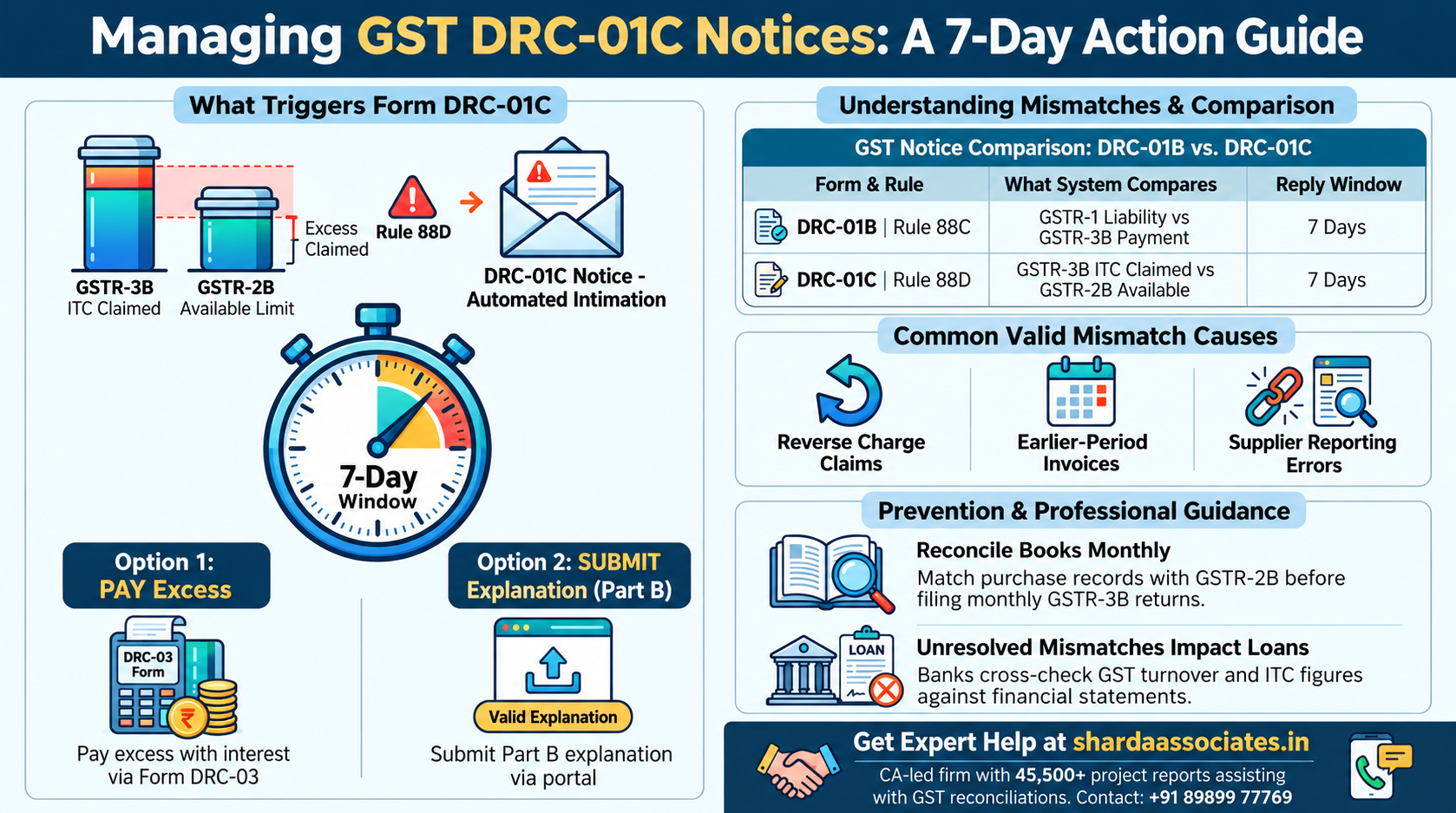
Short answer: A DRC-01C notice is a system-generated intimation under Rule 88D, sent when the ITC you claimed in GSTR-3B exceeds the ITC available in GSTR-2B beyond the prescribed limit. You have 7 days to either pay the excess ITC with interest through DRC-03, or explain the difference in Part B with a reconciliation and supporting documents.
A DRC-01C notice usually arrives soon after you file GSTR-3B, as a portal message and an email, with a seven-day clock attached. Many businesses panic, yet in a good share of cases the difference has a simple reason that can be documented.
Sharda Associates is a CA-led firm that has prepared over 45,500 CA-certified project reports for businesses across India. GST records matter to us because banks cross-check GST turnover and ITC against financial statements, so an unresolved mismatch can follow a business into loan appraisal.
What Is a DRC-01C Notice and Why Did You Get One?
Rule 88D was inserted into the CGST Rules by Notification 38/2023-Central Tax dated 4 August 2023, following the 50th GST Council meeting. The system compares ITC availed in GSTR-3B with ITC available in GSTR-2B. If the excess crosses the amount and percentage prescribed on the Council’s recommendation, Part A of Form DRC-01C is issued on the portal, with a copy to your registered email. Thresholds are reported differently across websites, so rely on the figures shown in your own notice, not on a number quoted online.
How Is DRC-01C Different from DRC-01B?
| Form | Rule | What the system compares | Reply window |
| DRC-01B | Rule 88C | Liability in GSTR-1 against tax paid in GSTR-3B | 7 days |
| DRC-01C | Rule 88D | ITC claimed in GSTR-3B against ITC available in GSTR-2B | 7 days |
Both use the same two-part structure: Part A is the system’s intimation, Part B is your reply.
What Are Your Two Options Within 7 Days?
- Pay the excess ITC, fully or partly, with interest under Section 50. Pay through Form DRC-03 and report the details in Part B.
- Explain the difference in Part B. Give reasons for the amount you believe is validly claimed and attach supporting documents.
You can combine both: pay the portion you accept as excess and explain the rest.
Why Can ITC in GSTR-3B Be Higher Than GSTR-2B Legitimately?
A gap is not always an error. Common valid reasons include:
- Reverse charge purchases. ITC on inward supplies under reverse charge is claimed in GSTR-3B but does not appear in GSTR-2B.
- Earlier-period invoices claimed later. An invoice that appeared in a previous month’s GSTR-2B but was claimed now, within the Section 16 time limit.
- Supplier-side errors. A clerical or rate error in the supplier’s filing, so GSTR-2B shows a different figure from the correct invoice.
- Timing across periods. The rule compares the period or periods concerned, so check whether the gap reverses in the next month’s GSTR-2B.
Genuine excess claims also happen. If an invoice is not eligible, or the supplier has not reported it, paying with interest is usually cleaner than defending it.
How Do You Reply to DRC-01C, Step by Step?
- Open Part A on the portal and note the tax period and the difference by tax head.
- Prepare an invoice-wise reconciliation of GSTR-3B ITC against GSTR-2B.
- Classify each difference as valid, a timing item, or excess.
- Decide whether to pay, explain, or do both.
- Gather attachments: the reconciliation statement, reverse charge working, and supplier correspondence.
- File Part B within 7 days and keep the acknowledgement.
What Happens If You Do Not Reply?
If you neither pay nor give a satisfactory explanation within the window, the department can issue a notice under Section 73 or 74 demanding the amount. Some practitioners also report that an unanswered intimation can restrict filing of GSTR-1 or IFF for the following period. Confirm this on the portal, since procedures change.
How Can You Avoid the Next DRC-01C Notice?
- Reconcile GSTR-2B with your purchase records before filing GSTR-3B, every month
- Keep a separate working for reverse charge ITC
- Claim ITC only on invoices that appear in GSTR-2B, except where a valid exception applies
- Follow up with suppliers who have not filed, before the due date
- Keep invoices, payment proof and reconciliations ready for at least the period your records must be retained
Conclusion
A DRC-01C notice is a prompt to explain or correct your ITC claim, not a final demand. Most of the work is a clean invoice-wise reconciliation, done early, so that you reply with facts inside the seven days rather than with a guess.
The cheaper fix is prevention. Monthly reconciliation of GSTR-2B against your books, before GSTR-3B is filed, catches most gaps while they are still small. It also keeps your GST figures consistent with your financial statements, which banks compare when they review a loan proposal.
If you have an open notice, or want your ITC reconciliation checked before the next return, call Sharda Associates on +91 89899 77769 to discuss it. Outcomes depend on the facts of each case, so no result can be promised in advance.
Frequently Asked Questions
1. What is a DRC-01C notice? It is a system-generated intimation under Rule 88D, issued when ITC in GSTR-3B exceeds ITC available in GSTR-2B by the prescribed amount and percentage.
2. How many days do I have to reply? Seven days from receiving the intimation, either by paying with interest via DRC-03 or by explaining in Part B.
3. Is a DRC-01C notice a demand or a penalty? No. It is an intimation asking you to pay or explain. A demand notice under Section 73 or 74 can follow if you do neither.
4. What is the difference between DRC-01B and DRC-01C? DRC-01B compares GSTR-1 liability with GSTR-3B payment, while DRC-01C compares ITC in GSTR-3B with ITC in GSTR-2B.
5. Can reverse charge ITC cause a mismatch? Yes. Reverse charge ITC is claimed in GSTR-3B but does not appear in GSTR-2B, so it can create a legitimate gap.
6. Can I pay only part of the amount and explain the rest? Yes, the rule allows payment in full or in part, with reasons given for the balance.
7. What threshold triggers the notice? It is based on an amount and percentage set on the GST Council’s recommendation. Sources quote different figures, so check your notice and the portal.