
Getting the allotment letter and signing the Agreement to Lease feels like the finish line, but for an MIDC plot, it is closer to the starting gun. MIDC’s own requirements for setting up a new industry list several permissions and clearances that need to be obtained after allotment. Missing the required sequence or timelines can result in additional charges, delays, or, in serious cases, issues with the plot allotment.
This is where proper project planning and documentation can make a significant difference. Sharda Associates can assist entrepreneurs with CA-certified project reports, Detailed Project Reports (DPRs), financial projections, bank loan documentation, and project-related consultancy to help prepare the documentation required for setting up and financing an industrial project.
📞 Need assistance with your MIDC project or CA-certified project report?
Contact Sharda Associates: +91 89899 77769
Here’s what actually needs to happen, in the order it needs to happen.
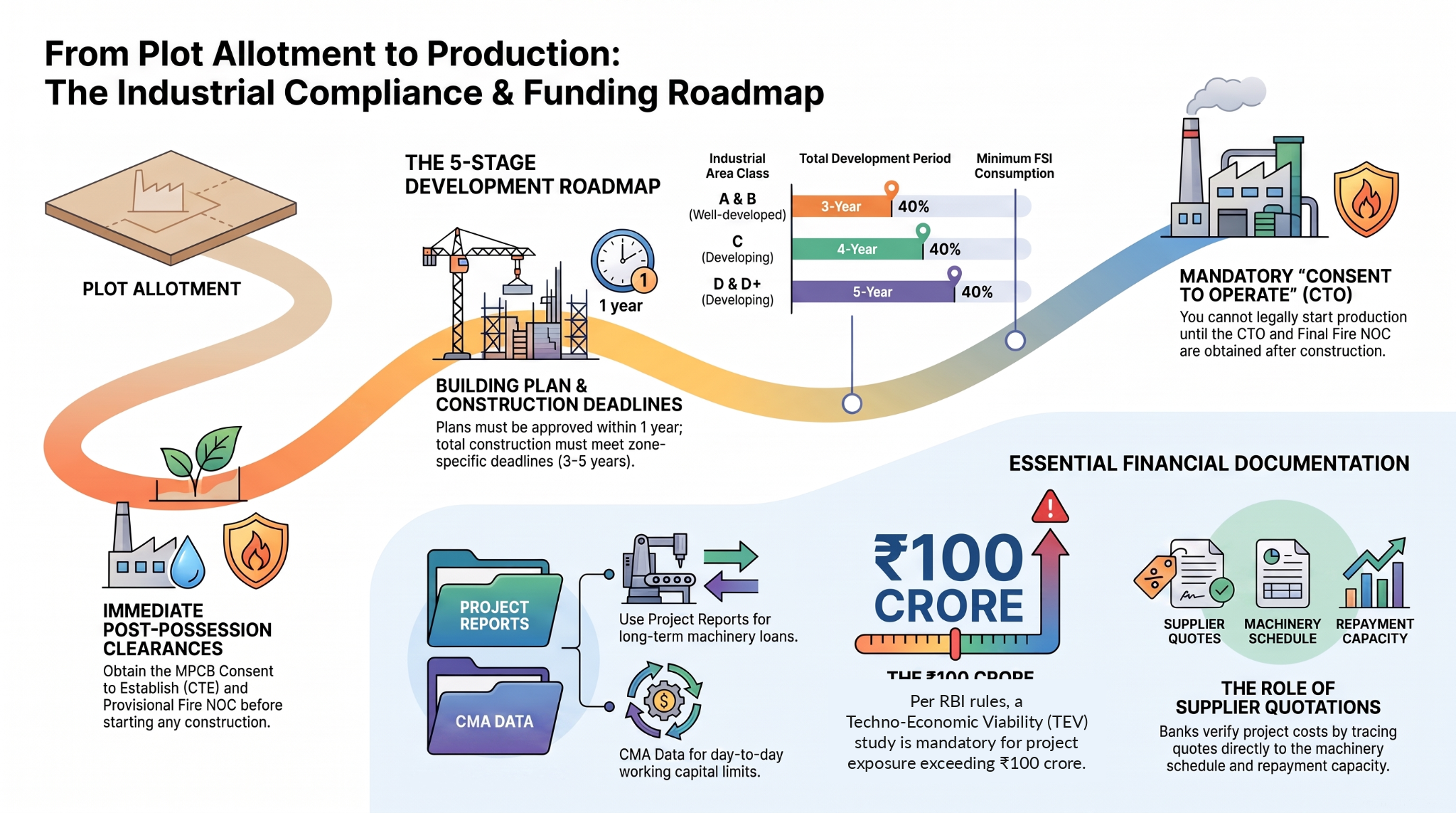
Stage 1: Right After You Take Possession
The moment you sign the Agreement to Lease and get physical possession, the development clock starts — not from when you’re ready, but from that date. Before you can even submit building plans, line up:
- Provisional IEM (Industrial Entrepreneur Memorandum) / Udyam registration
- Appointment of a licensed architect
- Appointment of a structural engineer
- MPCB Consent to Establish (CTE)—mandatory under the Water Act, 1974 and Air Act, 1981 before construction can legally start
- Provisional Fire NOC from the MIDC Fire Department
Skipping the CTE and starting construction anyway is a common shortcut applicants take—and it’s the one MPCB is least forgiving about later.
Stage 2: Getting Building Plans Approved
Your building plan approval has its own clock too—MIDC typically requires it within one year of possession, separate from the overall development deadline. This is submitted to the Special Planning Authority (SPA) along with:
- Sanctioned water connection request (temporary, for construction use)
- Sanctioned electricity connection request (temporary, for construction use)
- Drainage plan approval, where applicable
- Financial closure proof—bank loan sanction letter, if the project is debt-funded
Stage 3: How Long You Actually Have to Build
This is where a lot of plot holders lose track, because the deadline depends on which zone your plot falls in:
| Industrial Area Class | Total Development Period |
| A & B (well-developed areas) | 3 years |
| C | 4 years |
| D & D+ (developing areas) | 5 years |
Within this period, you’re required to consume a minimum of 40% FSI and obtain a Building Completion Certificate (BCC)—this figure was revised upward from 20% in 2019, so if you’re going by older advice or an older consultant’s checklist, the number is outdated. Miss this and MIDC charges extension fees calculated as a percentage of the prevailing plot rate, and repeated defaults can put the plot at risk of repossession.
Stage 4: Before You Can Legally Start Production
Construction being complete doesn’t mean you’re clear to run machines. This is the stage most applicants underestimate:
- MPCB Consent to Operate (CTO)—mandatory before starting commercial production, separate from and issued only after CTE
- Factory License from DISH (Directorate of Industrial Safety and Health), if your unit qualifies as a factory
- IEM Part B filing, confirming actual commencement
- Permanent water connection—including executing a formal Water Supply Agreement with MIDC, not just the construction-stage connection
- Permanent electricity connection and any required Electrical Inspector approval for transformers/high-load equipment
- CETP membership (Common Effluent Treatment Plant), where your industrial area has one
- Final Fire NOC, replacing the provisional one issued earlier
A plant that’s physically built but running on the temporary construction-stage water and power connections, without CTO, is not legally in production yet — even if machines are running.
Stage 5: What Continues After You’re Operational
A few conditions don’t end once production starts:
- No change of land use for 5 years from allotment
- No transfer or sub-letting of the plot for 5 years
- Original directors/shareholders must retain at least 51% holding for 5 years from possession, where applicable
- Only the same product or allied products declared in your application can be manufactured on the plot
- MPCB Consent to Operate needs periodic renewal — an application is due at least 60 days before expiry, and missing that deadline attracts a penalty of up to 10 times the consent fee
What Happens If You Fall Behind
MIDC does allow extension of the development timeline, but only if you can show “effective steps” already taken — CTE obtained, building plan submitted, architect and structural engineer appointed, financial closure done. An extension granted with none of this in place is unlikely, and going into production without a BCC at all is a compliance gap that surfaces later, usually during a transfer, expansion, or renewal application.
Because the sequence spans multiple departments — MIDC’s own planning wing, MPCB, DISH, the electricity board, and the fire department — the practical difficulty isn’t any single approval; it’s making sure applications for each go in at the right stage rather than out of order, since several of them (CTO after CTE, final Fire NOC after provisional) are conditional on the one before it. Where the underlying paperwork is a project report or a bank-funded project, Sharda Associates’ CA team helps applicants keep the financial and compliance timelines aligned so financing, construction, and licensing don’t end up working against each other.
Frequently Asked Questions
- What should I do after getting an MIDC plot?
After allotment, you generally need to complete plot possession, lease-related formalities, building approvals, utility arrangements, statutory registrations, and other applicable permissions before starting operations.
- What approvals are required to start a factory on an MIDC plot?
Depending on the project, approvals may include building plan approval, factory licence, MPCB consent, fire NOC, electricity connection, water connection, and other industry-specific permissions.
- Is an MIDC building plan approval mandatory?
Yes. The proposed industrial building and site development generally need approval from the appropriate MIDC authority before construction and use.
- Do I need MPCB approval for my MIDC industrial unit?
If your proposed activity falls under the applicable environmental regulations, you may need consent from the Maharashtra Pollution Control Board (MPCB), such as Consent to Establish and later Consent to Operate.
- When should I apply for a factory licence?
If your establishment qualifies as a factory under applicable laws, the required factory registration/licence should generally be completed before commencing manufacturing operations.
- What utility connections are required for an MIDC plot?
Common requirements include electricity, industrial water supply, drainage/sewerage, and other infrastructure services depending on the nature and scale of the project.
- Can I start production immediately after constructing the factory?
Not necessarily. Construction completion does not automatically mean you can begin production. Required operational, environmental, safety, factory and other statutory approvals should be obtained first.
- What documents are generally required for MIDC project approvals?
Common documents may include the MIDC allotment/lease documents, approved plans, project report, land-related documents, machinery details, identity and entity documents, utility applications and applicable statutory forms.
- How long does it take to complete MIDC pre-operation compliances?
The timeline varies depending on the industry, project size, construction status, approvals required and the authorities involved. Planning approvals early can help avoid delays in commercial operations.
- What is the best way to ensure an MIDC project is ready to start operations?
Prepare a pre-operation compliance checklist covering MIDC requirements, construction approvals, utilities, environmental permissions, factory compliance, fire and safety requirements, registrations and industry-specific licences before commencing production.