
An Indian business considering expansion into another country should evaluate much more than whether the overseas market is large. A cross-border feasibility study should test customer demand, pricing, local competition, market-entry structure, operating cost, taxation, foreign-exchange exposure, funding requirements and Indian overseas-investment compliance before significant capital is committed. Sharda Associates can support the CA-expert-led financial-feasibility side of international expansion, while country-specific legal, tax, regulatory and technical issues should be reviewed by qualified professionals in the relevant jurisdiction.
Why Is Overseas Expansion Different From Opening Another Indian Branch?
Suppose an Indian manufacturer has performed well in Maharashtra and wants to enter the UAE.
The tempting assumption is:
“The product already sells successfully in India, so we can use the same model abroad.”
But several things may change:
Customer expectations
Selling price
Distribution margins
Import duties
Labour costs
Warehousing
Taxation
Currency
Local licences
Payment cycles
A business model that generates a 15% margin in India may perform very differently in another country.
The feasibility question is therefore:
Can our Indian business model be adapted economically and legally to this specific foreign market?
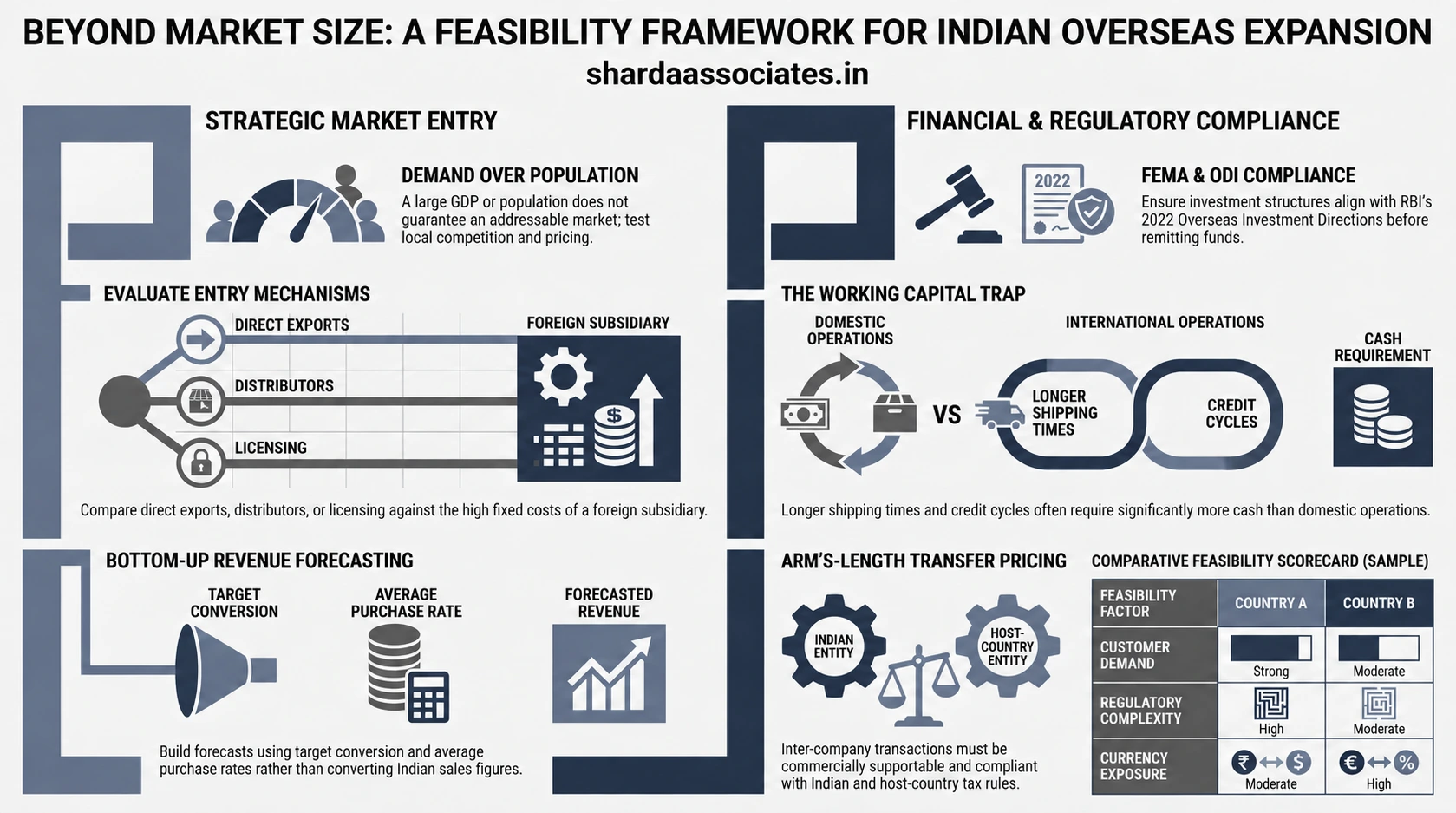
What Should You Test Before Choosing the Country?
Do not begin with company incorporation.
Begin with demand.
The feasibility study should first examine:
- Who would actually buy the product?
- How large is the realistic target segment?
- What local alternatives exist?
- What price will customers accept?
- How is the product currently distributed?
- Are buyers accustomed to importing?
- Are certifications or localisation required?
- How long is the typical sales cycle?
A large GDP or population does not automatically mean a large addressable market for your product.
For manufacturing expansion, market-entry feasibility work commonly combines macroeconomic analysis, market sizing, customer/end-user research, competitive presence and country-specific demand rather than relying on market size alone.
Should You Export First or Set Up a Foreign Company?
This is one of the most important feasibility decisions.
Possible approaches can include:
| Entry Approach | What the Business Should Test |
| Direct export | Freight, duties, distributor/customer economics |
| Local distributor | Distributor margin, control and customer access |
| Licensing/partner arrangement | IP, commercial control and revenue sharing |
| Foreign subsidiary | Setup cost, compliance, staffing and working capital |
| Joint venture | Partner quality, governance and economics |
| Local manufacturing | Capital cost, supply chain, market scale and regulatory requirements |
There is no universally best model.
If annual demand is still uncertain, building a factory immediately may create unnecessary fixed cost.
If the market is already substantial and import costs are high, local manufacturing may become worth studying.
The feasibility analysis should compare alternatives rather than assuming that overseas expansion automatically means opening a foreign subsidiary.
What Does FEMA Have to Do With Overseas Expansion?
If an Indian entity invests in a foreign entity, Indian foreign-exchange rules become relevant.
RBI’s current Foreign Exchange Management (Overseas Investment) Directions, 2022, operate alongside the Overseas Investment Rules and Regulations and govern overseas investment by persons resident in India. The framework covers matters such as permitted overseas investment, financial commitments, reporting and specified approvals/NOCs where applicable.
This means the feasibility study should not only ask:
“Can we afford the foreign subsidiary?”
It should also ask:
“Can the proposed investment structure be implemented under the applicable Indian overseas-investment framework?”
The exact compliance steps depend on the investment structure and facts, so they should be checked before funds are remitted.
What If the Indian Business Already Has Bank Borrowings?
This can matter.
RBI’s Overseas Investment Directions include provisions concerning No Objection Certificates from lender banks, regulatory bodies or investigative agencies in specified circumstances.
This should not be interpreted as meaning that every company with a bank loan automatically needs the same approval.
Instead, the feasibility process should identify early whether the proposed overseas investment triggers any lender-related or regulatory condition.
Finding this out before incorporation is far easier than discovering it when money needs to be remitted.
How Should You Forecast Foreign-Market Revenue?
Do not take Indian sales and simply convert them into dollars, dirhams or euros.
Build the overseas revenue separately.
A useful bottom-up approach may be:
Target Customers × Expected Conversion × Average Annual Purchase = Revenue
For a distributor model:
Distributor Volume × Net Realisation to Indian Company = Revenue
For local retail:
Stores × Customers × Average Transaction × Operating Days = Revenue
Then test whether the local team, supply chain and working capital can actually support that volume.
Illustrative Example
Suppose an Indian food company evaluates a foreign market.
| Assumption | Base Case |
| Distributors | 5 |
| Average annual purchases/distributor | ₹40 lakh equivalent |
| Gross overseas sales | ₹2 crore equivalent |
| Distributor/logistics/local costs | ₹60 lakh equivalent |
| Other overseas operating cost | ₹80 lakh equivalent |
These figures are illustrative.
The feasibility question is not simply whether ₹2 crore revenue sounds attractive.
Ask:
- Can five distributors realistically be signed?
- How much time will that take?
- Who funds inventory?
- What is the local selling price?
- What currency will invoices use?
- How quickly will customers pay?
Revenue should be tested against the market-entry mechanism.
Why Is Foreign-Exchange Risk Important?
Imagine the foreign subsidiary earns revenue in one currency while:
- Machinery is purchased in another currency
- Indian funding is measured in rupees
- Raw material is sourced from India
- Local salaries are paid in the host-country currency
Currency movements can affect both profit and cash requirements.
The feasibility model can therefore test:
Base FX Case
Expected exchange-rate assumption for planning.
Adverse FX Case
What happens if the relevant currency movement makes imports, repayments or local costs more expensive?
Favourable FX Case
What happens if exchange rates improve economics?
A forecast should not pretend exchange rates can be predicted perfectly.
The purpose is to understand the project’s exposure.
How Can Transfer Pricing Affect the Business Model?
This becomes relevant when an Indian company and its overseas associated enterprise transact with each other.
Examples could include:
- Indian parent sells goods to foreign subsidiary
- Foreign subsidiary provides marketing services
- Indian company licenses technology or brand
- Group entities provide loans or support services
Indian transfer-pricing rules require applicable international transactions with associated enterprises to be considered on an arm’s-length basis. The Income Tax Department defines arm’s-length price broadly as the price that would apply between unrelated parties under uncontrolled conditions.
This matters to feasibility.
Suppose the financial model assumes the Indian parent sells products to the foreign subsidiary at an artificially low internal price merely to make the overseas entity appear profitable.
That may not represent a sustainable or compliant economic model.
The feasibility analysis should consider commercially supportable inter-company pricing rather than using arbitrary group prices.
What Tax Questions Should Be Checked Before Expansion?
A cross-border feasibility study should identify tax questions early, but it should not pretend one general India-based report can determine every foreign tax liability.
Depending on the structure, questions can include:
- Host-country corporate tax
- Withholding taxes
- Customs/import duties
- VAT/GST or equivalent indirect tax
- Permanent-establishment exposure
- Transfer pricing
- Dividend/profit repatriation
- Applicable tax treaty
- Employee/payroll obligations
Country-specific tax advice should come from professionals familiar with the relevant jurisdiction.
The feasibility model should then incorporate the applicable verified tax treatment.
Why Does Working Capital Often Increase During Overseas Expansion?
Foreign-market expansion can consume cash before it generates profit.
You may need money for:
- Overseas inventory
- Shipping time
- Customs clearance
- Warehouse stock
- Distributor credit
- Customer receivables
- Local payroll
- Rent
- Marketing
- Regulatory approvals
Suppose domestic customers pay in 30 days but overseas distributors require 90-day credit.
Even if the overseas margin is attractive, the business may need significantly more cash.
This is why the model should calculate:
Profitability AND cash requirement.
How Should You Compare Countries?
Do not compare markets only by revenue potential.
A practical feasibility scorecard can compare:
| Factor | Country A | Country B |
| Customer demand | Strong | Moderate |
| Pricing potential | Moderate | Strong |
| Competition | High | Moderate |
| Setup cost | High | Low |
| Logistics | Moderate | Strong |
| Regulatory complexity | High | Moderate |
| Currency exposure | Moderate | High |
| Expected cash requirement | High | Moderate |
The labels above are illustrative.
The actual score should come from country-specific research.
This can reveal a useful truth:
The biggest market is not always the best first market.
A smaller country with easier distribution and lower setup cost may be a better initial expansion choice.
What Scenarios Should the Financial Model Test?
A foreign expansion should rarely rely on one perfect forecast.
Useful scenarios include:
Slower Market Entry
Customer acquisition takes longer.
Lower Selling Price
Competitive pressure reduces price.
Higher Local Cost
Rent, salaries or logistics exceed estimates.
Currency Stress
Exchange rates move adversely.
Longer Receivable Period
Customers take longer to pay.
Then ask:
How much additional funding would be required?
Does the expansion still break even?
Would India operations need to support the overseas business for longer?
These questions often matter more than the headline revenue forecast.
What Should Be Decided Before Money Is Invested?
A good cross-border feasibility study should help management reach a clear decision:
Go now
Pilot/export first
Enter through distributor
Form local subsidiary
Use JV/partner
Delay entry
Reject market
The purpose is not to prove that overseas expansion is a good idea.
The purpose is to determine whether it is a good idea under the proposed structure and assumptions.
How Can Professional Review Help?
A financial advisor or CA can help test:
Market Revenue → Gross Margin → Local Costs → Tax → Working Capital → Cash Flow → Funding Requirement → Return/Viability
Sharda Associates can support these financial-feasibility calculations from the Indian business perspective.
But specialist advice may also be needed from:
- Host-country tax advisor
- Local legal counsel
- FEMA/ODI specialist
- Customs/trade expert
- Industry specialist
Cross-border feasibility is inherently multidisciplinary.
Final Takeaway
Indian businesses should not treat overseas expansion as simply a larger domestic sales opportunity.
A reliable feasibility study asks:
Is there real demand?
What entry model should we use?
How much capital will be required?
What happens to margins after local costs?
How much working capital is tied up?
What currency risk exists?
Does the investment structure comply with India’s overseas-investment framework?
How will related-party international transactions be priced?
When these questions are answered before capital is committed, management can make a much better cross-border decision.
Frequently Asked Questions
1. Can an Indian company set up a subsidiary abroad?
Indian entities may undertake overseas investment subject to the applicable FEMA Overseas Investment Rules, Regulations and RBI Directions.
2. Is RBI approval required for every overseas investment?
Not every overseas investment follows the same approval process. The applicable route and requirements depend on the structure and circumstances.
3. Should a business export before setting up a foreign subsidiary?
It can be a useful market-testing approach in some cases, but the best entry model depends on demand, costs, regulation and commercial strategy.
4. What should a foreign-market feasibility study include?
It should consider market demand, entry structure, pricing, competition, operating cost, tax, currency exposure, working capital and funding.
5. How does foreign exchange affect feasibility?
Currency movements can change import costs, reported revenue, inter-company payments and cash requirements.
6. What is transfer pricing in cross-border expansion?
It concerns pricing applicable transactions between associated enterprises, such as an Indian parent and overseas subsidiary, using arm’s-length principles where the Indian transfer-pricing rules apply.
7. Can the Indian parent finance its foreign subsidiary?
Different forms of overseas financial commitment are regulated under the applicable Overseas Investment framework. The proposed structure should be checked before funding.
8. Does a profitable overseas forecast mean the market is feasible?
Not necessarily. The company must also consider cash requirements, regulations, operating execution, currency and implementation risk.
9. Do I need foreign tax advice before expansion?
Country-specific professional advice is advisable where local corporate, indirect, payroll, withholding or other taxes can materially affect the project.
10. Can a feasibility consultant guarantee that overseas expansion will succeed?
No. Feasibility analysis improves decision-making but cannot remove market, regulatory or business risk.