
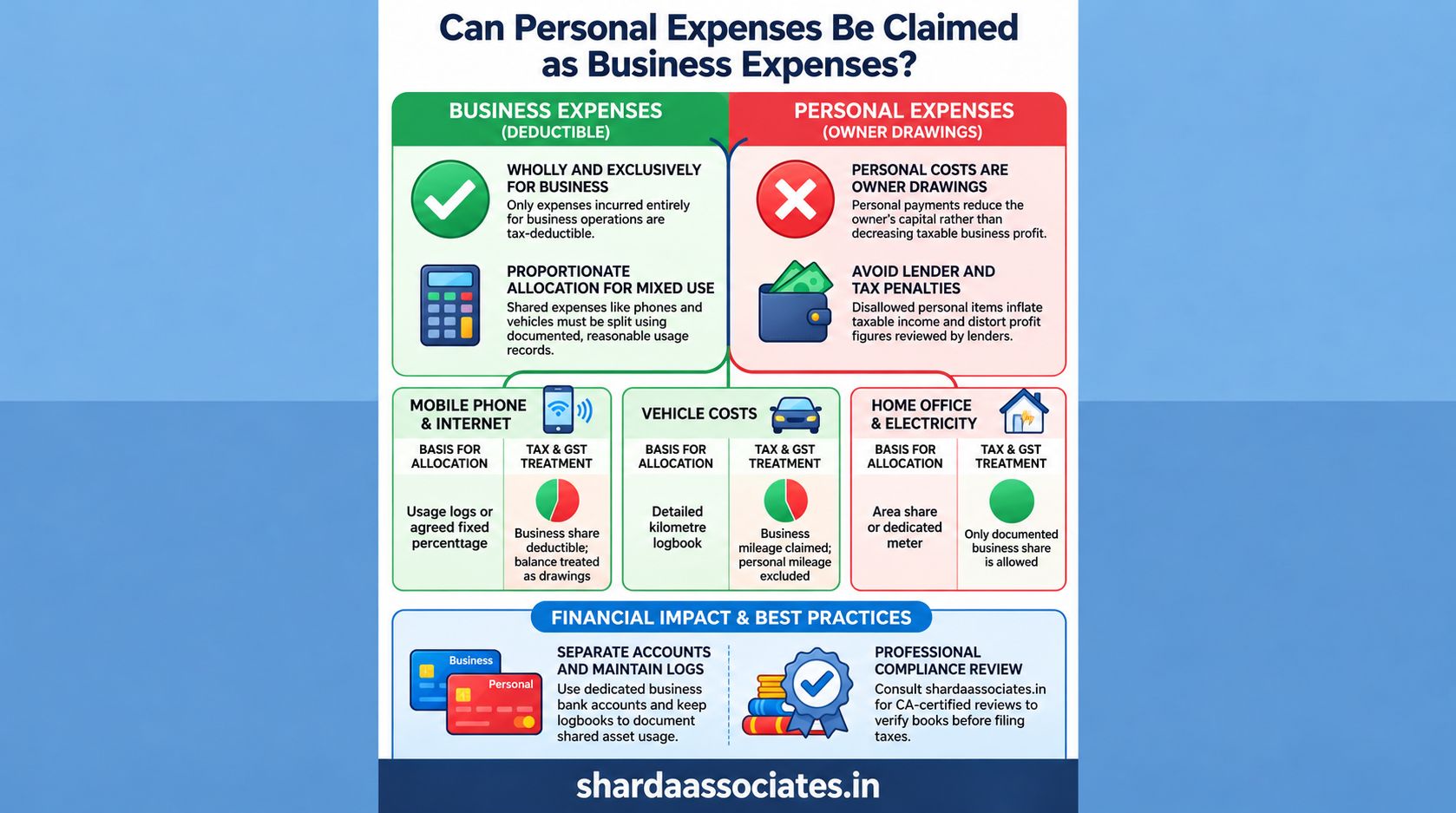
Short answer: No. Only expenses incurred wholly and exclusively for the business are deductible, and personal expenses are excluded. If an item is used partly for business and partly for personal use, such as a phone, vehicle or home office, only the business share can generally be claimed, based on a reasonable and documented split. Under GST, ITC is not available for goods or services used for personal consumption.
The line between personal and business spending looks clear until a proprietor pays a phone bill, a car instalment or an internet plan from the business account. Many owners then ask whether it is all deductible, partly deductible or not at all.
Sharda Associates is a CA-led firm that has prepared over 45,500 CA-certified reports. Lenders examine profit carefully, and a profit and loss account with personal items inside it gives a distorted picture of the business.
This guide explains the rule, how to split mixed-use items, the GST position and the habits that keep records clean. It is general information. The Income-tax Act, 2025, has been in force from 1 April 2026 with renumbered sections, so confirm section references with your CA.
What Is the Basic Rule?
Section 37(1) of the Income-tax Act, 1961, allows deduction of expenditure laid out wholly and exclusively for business, and it excludes capital and personal expenditure. Personal expenses of a proprietor are not business expenses; however, they are paid. A payment from the business account for a personal purpose is not an expense; it is the owner’s drawing.
What Are Drawings and Why Do They Matter?
For a proprietorship or partnership, money taken out for personal use is recorded as drawings, not as an expense. Drawings reduce the owner’s capital but do not reduce profit. Recording them as expenses reduces profit incorrectly and invites adjustment.
How Are Mixed-Use Items Treated?
Where an asset or service is used partly for business and partly for personal purposes, the deduction is generally limited to the business portion, supported by a reasonable basis. For buildings, machinery and similar assets used partly for business, the law provides for apportionment as well.
| Item | Mixed use | A reasonable basis to consider |
| Mobile phone and internet | Business and personal calls | Usage records or an agreed percentage |
| Vehicle | Business trips and family use | Logbook of trips and kilometres |
| Home office | Part of the house used for work | Area used for business |
| Electricity | Shop and residence in the same premises | Separate meter or area share |
What Is the GST Position?
GST does not allow ITC on goods or services used for personal consumption, and for items used partly for business and partly for non-business, credit is limited to the business share. Claiming full ITC on a mixed-use item can lead to a reversal with interest.
Does This Differ for Companies and Firms?
For a company, personal expenses of directors or shareholders are not business expenses of the company, and they may be treated as perquisites, drawings or loans depending on the facts. For firms, partners’ personal expenses are treated as drawings. Check the treatment with a CA for your structure.
What Happens If You Claim Personal Expenses?
Personal items found in the accounts can be disallowed, which raises taxable income and may attract interest and penalties. Lenders also adjust profit, which can reduce the loan amount or increase questions. Even small items add up when they are repeated.
How Do You Keep Records Clean?
- Use separate bank accounts and credit cards for business and personal use
- Pay for personal items from the personal account
- Record owner withdrawals as drawings
- Keep logbooks or usage notes for mixed-use items
- Review the ledger monthly for items that look personal
A Worked Example of Splitting a Mixed-Use Expense
Here is an illustration with made-up figures. A proprietor pays ₹30,000 a year for a mobile phone and internet plan used for both work and family. A usage review shows about 60% of the use is for business, so ₹18,000 is claimed as a business expense, and the remaining ₹12,000 is treated as drawings. For a vehicle with running costs of ₹120,000 a year, a logbook shows 70% of the kilometres were for business, so ₹84,000 is claimed and ₹36,000 is a personal cost. The percentages come from records, not from a guess, and they are applied the same way every year unless usage changes.
What Do Lenders Do with Personal Items in Your Accounts?
Lenders and CAs who prepare CMA data look for items that do not belong in the business, and they may adjust profit and net worth when they find them. If your accounts mix personal costs with business costs, the profit shown can be lower than the true business profit, which understates repayment capacity. If personal costs are removed correctly, the profit is cleaner and easier to defend.
Which Everyday Items Are Commonly Misclassified?
| Item | Usual treatment |
| Family holiday | Personal, not deductible |
| Household groceries | Personal, treated as drawings |
| Personal life or health insurance | Personal, not a business expense |
| Fuel for the family vehicle | Personal, unless business use is documented |
| Client meeting travel | Business, with a record of the purpose |
Conclusion
The rule is simple even if the habits are hard: business expenses go in the books, personal expenses stay out, and mixed items are split on a basis you can explain. A clean line makes tax filing easier and makes your profit believable to a lender.
The easiest fix is structural. Separate accounts, a drawings entry and a logbook for shared items turn an uncertain judgement into a routine record.
If you would like your books reviewed for personal items before filing or a loan application, call Sharda Associates on +91 89899 77769. Outcomes depend on the facts, so no result can be promised.
Frequently Asked Questions
1. Can I claim my personal expenses in my business?
No. Only expenses wholly and exclusively for the business are deductible.
2. What if an item is used for both?
Generally only the business share can be claimed, on a reasonable and documented basis.
3. How do I treat a phone bill used for business and personal calls?
Claim the business portion using usage records or an agreed percentage.
4. Can I claim vehicle expenses?
For business use, yes, with records such as a logbook. Personal use is not deductible.
5. What are drawings?
Money the owner takes for personal use, which reduces capital but not profit.
6. Can I claim ITC on personal purchases?
No. GST does not allow ITC on goods or services for personal consumption.
7. Will personal expenses in my books be a problem?
They can be disallowed, which increases taxable income, and lenders may adjust profit.
8. Is it different for a company?
Yes, a director’s personal expenses are not the company’s business expenses, and the treatment depends on the facts.
9. Is the rule different under the new Income-tax Act, 2025?
The principle is similar, but section numbers differ, so check current references.
10. Can a CA help split mixed-use expenses?
Yes, a CA can help set a reasonable basis and record it.