
Project Report for Biogas Bottling Plant
A biogas bottling facility converts farm waste, animal manure, or food waste into compressed biogas (CBG) and sells it as a transportable, CNG-equivalent fuel, backed by India’s SATAT scheme, which requires blending and virtually assures a market for each cylinder produced. It is capital-intensive, yet feedstock-driven and policy-supported. Sharda Associates creates CA-certified CBG plant project reports. Starting at Rs.2,999 and ready in 24-48 hours.
Get Your Report
What Does a Biogas Bottling Plant Actually Do?
A typical biogas plant produces gas for immediate, on-site usage — cooking and power generation right where it is produced. A bottling plant goes a step further by scrubbing raw biogas (which is naturally only around 60% methane, mixed with CO2 and impurities such as hydrogen sulfide) to 95%+ methane purity, compressing it to 200-250 bar, and filling it into steel cylinders for transport and sale, making it functionally interchangeable with CNG in vehicles, industrial burners, and even domestic kitchens.
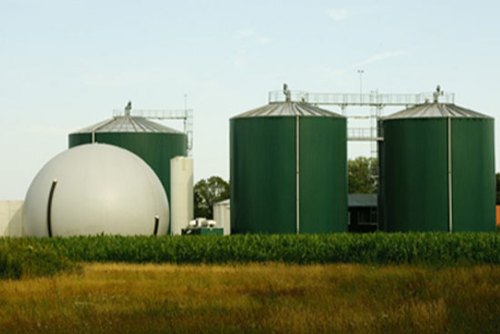
The feedstock — cattle dung, agricultural residue, food/kitchen waste, or press mud from sugar mills — goes into anaerobic digesters first, producing raw biogas, which then moves through your purification and compression line. The solid/liquid digestate left over is sold separately as organic fertilizer — a genuine secondary revenue stream, not just a waste byproduct.
This is fundamentally a feedstock-availability business as much as a manufacturing one — your plant’s output depends entirely on having a steady, contracted supply of organic waste, which is exactly why most successful CBG plants are located near dairy farms, sugar mills, agricultural belts, or municipal waste collection points rather than just anywhere convenient.
How Does a CBG Plant Make Money?
1. CBG Sale (the primary revenue)
CBG is typically priced at 85% of the current retail CNG price; this benchmark is a real, government-supported pricing mechanism, not a rough estimate, because SATAT guarantees offtake at this linked rate from authorized buyers (Oil Marketing Companies and industrial users).
To compute revenue (a plant generating 5 tonnes/day of CBG, sold at about Rs.48,000-50,000/tonne — 85% of an approximate CNG-equivalent rate), multiply 5 × Rs.49,000 to get roughly Rs.2.45 lakh/day, or around Rs.61-73 lakh/month at full, continuous production.
2. Organic Fertilizer (Digestate) Sales (secondary)
The remaining digestate from the anaerobic digestion process is converted into Fermented Organic Manure (FOM) or liquid fertilizer, which is then sold to farmers and agri-input companies. This isn’t a minor afterthought – digestate sales may significantly increase monthly revenue for a mid-sized facility, and government programs are increasingly supporting its marketing as part of the larger “waste-to-value” push.
The P&L of a Biogas Bottling Plant
Feedstock costs vary greatly depending on whether you have a free/cheap supply tie-up (dairy farm waste, agri-residue that would otherwise be discarded) or are paying market rate for collected municipal/food waste — this is the single most variable cost line, and ranges from near-zero (if waste is essentially free at the source) to a significant ongoing expense if you’re paying for collection and transport.
The purification (scrubbing) and compression stages consume a significant amount of power; compressing gas to 200-250 bar is energy-intensive, costing approximately Rs.1.5-3 lakh per month for a mid-scale operation.
Plant operators, feedstock handling staff, and maintenance technicians often earn Rs.1-2 lakh per month combined for a mid-scale operation due to the technical nature of digester and compression equipment management.
Maintenance for the digesters, scrubbing system, and high-pressure compressors is a real, recurrent cost — Rs.40,000-1,00,000 per month — because this is mechanically intensive equipment that runs continually.
P&L overview (5 tonnes/day, ~Rs.65 lakh/month combined CBG and digestate revenue): Feedstock (assuming a moderately priced tie-up, not free): Rs. 10 lakh. Power: Rs. 2.5 lakh. Labour costs Rs. 1.5 lakh. Maintenance costs Rs.70,000. At this scale, the net margin is roughly Rs.45-50 lakh/month, which demonstrates why well-managed, well-fed CBG plants may be truly high-margin once feedstock supply is guaranteed, albeit reaching constant full-capacity output in practice takes time to ramp up to.
What Actually Decides Profitability
The purification and compression technology is essentially standardized at this point; what distinguishes a profitable CBG plant from a struggling one is the availability of a secure, contracted, and constant feedstock supply.
Secure feedstock (good): a long-term supply agreement with a dairy cooperative, sugar mill, or municipal corporation for waste collection ensures that your digesters operate at steady capacity and that your CBG output (and revenue) is predictable month after month.
Insecure feedstock (bad): relying on ad hoc, uncontracted waste collection causes digester feed volume to fluctuate, directly reducing gas output below plant capacity — and because fixed costs (power, labor, and maintenance) do not decrease with reduced feedstock, this is the single most common reason CBG plant projections fail to materialize in practice.
This is precisely why banks and NABARD want verified feedstock supply agreements as part of a CBG plant project report, rather than simply assuming that “waste is available locally.”
Licenses, SATAT, and Compliance
SATAT scheme registration (Sustainable Alternative Towards Affordable Transportation) is the central government framework that connects your plant to mandated CBG offtake by Oil Marketing Companies — registering under SATAT is effectively how you secure a guaranteed buyer for your output, making it a necessary rather than optional step.
You’ll additionally require Petroleum and Explosives Safety Organisation (PESO) approval for high-pressure gas storage and cylinder handling, pollution control board clearance (due to the waste processing and digestate handling), and Udyam/MSME certification.
GST on CBG is currently set at a concessional rate to encourage adoption (significantly lower than standard fuel taxation), which is a genuine policy support point worth accurately reflecting in financial projections; however, rates can be revised, so the current applicable rate should be verified at the time of filing.
What Will It Actually Cost You to Set Up?
Setup | Approximate Cost (₹) |
Small plant (1-2 tonnes/day CBG capacity) | Rs.2-4 crore |
Mid-scale plant (5 tonnes/day capacity) | Rs.6-10 crore |
Large-scale plant (10+ tonnes/day) | Rs.12-20 crore+ |
This includes anaerobic digesters, a gas purification/scrubbing system, high-pressure compression units, cylinder storage/handling infrastructure, feedstock collection/transport setup, and digestate processing equipment; CBG plants are truly capital-intensive due to the specialized compression and purification technology involved.
Given the magnitude, CBG plants often use NABARD’s Agriculture Infrastructure Fund (sometimes with interest subsidy) or PMEGP for smaller-scale projects, as well as dedicated government CBG/biogas capital subsidy schemes under SATAT.
Why Work With Sharda Associates on This?
- We’ve completed over 45,500 project reports, and CBG/biogas bottling plants are one category where banks and NABARD prefer verified feedstock supply agreements over generic availability assumptions – this is the single most important element in determining whether financing is authorized.
- We model revenue using the actual SATAT-linked CBG pricing benchmark (tied to CNG rates) rather than an arbitrary number, treat digestate/organic fertilizer as a legitimate secondary revenue line rather than ignoring it, and ensure that SATAT registration, PESO approval, and NABARD’s specific documentation requirements for biogas infrastructure projects are all met.
- Aside from compiling the project report, Sharda Associates offers comprehensive assistance in developing realistic financial forecasts, such as feedstock procurement prices, plant utilization, CBG production estimates, bottling capacity, operating expenses, cash flow, DSCR, and profitability analysis.
- Starting at Rs.2,999 · 24-48 Hours +91 89899 77769
Frequently Asked Questions
A biogas bottling plant project report is prepared by analysing plant capacity, raw material availability, technology requirements, machinery, investment cost, operating expenses, revenue projections, and financial feasibility.
To start a biogas bottling plant, an entrepreneur needs to identify suitable feedstock sources, select plant technology, arrange land and infrastructure, install required equipment, obtain approvals, and prepare a detailed business plan.
The investment depends on plant capacity, machinery selection, land requirement, purification and compression systems, storage facilities, and working capital requirements.
A bank loan project report includes promoter details, project overview, technical details, plant capacity, machinery, project cost, means of finance, production estimates, sales projections, profitability analysis, and repayment capacity.
A biogas bottling plant converts organic waste into biogas through anaerobic digestion. The gas is purified, upgraded, compressed, and stored for commercial use as compressed biogas (CBG).
Profitability is calculated by considering feedstock availability, biogas production capacity, CBG selling price, operating expenses, manpower cost, electricity consumption, maintenance costs, and transportation expenses.
Machinery selection depends on plant capacity, type of raw material, gas purification technology, compression requirement, storage capacity, and quality standards.
Financial projections are prepared by estimating production capacity, CBG sales, raw material costs, employee expenses, electricity costs, maintenance expenses, depreciation, and expected profits.