
Project Report For Online Pharmacy
Introduction
The Project Report for Online Pharmacy provides a detailed and updated business analysis for launching an e-pharmacy platform in 2026. An online pharmacy, also known as an e-pharmacy or internet pharmacy, is a digital platform that allows customers to order prescription and over-the-counter medicines through a website or mobile application, with home delivery services. The rapid digital transformation in healthcare, growing internet penetration, and rising demand for convenience have significantly accelerated the growth of online pharmacies worldwide.
In 2026, the e-pharmacy model has evolved beyond simple medicine delivery. Modern platforms integrate teleconsultation services, e-prescriptions, digital health records, AI-based drug recommendations, subscription medicine refills, diagnostic booking, and wellness product sales. Customers can upload prescriptions, consult licensed doctors remotely, compare medicine prices, and receive doorstep delivery within hours in urban areas. This digital convenience is gradually transforming the traditional pharmacy ecosystem.
The Project Report highlights that online pharmacies are particularly beneficial for elderly patients, individuals with chronic diseases, disabled persons, and those living in remote areas with limited access to physical pharmacies. Privacy is another strong advantage, as customers can discreetly order medications related to sensitive health conditions without face-to-face interactions. With increasing smartphone usage and improved logistics networks, online pharmacies are becoming an integral part of the healthcare supply chain.

It is very easy to order prescription drugs through E-Pharmacy. Especially for people who live far away from a traditional pharmacy, the elderly, disabled people, and those who work very intensively, this system is both a very easy and a very fast method of obtaining medicine. Additionally, the shipping cost is much cheaper than traveling to a traditional pharmacy.
Advantages of Online Pharmacy:
- Using E-Pharmacy to purchase prescription medications is quite simple. This technique is a very simple and quick way to get medicine, especially for persons who live far from a typical pharmacy, the elderly, the crippled, and those who work very hard. Additionally, shipping is far less expensive than going to a conventional drugstore.
- Time savings is one of the E-Pharmacy application’s most significant benefits. You may simply get your medication online and receive your prescription drugs. All you need to do is use the mobile application or online to place an order by entering the prescription. There is no need for you to visit the pharmacy, and there will be no need for you to stand in line there.
- Privacy and secrecy are two other benefits of using an online pharmacy. For those who are uncomfortable speaking with doctors and pharmacists in person, this technique is very helpful. Additionally, there are no restrictions on ordering drugs related to sensitive topics like sexuality or puberty that can be embarrassing.
Market Potential and Financial Outlook (2026–2031)
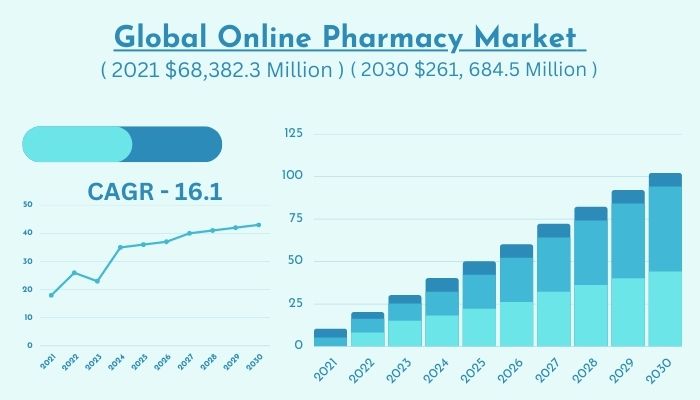
The global online pharmacy market was valued at approximately USD 68 billion in 2021 and is projected to reach over USD 260 billion by 2030, growing at a CAGR of around 16%. As of 2026, the industry continues to expand rapidly due to increased adoption of telehealth services, e-prescriptions, and digital healthcare platforms. Rising chronic disease prevalence, aging populations, and growing healthcare awareness are major contributors to this growth.
One of the strongest growth drivers is the expansion of teleconsultation services. Patients can now consult doctors remotely, receive electronic prescriptions, and immediately place orders through e-pharmacy platforms. Integration with electronic health record (EHR) systems further enhances operational efficiency and customer convenience. Additionally, shortages of healthcare professionals in certain regions have accelerated telehealth adoption, indirectly supporting the growth of online pharmacies.
In developing countries, increasing internet access and smartphone penetration are enabling wider adoption of digital healthcare services. In urban regions, same-day or next-day medicine delivery services provide competitive advantages over traditional pharmacies. In rural areas, online pharmacies improve access to essential medicines that may not be readily available in local stores.
Financially, e-pharmacy businesses offer scalable growth potential. Gross profit margins on medicines typically range between 15% and 30%, depending on procurement strategies and product mix. Subscription and recurring refill models improve customer retention and lifetime value. Break-even for a well-managed mid-scale online pharmacy platform can typically be achieved within 3–5 years, depending on customer acquisition costs and operational efficiency.
In conclusion, this Project Report for Online Pharmacy demonstrates that the e-pharmacy sector in 2026 represents one of the fastest-growing segments in digital healthcare. With increasing reliance on telemedicine, expanding chronic disease management needs, and rising consumer preference for convenience and privacy, online pharmacies are poised for sustained long-term growth. Strategic compliance management, strong technology infrastructure, efficient logistics networks, and customer trust are key success factors. This Project Report confirms that with proper planning and execution, the online pharmacy business offers strong scalability, recurring revenue potential, and significant market opportunity in the evolving healthc
Business Model, Operations and Regulatory Framework
The Project Report for Online Pharmacy outlines several operational models for 2026. The first is the marketplace model, where the platform connects licensed pharmacies with customers and earns commission per order. The second is the inventory-led model, where the company maintains its own stock of medicines and manages direct sales and delivery. The third is a hybrid model combining both marketplace and inventory approaches, along with telemedicine integration.
To start an online pharmacy business in India or globally, compliance with pharmaceutical and healthcare regulations is mandatory. The platform must partner with licensed pharmacists and ensure valid prescription verification for restricted medicines. Drug storage facilities must meet regulatory standards for temperature control and quality maintenance. Integration with digital health record systems and secure payment gateways is essential to protect patient data and ensure privacy compliance under health data protection laws.
Technology infrastructure plays a critical role in operational success. A robust website and mobile app, secure prescription upload system, automated order management, AI-driven inventory tracking, and last-mile delivery partnerships are essential components. Many e-pharmacies in 2026 also integrate teleconsultation services, allowing patients to consult doctors online and receive e-prescriptions instantly. Subscription-based medicine refills for chronic conditions such as diabetes, hypertension, and heart disease create recurring revenue streams.
Investment requirements vary depending on scale. A small-to-mid-level e-pharmacy startup may require ₹1.5 to ₹5 crores, covering technology development, licensing, warehousing, marketing, logistics partnerships, and working capital. Larger platforms with nationwide operations may require higher capital investment due to expanded inventory and delivery networks. Revenue streams include medicine sales margins, subscription services, teleconsultation fees, advertising partnerships, and diagnostic booking commissions
Project Report Sample On Online Pharmacy
Need Help?
Create 100% Bankable Project Report