
Introduction
The project report for the stitching unit is as follows.
A stitching unit, referred to as a garment manufacturing cell, is the heart of the textile business. It forms the link between a flat piece of fabric and a finished, wearable garment. In layman’s terms, a stitching unit is a specialized facility where cloth is cut, joined, and sewed together using industrial technology to produce everything from basic t-shirts and uniforms to haute couture.
While traditional tailoring focuses on one-off items, a modern stitching unit is designed for mass manufacturing, guaranteeing that each piece is similar in size, quality, and finish.
A stitching unit is usually broken into three sections: cutting, sewing, and finishing. The procedure starts in the cutting room, where vast rolls of cloth are laid out and cut into precise patterns with electric cutters. These “panels” (which include sleeves, collars, and fronts) are then packed and delivered to the sewing floor.
In a professional unit, this is done using an assembly line approach rather than one individual sewing an entire garment. One operator might merely sew the collars, while another connects the sleeves and finishes the side seams. This separation of work provides both speed and consistency in quality.
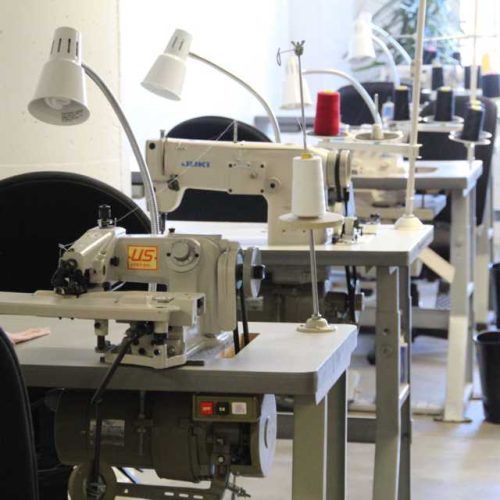
Benefits Of Stitching Unit
Minimal Capital Expenditure
A stitching unit is a very accessible business for novice entrepreneurs because it requires little equipment and a tiny workplace. As demand rises, it enables a progressive scale-up.
Creation of Employment
For skilled and semi-skilled workers, these units offer steady employment prospects, especially in nearby communities. It is essential to maintaining the livelihoods of craftspeople and tailors.
High Demand in the Market
A consistent flow of orders is guaranteed throughout the year due to the ongoing demand for corporate clothing, school uniforms, and trendy clothes. Depending on seasonal trends, you can quickly switch between several apparel sectors.
Government Subsidy Benefits
Numerous small-business and textile programs provide funding and incentives for establishing production facilities. This lowers the initial cost of buying industrial sewing machines considerably.
Upcycling and Waste Management
You can manage fabric scrap, which can be turned into accessories or smaller products, by running your own unit. This lowers material waste and gives your company an additional layer of “sustainable” profit.
Market Potential Of Stitching Unit
The market potential for a stitching unit is currently at an all-time high, driven by the global shift toward “Fast Fashion” and rising demand for ready-made clothing. In India, the textile and clothing business is expected to develop at a CAGR (Compound Annual Growth Rate) of 10%, reaching a stunning $350 billion by 2030. This expansion is not confined to major factories; small and medium-sized stitching units are becoming the industry’s backbone by delivering “Small-Batch Production,” which allows firms to debut new designs rapidly without the risk of having too much unsold stock.
The government is also heavily involved in making this a profitable enterprise. Schemes such as the Production Linked Incentive (PLI) and the establishment of PM MITRA textile parks offer subsidies and improved infrastructure for new units. Furthermore, the industrial sewing machine market in India is expanding at a 7.7% CAGR, as facilities upgrade to computerized and automated machines for greater precision. These technical developments enable even a 10-machine operation to compete with larger firms by producing high-quality finishes and “zero-defect” products.
Project Report Sample On Stitching Unit
Need Help?
Create 100% Bankable Project Report