
Project Report For Solar Water Heater Manufacturing
Introduction
Project report for Solar Water Heater Manufacturing is as follows.
By 2026, solar water heating will have evolved from a “rooftop luxury” to a vital component of industrial and urban infrastructure. The basic concept is heating a fluid (often water or a glycol-based heat transfer fluid) by absorbing solar energy, but the 2026 manufacturing requirements have brought about a level of efficiency that was previously unthinkable. The “Solar Thermal” industry has experienced a huge comeback as the most economical means of decarbonizing residential and commercial heating, as electricity prices have reached all-time highs worldwide.
Project Report Sample On Solar
Water Heater Manufacturing
Get Completely Custom Bankable Project Report
The transition from “Passive” to “Active Intelligent” systems characterizes the industry in 2026. The industry’s mainstays, the traditional Evacuated Tube Collector (ETC) and Flat Plate Collector (FPC), are now combined with “Phase Change Materials” (PCMs). By acting as “thermal batteries,” these materials enable the system to store heat far more efficiently and release it at night or on overcast days without the need for electric backups.

Additionally, “Hybrid PV-T” (Photovoltaic-Thermal) technology has been adopted by the 2026 production line. These days, manufacturers are making integrated panels that produce hot water and energy at the same time. Water is used to cool the solar cells, increasing their electrical efficiency and capturing “waste” heat for domestic use. Traditional solar heater manufacturers are now collaborating with semiconductor and photovoltaic companies to provide all-in-one energy solutions, a “Dual-Energy” approach that has completely changed the industrial environment. The 2026 solar water heater is the main driver of home energy independence in a world where “Net-Zero” households are the focus.
Market Potential Of Solar Water Heater Manufacturing
Expenses

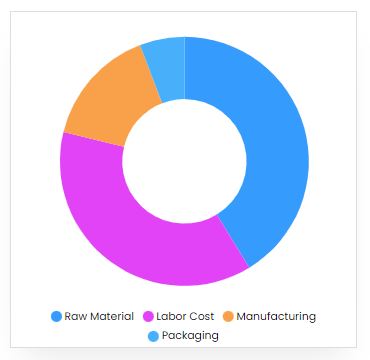
Product Cost Breakup
Reveneue Vs Expenses

Market Trend

In 2026, the manufacturing of solar water heaters will be characterized by “Mandated Growth.” With a projected Compound Annual Growth Rate (CAGR) of 8.5%, the worldwide solar thermal market has achieved a valuation of $28 billion this year. The remarkable stability of this expansion can be attributed to its growing correlation with government regulations and the “electrification of everything.”
-The Mandate for “Green Building”
The National Building Codes will be the main factor influencing market potential in 2026. New residential and commercial buildings must now legally meet a minimum percentage of their heating needs through renewable sources in areas like India, the European Union, and portions of the United States. For manufacturers, this has resulted in a “locked-in” market. Particularly in Tier-1 and Tier-2 cities in India, where municipal corporations provide property tax credits for buildings with certified solar thermal systems, the “Solar City” project has caused demand to soar.
-The “Process Heat” Revolution in Industry
The entry into Industrial Solar Heat (ISH) will be a significant market innovation in 2026. Large volumes of hot water (between 60°C and 120°C) are needed by industries like textiles, food processing, and pharmaceuticals. In the past, they employed gas or coal-fueled boilers. Large-scale “Solar Concentrator” arrays are being produced in 2026 to supply this “Process Heat” for a quarter of the price of fossil fuels. As businesses rush to reduce their “Scope 1” emissions in order to avoid high carbon taxes, this B2B (Business-to-Business) section of the industry is currently expanding at the quickest rate.
-The Integration of “Smart Home”
The system’s “Intelligence” will be a key selling factor in 2026. IoT-enabled controllers are increasingly standard on modern solar heaters. These devices employ artificial intelligence (AI) to evaluate weather forecasts; if the AI anticipates a rainy day, the water is preheated during the last hours of the sun’s light. Customers are more prepared to spend 15–20% more for “Smart Heaters” that can be tracked via smartphone apps that provide data on carbon offsets and energy savings in real time. For manufacturers that can incorporate software into their hardware products, this has created a high-margin market.
-The “Local-for-Local” Boom and Regional Dynamics
With more than half of the market, the Asia-Pacific region continues to be the global powerhouse. Both production and consumption are dominated by China and India. But the 2026 market is moving in the direction of “Regional Hubs.” There is a huge possibility for “Micro-Assembly Plants” situated closer to high-demand areas because water heaters are heavy and costly to transport across oceans. In Africa and Latin America, where solar radiation is plentiful but the electrical system is unstable, investors are pouring money into local manufacturing facilities.
-Investment Prospects
The 2026 opportunity for entrepreneurs and investors is “Thermal Storage and Hybridization.” The following have the most potential for growth:
Solar-Assisted Heat Pumps: For complete dependability in cold climates, solar thermal and electric heat pumps are combined.
Nano-Coating Technology: The development of “Selective Absorber” coatings that can retain heat even in dim or cloudy environments is known as nano-coating technology.
Retrofit Kits: Convenient, “plug-and-play” solar kits for pre-existing metropolitan residences with constrained roof space.