
Project Report for Wheat Grading Plant
Wheat harvested directly from the field always contains stones, dust, and broken grain; a grading plant cleans, sorts, and grades it into a premium product for which flour mills, exporters, and bulk buyers pay 12-20% more. It is fundamentally a job-work and value-added business based on throughput capacity. Sharda Associates creates CA-certified wheat grading facility project reports. Starting at Rs.2,999 and ready in 24-48 hours.
Get free Sample
What Does a Wheat Grading Plant Actually Do?
You aren’t cultivating or trading wheat; you are processing it. Raw wheat arrives with foreign matter (stones, dust, weed seeds, shriveled grains), which your plant processes through pre-cleaning (vibrating screens removing large contaminants), de-stoning (gravity/air separation), and grading (sorting by size/weight into Grade A, B, and C), with higher-end plants adding optical/color sorting to remove discolored or diseased grains. The output is the same wheat, but it is now standardized, clean, and sellable at a significant premium; this is a value-added business rather than a manufacturing one in the traditional sense.
Your revenue comes from two sources: you can buy raw wheat cheaply, grade it, and sell it at a premium (trading model), or you can do job-work by charging a per-tonne processing fee to traders, FPOs (Farmer Producer Organizations), or flour mills who bring their own wheat to be cleaned and graded (service model). Most successful factories run both, with job-work serving as a solid foundation.
Another important feature of a wheat grading facility is maintaining uniform grain quality while minimizing processing losses. Buyers include flour mills, food processing firms, exporters, government procurement agencies, and major wholesalers, who want wheat with uniform grain size, low impurity levels, and consistent moisture content.
How Does a Wheat Grading Plant Make Money?
1. Job-Work/Processing Fee (the steady base)
The per-tonne processing rate ranges from Rs.300 to Rs.600, depending on the quality of processing (simple cleaning versus full optical sorting and grading). This is billed regardless of who subsequently buys the wheat; your income is based on the service, not the commodity price.
A 5 TPH (tonnes per hour) facility that operates 8 hours per day, 25 days per month, at 70% capacity utilization processes approximately 700 tonnes. At an average processing charge of Rs.450/tonne, that equates to around Rs.3.15 lakh per month from job work alone.
2. Trading Margin (the higher-value, higher-risk side)
Buying raw wheat and selling graded wheat yourself collects the full 12-20% price premium rather than just a processing fee, making it much more profitable per tonne, but also ties up working capital in wheat stock and exposes you to commodity price fluctuations, which job-work does not.
The P&L of a Wheat Grading Plant
Power is your most expensive ongoing cost; cleaning, de-stoning, and optical sorting equipment, in particular, use a lot of power. A 5 TPH factory normally consumes Rs.40,000-80,000 per month in power, depending on the hours of operation and whether optical sorting is incorporated.
Labour: A plant of this scale requires 4-6 workers (loading, machine operation, bagging, and quality inspections) at Rs.9,000-15,000 per month each.
Maintenance of the screening, de-stoning, and sorting equipment costs Rs.10,000-25,000 per month; they are mechanical systems that wear out over time, and failure to maintain them leads to decreased grading accuracy.
Packaging (if you’re bagging and selling rather than performing odd jobs): Rs.500-1,000 per tonne for bags and handling.
For a plant earning Rs.3.15 lakh/month from job-work alone: power costs around Rs.55,000, labor costs Rs.60,000, and maintenance costs Rs.15,000, leaving a net margin of around Rs.1.85 lakh/month, or roughly 59% on the job-work side, because there are no raw material costs to absorb. On the trade side, margins look drastically different, and significantly smaller per tonne, if raw wheat costs are included.
What Actually Decides Profitability
A plant’s “5 TPH” or “10 TPH” rating indicates maximum capacity rather than actual income; what matters is how many tonnes you process against that ceiling on a monthly basis.
High utilization (good): continuous job-work tie-ups with 2-3 FPOs or grain brokers that provide a steady supply of wheat to grade, allowing the plant to operate at 70% or more of its rated capacity. Fixed expenses (electricity, labor, and maintenance) remain same whether you run at 30% or 80% capacity, therefore utilization is where margins are gained or lost.
Low utilization (bad): a facility that only processes during the immediate post-harvest rush (a few months) and is largely idle the rest of the year – a common mistake made by first-time operators who do not acquire off-season job-work or storage-linked grading contracts.
The strongest project reports — and real businesses — include a plan for utilization beyond the harvest season, such as tie-ups with FPOs for staggered supply, storage-linked grading services, or processing for several grain kinds if the technology enables it
Machinery and Compliance
Core gear includes a pre-cleaner (vibrating screens), a de-stoner, a grading/sieving machine (size/weight separation), and, increasingly, an optical/color sorter for export-grade or premium-segment production. Conveyor systems and bagging/weighing equipment complete the line.
FSSAI certification is required because you are handling food grain, even if you are not directly creating a packaged food product – most state food safety bureaus demand this for grain processing facilities. Udyam/MSME registration is mandatory, and a pollution control clearance is usually required for dust management.
For export-oriented plants, phytosanitary compliance and quality certification matching destination-market standards (especially for Middle East and Southeast Asia routes) becomes essential — this isn’t optional if export revenue is part of your plan, and it should be reflected as a real compliance cost in the project report, not an afterthought.
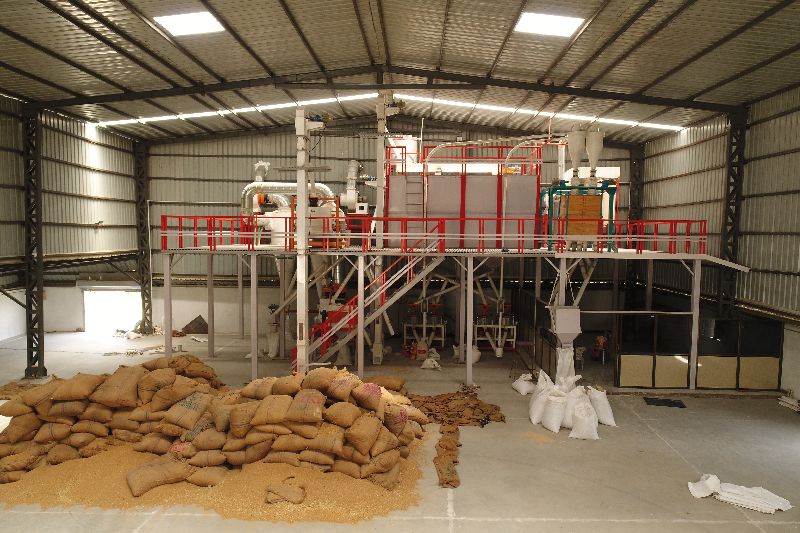
What Will It Actually Cost You to Set Up?
Setup | Approximate Cost (₹) |
Small plant (2-3 TPH, basic cleaning + grading) | Rs.20-35 lakh |
Mid-scale plant (5-8 TPH, with de-stoning) | Rs.35-70 lakh |
Export-grade plant (10+ TPH, with optical sorting) | Rs.70 lakh – 1.5 crore |
This includes machinery (pre-cleaner, de-stoner, grader, optical sorter if included), shed/warehouse construction, electrical infrastructure, and initial working capital if you intend to trade wheat in addition to doing job work.
Smaller plants frequently use Mudra Tarun in conjunction with NABARD agricultural infrastructure programs. Mid-to-large factories are often funded through PMEGP (agri/allied manufacturing) or regular term loans supported by NABARD’s Agriculture Infrastructure Fund, which frequently include interest subvention benefits.
Why Work With Sharda Associates on This?
- We’ve completed over 45,500 project reports, and wheat grading plants are in an interesting position: banks want to see realistic capacity utilization (rather than just rated TPH), a clear job-work vs. trading revenue split, and proper alignment with NABARD/Agri-Infrastructure Fund documentation, because this is fundamentally an agri-processing business, even if it appears “industrial.”
- We model job-work and trading revenue separately because they have completely different margin and risk profiles, build in realistic utilization assumptions that account for seasonal harvest patterns rather than assuming year-round peak operation, and make sure FSSAI, pollution clearance, and export compliance (where relevant) are properly documented. Getting the scheme alignment wrong (PMEGP vs. NABARD vs. standard term loan) is one of the more common reasons these report
- We create realistic cost estimates for plant and machinery, working capital requirements, storage infrastructure, and operating expenses while also generating detailed profitability projections, cash flow statements, DSCR calculations, and break-even analysis. Each
- Starting at Rs.2,999 · 24-48 Hours · +91 89899 77769
Frequently Asked Questions
Rs.20-35 lakh for a modest 2-3 TPH plant, Rs.35-70 lakh for a medium-sized 5-8 TPH plant with de-stoning, and Rs.70 lakh to 1.5 crore for an export-grade facility with optical sorting.
Through two streams: job-work (charging a per-tonne processing fee, often Rs.300-600/tonne, to traders or FPOs who bring their own wheat) and trading (purchasing raw wheat, grading it, and selling at the 12-20% premium graded wheat demands). Job-work is more consistent; trading has a better profit margin but requires more working capital and entails commodity price risk.
Because fixed expenses (electricity, labour, and maintenance) remain relatively constant whether you process 30% or 80% of rated capacity. A "5 TPH" plant operating at only 30% utilization will suffer financially, despite its high rated capacity - actual monthly tonnage handled, not the machinery's maximum rating, determines real profitability.
Because there are no raw material costs involved, you can charge a service fee on the customer's own wheat, resulting in a net margin of 55-60%. When the cost of raw wheat is taken in, trade margins are much thinner per tonne, but absolute profit per tonne is often higher.
NABARD is often the best fit due to its Agriculture Infrastructure Fund, which frequently offers interest subsidies for post-harvest processing units such as grading plants. Smaller setups can also work with Mudra Tarun, but mid-to-large facilities are typically processed through PMEGP under the agri/allied manufacturing classification.
FSSAI registration (since you're dealing with food grain), Udyam/MSME registration, and pollution control clearance for dust management, as grading and de-stoning produce a lot of grain dust. Export-oriented plants also require phytosanitary compliance with destination-market norms.
Starting at Rs.2,999 and delivered in 24-48 hours. It comprises job-work/trading revenue modeling, realistic seasonal capacity utilization assumptions, and proper adherence to NABARD, PMEGP, or Mudra documentation standards. If the bank expresses a concern, there is no charge for correction. Call +91 89899 77769.
The best solution is to secure job-work agreements with FPOs or dealers who provide wheat on a staggered basis (rather than just immediately after harvest), to offer storage-linked grading services, or, if machinery allows, to process other grains during off-season months. A project report that only considers harvest-season activity year-round is likely to exaggerate income.
Basic cleaning (pre-cleaning, de-stoning, and size grading) eliminates physical impurities and sorts by size/weight, which is adequate for most home flour mill and trader buyers. Optical/color sorting, which uses cameras and AI to detect and eliminate discolored or diseased grains at fast speeds, is increasingly essential for export-grade wheat and premium domestic segments — but it adds significantly to apparatus costs and power usage.
Yes, more than other processing firms, demand peaks during the post-harvest period (March-May in most wheat-growing countries), when fresh wheat requires urgent cleaning and grading before storage or sale. A well-planned facility incorporates off-season job-work or storage-related activities to help balance out the seasonal concentration.