
When a bank raises an objection on a submitted project report, the fix is rarely to rewrite the entire document — it’s to identify exactly which figure, ratio, or document triggered the query and correct that specific gap while keeping the rest of the report consistent. Most objections fall into a handful of recurring categories: inconsistent figures, unrealistic projections, missing documents, or a mismatch between the project report and the CMA data attached to it.
Sharda Associates, a CA-certified project report provider, revises and resubmits objected reports for MSME and business loan applicants across India.
Why Do Banks Raise Objections Instead of Rejecting Outright?
Banks generally prefer to query a report rather than reject it outright when the underlying business looks viable but the documentation has a specific, fixable problem. An objection is effectively the credit officer’s way of saying, “I can’t approve this as it stands, but I might if you address this point” — which is different from a rejection, where the bank has decided the proposal doesn’t meet its lending criteria at all. Treating an objection as a rejection, and starting over from scratch, often wastes time that a focused correction wouldn’t.
What Are the Most Common Bank Objections?
- Inconsistent figures — the project cost, means of finance, or projections in the narrative don’t match the numbers in the attached CMA data or financial statements
- Unrealistic projections — sales, profit, or capacity utilisation assumptions that aren’t supported by the promoter’s experience, market conditions, or past performance
- Weak DSCR or repayment capacity — the Debt Service Coverage Ratio doesn’t comfortably support the loan tenure requested
- Low or missing promoter contribution — a proposal asking for close to 100% financing, with little to no promoter’s own money at risk, raises red flags
- Missing or outdated documents — quotations, KYC, land papers, or licences that are incomplete, expired, or inconsistent with the report
- Format not matching the bank’s or scheme’s requirement — a generic report not adapted to that specific bank’s appraisal template
- Credit history or promoter background concerns — issues unrelated to the report itself but which the report doesn’t help address.
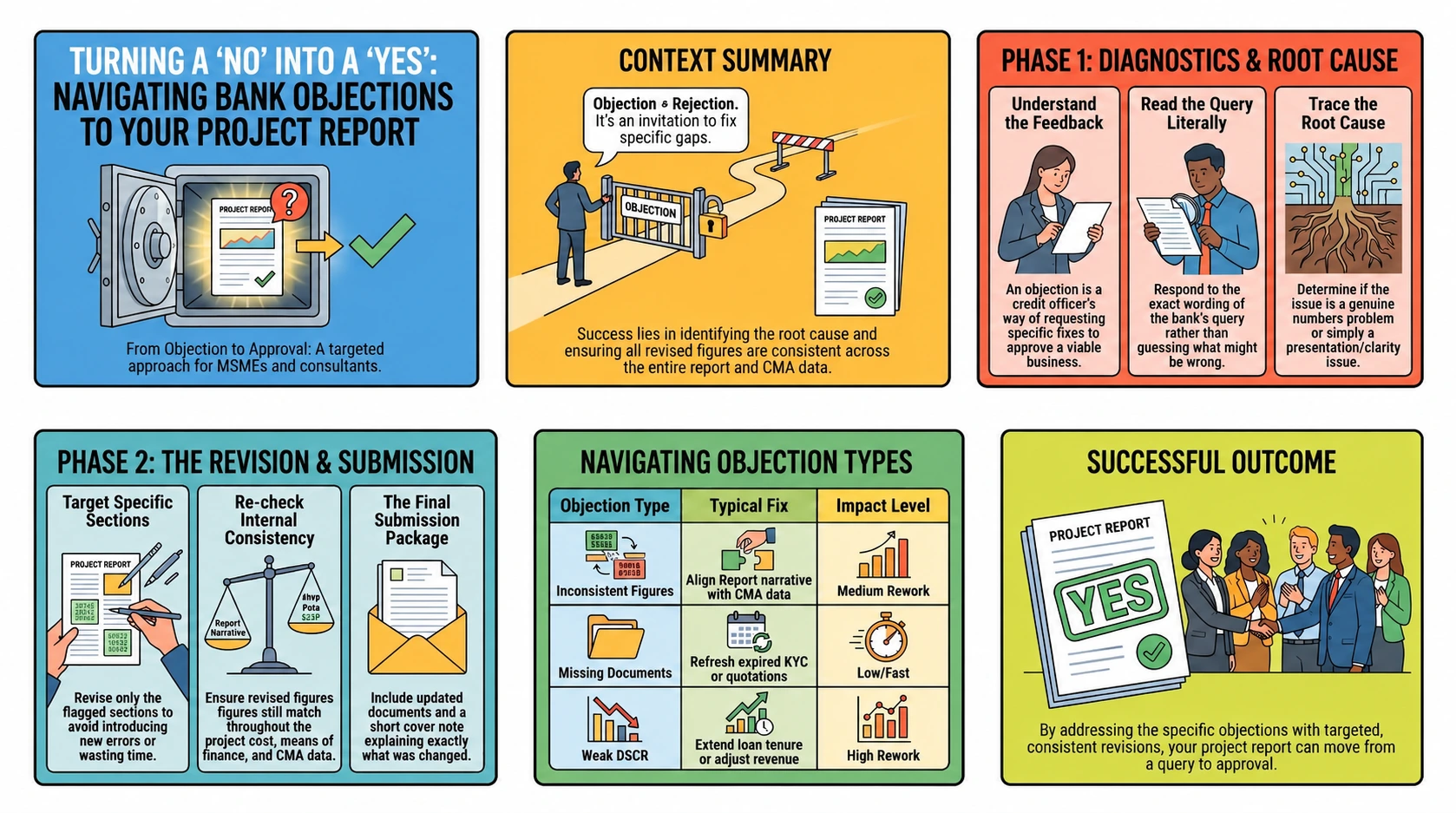
How Do You Identify What’s Actually Wrong?
- Read the bank’s query exactly as worded — objections are often specific (“DSCR below acceptable range”, “promoter contribution insufficient”), not a general “report is weak.” Responding to the literal wording, not a guess at what might be wrong, saves a second round of queries.
- Cross-check the flagged figure against every other place it appears—a DSCR objection, for example, may trace back to an inflated project cost or an understated repayment amount elsewhere in the report.
- Compare the project report narrative against the CMA data—mismatches between the two are one of the most common (and most avoidable) causes of a query, since banks check both documents side by side.
- Check whether the format matches the bank’s own template—some objections are purely about presentation, not substance, and are quick to fix once identified.
Step-by-Step: How to Revise the Report
- Pin down the exact objection — get it in writing from the bank if it wasn’t already, rather than working from a verbal summary.
- Trace the root cause — decide whether the issue is a genuine numbers problem (e.g., project cost is actually too high) or a presentation problem (e.g., the right figures exist but weren’t shown clearly).
- Correct the specific section — revise the project report, means of finance, projections, or ratio calculation as needed, without altering unrelated sections that weren’t queried.
- Re-check internal consistency — after any change, verify that the project cost, means of finance, CMA data, and projections still tie together throughout the report.
- Update supporting documents — refresh any expired quotations, KYC, or financial statements that triggered the objection.
- Add a short cover note — briefly explaining what was revised and why, so the credit officer doesn’t have to compare the old and new versions line by line.
- Resubmit promptly — delays in responding to a query can sometimes cause the file to be deprioritised or the sanction process to restart.
What If the Objection Is About Promoter Contribution or DSCR?
These are the two objections that usually require the most substantive rework, since they touch the core financial structure rather than a single figure:
- Low promoter contribution — either the promoter increases their own contribution (reducing the loan-to-cost ratio), or the project cost itself is trimmed to bring the required loan down to a level the bank is comfortable financing.
- Weak DSCR — options include extending the loan tenure (lowering the annual repayment burden), revisiting overly conservative revenue assumptions if they were genuinely understated, or reducing the loan amount requested.
Both of these should be handled carefully — inflating revenue projections just to fix a DSCR number on paper, without a realistic basis, usually creates a bigger problem later if the bank cross-checks assumptions.
What If the Objection Is About Missing or Inconsistent Documents?
This is typically the fastest category to complete; the report itself may not require any modifications at all; only the supporting documentation (new quotes, updated KYC, property ownership documents, licences) must be collected and resubmitted, along with verification that the report’s numbers still match.
How Long Does a Revision Typically Take?
A genuine restructuring of the financial section (adjusting promoter contribution, DSCR, or loan tenure) may take longer because it may require recalculating the entire projection set, whereas a documentation gap can frequently be resolved within a day or two once the missing paper is available. Since they already understand the project and won’t have to start from scratch, working with the same consultant who created the initial report is typically quicker than beginning the revision with a different source.
Common Mistakes When Revising a Report
- Rewriting the entire report from the beginning rather than addressing the particular issue that was reported
- Resolving the questioned figure without determining if it violates the report’s overall consistency
- Inflating predictions without a solid foundation in order to compel a superior DSCR
- Resubmitting without a cover note so the credit officer can determine what was altered
- Responding slowly runs the danger of deprioritising the file.
Frequently Asked Questions
1. How do I revise a project report after bank objections?
Identify the exact objection as worded by the bank, trace it to the specific figure or document causing it, correct only that section while keeping the rest of the report consistent, and resubmit with a brief cover note explaining the change.
2. Is an objection the same as a loan rejection?
No — an objection means the bank wants a specific issue addressed before it can approve the proposal, while a rejection means the bank has decided not to proceed with the loan at all.
3. What is the most common reason banks raise objections on a project report?
Inconsistency between the project report and the attached CMA data, along with unrealistic projections and low promoter contribution, are among the most common causes.
4. Should I rewrite the entire project report if the bank objects to one section?
Usually not — a targeted revision of the flagged section, checked for consistency with the rest of the report, is faster and reduces the risk of introducing new inconsistencies.
5. What should I do if the bank objects to my DSCR calculation?
Review whether the loan tenure, loan amount, or revenue assumptions are realistic, and adjust one or more of these — extending tenure or trimming the loan amount are common fixes, provided the underlying figures remain credible.
6. Can I revise and resubmit the same project report multiple times?
Yes, this is common—banks often allow multiple rounds of clarification before a final decision, though repeated queries without resolution can eventually lead to the file being deprioritised.
7. How quickly should I respond to a bank’s objection?
As promptly as possible—delayed responses can cause the file to lose priority in the bank’s processing queue, even if the underlying issue is minor.
8. Do I need a CA to revise a project report after an objection?
Not strictly required, but a CA or the original report preparer can usually identify and fix the root cause faster and is better placed to keep the revised figures internally consistent.
9. What if the objection is about my credit history rather than the report itself?
This isn’t something the project report itself can resolve — it typically needs a separate conversation with the bank about how the credit history issue will be addressed or explained.
10. Will revising the report guarantee approval on resubmission?
No—resolving the specific objection improves the chances, but final sanction still depends on the bank’s overall credit assessment, including factors outside the report itself.