
A project report for land allotment is a document that explains the proposed business, land requirement, project investment, planned activities, infrastructure, employment potential and financial feasibility of the proposed unit. Industrial development authorities may require project-related information while evaluating applications for industrial land or plots. The exact format, documents and financial details depend on the concerned authority and the type of project.
At Sharda Associates, our CA-certified project report for land allotment cost are prepared to match each authority’s checklist, starting from Rs.2,999, so your application moves through scrutiny without back-and-forth queries.
What Does a Project Report for Land Allotment Cost Actually Cover?
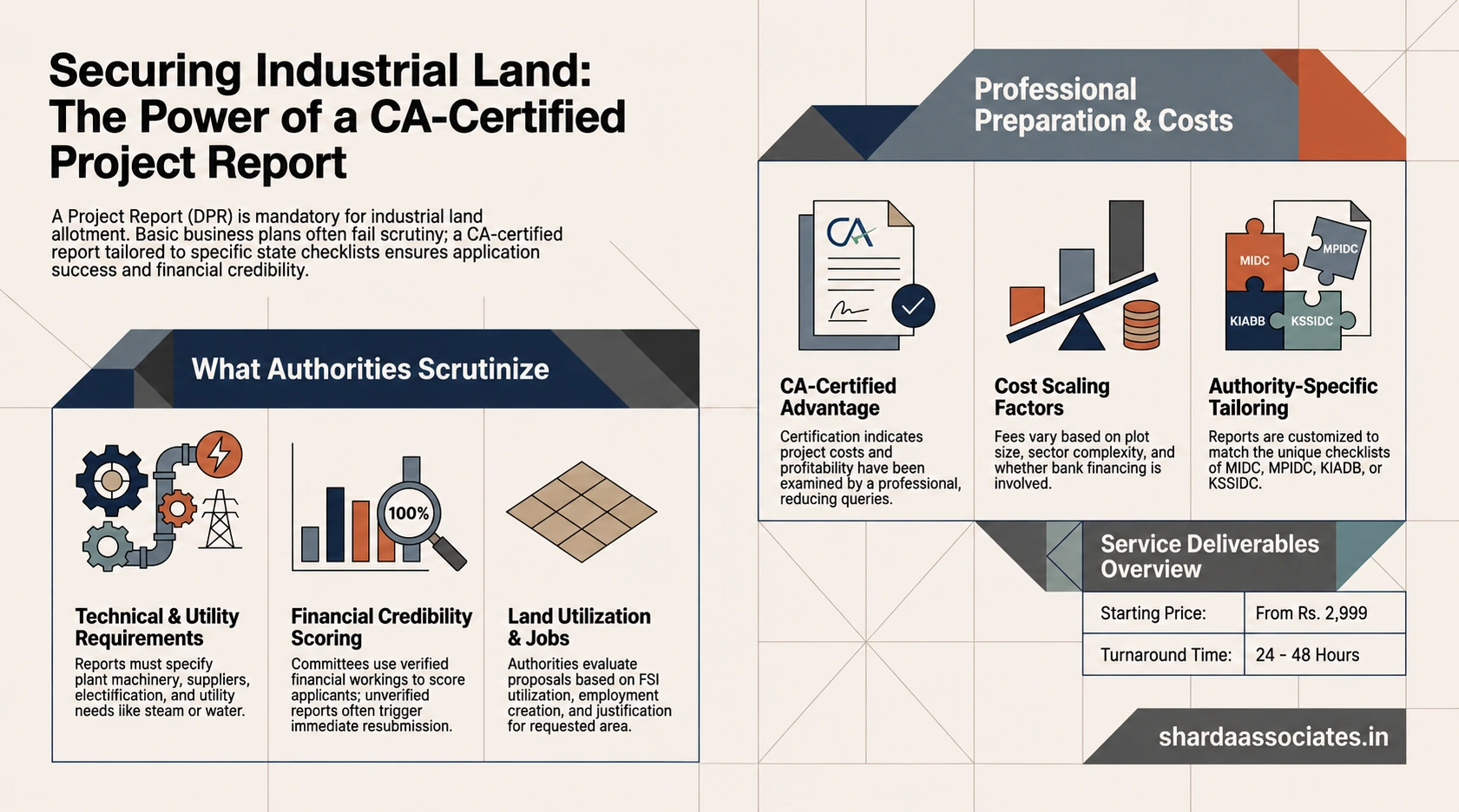
A basic business plan is not the same as a land allotment project report. Details like the promoter’s profile, a list of plants and machinery with suppliers and costs, electrification requirements, utilities like compressed air, water, and steam, technical know-how, additional land needed for the storage of raw materials or finished goods, and the creation of jobs are all specifically requested by authorities like MIDC.
A concise project profile encompassing plant and machinery, raw material arrangement, financial management, and the project’s commercial requirements is also required under Madhya Pradesh’s allocation regulations. One of the most frequent causes of an application being returned for resubmission is a generic template that omits these authority-specific fields.
Core Financial Sections Every Authority Checks
- Project expenses and funding sources (own contribution vs. loan/term loan required)
- Estimated cash flow, profitability, and ability to repay or service debt
- FSI/land utilisation and employment creation, as some LACs evaluate proposals based in part on this
What Factors Affect the Cost of the Report?
The fee for a project report is not fixed across every case, since scope changes with the project. Broadly, these factors move the price:
- Plot size and category: A report for a large allotment exceeding 20,000 square metres, which is sent to a higher committee or the State Level Committee, requires more detail than one for a tiny plot under 2,500 square metres, which typically goes via a Regional Officer-level committee.
- New unit vs. expansion: Cases involving expansion, modernisation, or diversification require comparative financials, capacity utilisation statistics, and existing balance sheets, which adds effort beyond the report of a new unit.
- Sector complexity: Compared to a basic assembly or warehousing unit, a manufacturing facility with heavy machinery, foreign technical know-how, or specialised utilities like compressed air or steam requires more technical information.
- Financing involved: DSCR, break-even, and payback schedules must be included if the report is presented to a bank for a term loan in addition to the land allotment application. This requires more work than a study intended solely for the land authority.
- Turnaround required: Urgent 24-48 hour delivery is priced differently from a typical timeline since most authorities set a submission window once your plot is provisionally picked in the direct or advertized allotment process.
Because of these variables, treat any quoted cost as a starting point. Confirm the exact fee for your project by sharing your plot size, sector, and whether the report is only for land allotment or also for a bank loan.
Why a CA-Certified Report Matters for Land Allotment Applications
According to MIDC’s own scrutiny checklist for Detailed Project Reports, Land Allotment Committees evaluate proposals based on factors such export/import orientation, industrial background, and financial credibility. Your score on the financial credibility metric is lowered by a report that is merely descriptive and lacks confirmed financial workings.
Committees are trained to search for a CA-certified project report since it indicates that the project cost, methods of financing, and profitability estimates have been examined by a knowledgeable professional. This is also the reason that while generic reports frequently result in a request for a resubmission, many DICs and industrial organisations accept CA-prepared reports without further financial enquiries.
Common Mistakes That Delay Allotment
- Submitting a project report format meant for one state’s rules to a different authority with different checklist requirements
- Missing the plant and machinery list with supplier, quantity and value, which most authorities explicitly ask for
- Ignoring extra land justification, so the committee cannot assess why the requested area exceeds standard norms
-
Call us at +91 89899 77769 to check your eligibility and get your application ready.
Frequently Asked Questions
Q1. What is a project report for land allotment?
A project report for land allotment explains the proposed business or industrial project, including the type of activity, land requirement, proposed investment, machinery or infrastructure, employment potential, implementation plan and financial feasibility.
Sharda Associates helps prepare project reports based on the proposed project and the requirements of the concerned industrial development authority, so the applicant has a structured document for the land-allotment application.
Q2. Why is a project report required for industrial land allotment?
A project report helps the concerned authority understand what the applicant proposes to establish on the industrial plot, how much land is required, what investment is planned and how the proposed unit is expected to operate.
Sharda Associates analyses the proposed project and organises these technical and financial details into a structured report for the intended land-allotment purpose.
Q.3 What information is included in a land allotment project report?
A project report may include the business profile, proposed products or services, land requirement, manufacturing or operating process, machinery, project cost, means of finance, manpower, implementation schedule, market information and financial projections.
Sharda Associates prepares the contents according to the nature of the project and the information required by the relevant authority.
4. How long does it take to get a project report prepared?
Turnaround depends on project complexity, but Sharda Associates delivers most reports within 24-48 hours once the required inputs are shared.
5. What documents do I need to share to get the report prepared?
Typically your business plan basics, plant and machinery details, promoter profile, project cost estimate, and the specific checklist of the authority you are applying to.
6. Does plot size affect what the project report must contain?
Yes. Larger plots often go through higher-level committees that expect more detailed financial and technical justification than smaller allotments reviewed at the regional level.
7. Will Sharda Associates tailor the report to my state’s land allotment rules?
Yes, the report is prepared to match the specific checklist of the authority you are applying to, whether that is MIDC, MPIDC, KIADB, KSSIDC or another state corporation.
8. What happens if the report is rejected or sent back for changes?
Most rejections happen due to missing checklist items or weak financial justification. Sharda Associates‘ CA-certified reports are built against each authority’s stated requirements to reduce this risk.
9. Is there a fixed price for a land allotment project report?
No single fixed price applies to every case, since cost depends on plot size, sector, financing needs and turnaround. Reports start from Rs.2,999, with the final fee confirmed after understanding your project.
10. Do I need a CA to certify the financial projections in the report?
Most Land Allotment Committees give more weight to reports with verified financial workings, so a CA-certified report strengthens your case on the financial credibility criterion during scrutiny.