
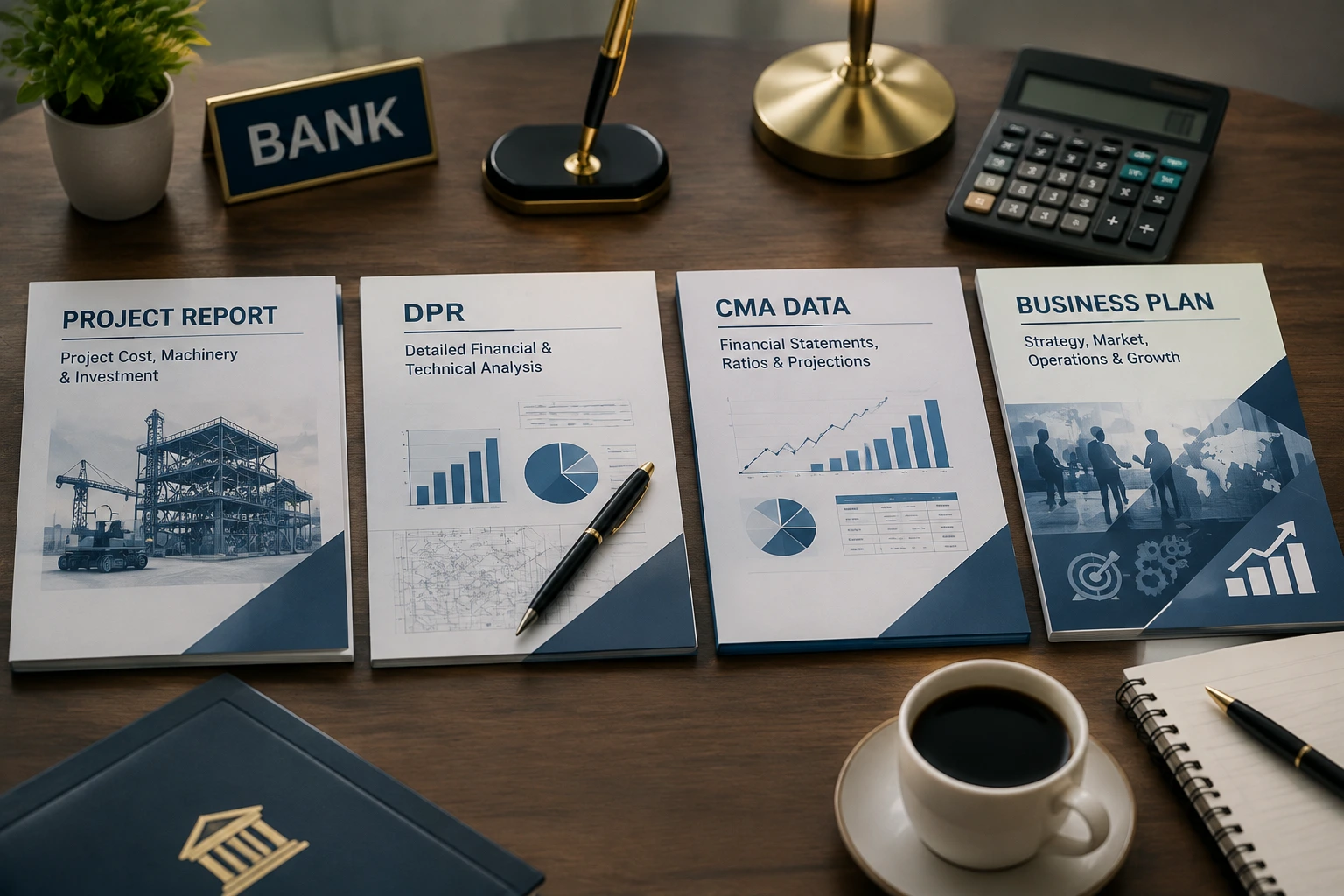
A Project Report vs DPR vs CMA Data vs Business Plan are not the same document, although some of their information can overlap. A Project Report usually explains a proposed investment and its financial viability; a DPR goes deeper into technical and implementation details. CMA Data focuses heavily on financial performance and credit assessment, while a Business Plan explains the broader business strategy and growth model.
Sharda Associates prepares CA-expert-led project reports, DPRs and CMA-related financial documentation, helping borrowers choose the report that fits the actual financing requirement rather than preparing multiple documents unnecessarily.
The easiest way to understand the difference is to ask:
Who will read the document, and what decision are they trying to make?
Project report vs dpr vs cma data vs Business Plan: What Is the Difference in Simple Terms?
| Document | Main Question It Answers | Common Use |
| Project Report | Is this proposed investment financially workable? | Bank term loan, new unit, expansion |
| DPR | How will this project be established, operated and financed in detail? | Larger or technically complex projects |
| CMA Data | What is the financial position and credit requirement of the business? | Working capital, CC/OD, renewal or credit appraisal |
| Business Plan | How will this business compete, grow and make money? | Investors, founders, internal planning |
The important point is that the names are not always used consistently.
A bank officer may sometimes use “project report” and “DPR” interchangeably. Another lender may use DPR specifically for a more detailed technical project.
Therefore, always ask what information and format the lender actually requires rather than relying only on the document name.
What Is a Project Report for a Bank Loan?
A Project Report explains a specific business proposal to a lender.
Suppose you want to establish a bakery unit and need ₹30 lakh.
The project report should help explain:
- What the bakery will produce
- How much the project will cost
- What machinery is required
- How much you will invest
- How much bank finance is required
- Expected production and sales
- Operating expenses
- Working-capital requirement
- Expected profitability
- How the proposed borrowing may be repaid
For relevant term loan proposals, Union Bank’s current credit-proposal checklist specifically refers to project information such as project background, cost and means of finance, machinery, capacity, financial projections, implementation, repayment and assumptions.
A project report, therefore, combines business information with financial projections.
When Does a Project Report Become a DPR?
A Detailed Project Report, as the name suggests, normally provides a deeper analysis.
There is no safe universal rule such as:
“Below ₹25 lakh = Project Report and above ₹25 lakh = DPR.”
Different lenders and schemes may use the terminology differently.
A DPR becomes more useful when the project requires detailed analysis of:
Technical Requirements
Machinery, technology, production process, plant capacity, utilities and infrastructure.
Market and Commercial Feasibility
Demand, target customers, pricing, competition and distribution.
Project Implementation
Construction, machine installation, trial production and commercial-operation timeline.
Detailed Financial Analysis
Project cost, funding, projected financial statements, working capital, repayment, DSCR and sensitivity where relevant.
For a large manufacturing plant, renewable-energy unit, hospital, hotel or food-processing facility, a DPR may therefore be considerably more detailed than the basic project report required for a small shop.
What Is CMA Data and Why Is It Different?
CMA Data is primarily a financial credit-appraisal document.
It becomes particularly relevant when a bank wants to understand an existing business’s financial performance and working-capital requirement.
Instead of spending many pages explaining the business idea, CMA analysis concentrates on figures such as:
- Historical sales and profitability
- Current financial position
- Projected sales and profit
- Balance Sheet
- Current assets
- Current liabilities
- Inventory
- Receivables
- Creditors
- Existing borrowing
- Proposed bank finance
- Fund movement
- Financial ratios
RBI guidance allows applicable lenders to assess working-capital requirements using projected turnover or other methods depending on the borrower and applicable framework. It also makes clear that lenders have to assess whether projected turnover is reasonable.
This is why CMA preparation should not simply increase projected sales until the required loan amount appears supportable.
The financial assumptions need a reasonable business basis.
Is There One Fixed CMA Format for Every Bank?
Not necessarily.
This is important because online information often describes one set of CMA statements as if every Indian lender must always use exactly the same format.
In practice, banks may have their own credit-appraisal formats and information requirements.
The underlying financial areas—historical performance, projections, Balance Sheet analysis and working-capital assessment—may be similar, but borrowers should follow the format actually requested by their lender.
What Is a Business Plan?
A Business Plan is broader and more strategy-focused than a typical bank project report.
It explains:
- Problem being solved
- Product or service
- Target customers
- Market opportunity
- Competitors
- Revenue model
- Sales strategy
- Management team
- Operations
- Growth plan
- Funding requirement
- Financial forecasts
Startup India’s investor guidance itself highlights business-model sustainability, market landscape, customers, competitors, sales forecasts, investment requirements, break-even and reasonable financial assumptions as important areas for investor consideration.
So a business plan is particularly useful when the reader wants to understand:
“How can this company grow?”
A bank project report focuses more strongly on:
“What is being financed, and can the proposed project support the borrowing?”
Can a Business Plan Be Submitted Instead of a Project Report?
Not automatically.
A strong Business Plan may contain much of the same business information, but it may not contain the lender-focused schedules the bank wants.
For example, an investor may care about:
- Market opportunity
- Scalability
- Competitive advantage
- Founder strategy
- Exit opportunity
A bank may be more concerned about:
- Project cost
- Promoter contribution
- Loan requirement
- Asset purchase
- Cash flow
- Working capital
- Repayment schedule
Therefore, if your bank specifically asks for a Project Report, do not simply submit an investor-oriented Business Plan without checking the requirement.
Which Document Do You Actually Need?
This is easier to understand through practical situations.
| Your Situation | Likely Document to Discuss |
| Starting a small unit with a term loan | Project Report |
| Setting up a technically complex manufacturing plant | DPR |
| Applying for or renewing CC/OD | CMA Data may be required |
| Expanding an existing manufacturing unit | Project Report/DPR + financial data |
| Approaching an investor | Business Plan |
| Seeking term loan plus working capital | Project Report/DPR and CMA may both be needed |
| Large project requiring technical feasibility | DPR/TEV-type analysis |
| Internal startup planning | Business Plan |
These are practical distinctions, not universal bank rules.
Actual requirements may vary depending on the lender, loan, project, scheme and applicant.
Can You Need More Than One of These Documents?
Yes.
This is where many borrowers become confused.
Imagine an existing rice-processing business adding a new production line.
It requires:
₹60 lakh machinery loan
plus
₹25 lakh additional working-capital facility.
For the machinery investment, the bank may need a Project Report or DPR explaining the machine, capacity, project cost and future operations.
For the working-capital assessment, the lender may also ask for CMA Data or equivalent detailed financial information.
If the business is simultaneously approaching an equity investor, it could also maintain a separate Business Plan focused on growth and investment strategy.
The important rule is:
One business can need different documents because different readers are making different decisions.
Should the Financial Numbers Match Across All Documents?
Yes, where they relate to the same assumptions and period.
This is one of the most important practical checks.
Suppose your DPR says:
Year 1 Sales = ₹1.50 crore
but your CMA says:
Year 1 Sales = ₹1.10 crore
and your Business Plan says:
Year 1 Sales = ₹2 crore.
The lender may reasonably ask which projection is correct.
Likewise, the proposed machinery cost, loan amount and promoter contribution should not change between documents without an explanation.
Your documents should represent one business and one financing proposal, not independent sets of attractive figures.
Which Document Should You Prepare First?
For a straightforward bank loan:
Understand bank requirement → collect actual project data → prepare Project Report/DPR → prepare additional CMA information if requested.
For a startup seeking investors:
Business model → Business Plan → financial model → investor presentation.
For a technically uncertain project:
Feasibility analysis → DPR → financing documentation.
The correct sequence can prevent unnecessary preparation costs and contradictory projections.
Frequently Asked Questions
1. Is a Project Report the same as a DPR?
Not always. The terms are sometimes used interchangeably, but a DPR generally provides deeper technical, market, implementation and financial detail.
2. Is CMA Data the same as a Project Report?
No. CMA Data concentrates mainly on financial and credit assessment, while a Project Report explains the overall project and financing proposal.
3. Is a Business Plan the same as a DPR?
No. A Business Plan focuses more on business strategy, market and growth, whereas a DPR focuses on detailed project implementation and viability.
4. Which document is needed for a bank term loan?
A Project Report or DPR may be required depending on the project and lender.
5. Which document is normally associated with working-capital finance?
Banks may ask for CMA Data or their own structured financial statements and working-capital information.
6. Do I need both CMA Data and a DPR?
Possibly. A proposal involving both term finance and working capital may require both types of information.
7. Can a CA prepare all four documents?
A CA or financial consultant can prepare the financial sections and may prepare the overall reports where competent. Complex DPRs may also require engineering, technical or market specialists.
8. Is CMA Data mandatory for every business loan?
No universal rule makes the same CMA format mandatory for every business loan. Follow your lender’s actual documentation requirement.
9. Which document is better for investors?
A business plan is generally more aligned with investor discussions because it covers strategy, market opportunity and scalability in addition to financial information.
10. Can one financial model be used across all documents?
Yes, and where the underlying assumptions are the same, using one properly reconciled financial model can help keep the Project Report, DPR, CMA and Business Plan consistent.