
A Solar Subsidy Rejected application is one of the most frustrating outcomes an applicant can face — you’ve already spent money installing the system, and now the ₹30,000 to ₹78,000 central subsidy under PM Surya Ghar Muft Bijli Yojana, or the project-linked subsidy for a business/agricultural solar installation, seems to be slipping away over what often turns out to be a small, fixable issue.
At Sharda Associates, our CA team regularly sees this exact pattern with clients pursuing subsidy-linked solar financing for commercial and MSME projects — a fundamentally eligible, well-installed system that gets stuck at the documentation or bank-appraisal stage rather than because of the installation itself.
Whether your rejection is at the residential PM Surya Ghar portal or at the bank/DISCOM stage of a commercial solar loan, this article walks through the real, verified reasons applications get rejected and exactly what to fix before resubmitting.
Understanding What Kind of Solar Subsidy You Applied For
Before troubleshooting a rejection, it helps to be clear on which scheme you’re actually dealing with, since the rejection reasons and fixes differ:
- PM Surya Ghar Muft Bijli Yojana — for residential rooftop solar, offering central financial assistance up to ₹78,000, disbursed via Direct Benefit Transfer after DISCOM approval and net meter installation.
- Commercial and industrial solar — not eligible for the PM Surya Ghar residential subsidy; these typically use different incentives such as accelerated depreciation, GST benefits, or state-specific industrial solar subsidies, often requiring a bank loan supported by a project report.
- PM-KUSUM and agricultural solar schemes — for farmers installing solar pumps or grid-connected solar plants, with their own eligibility and documentation process, again usually bank-loan linked.
If a commercial or business property owner applies through the residential PM Surya Ghar portal, the application is rejected at verification — this single mismatch accounts for a meaningful share of “solar subsidy rejected” complaints that have nothing to do with eligibility for solar financing altogether.
Common Reasons a Solar Subsidy Application Gets Rejected
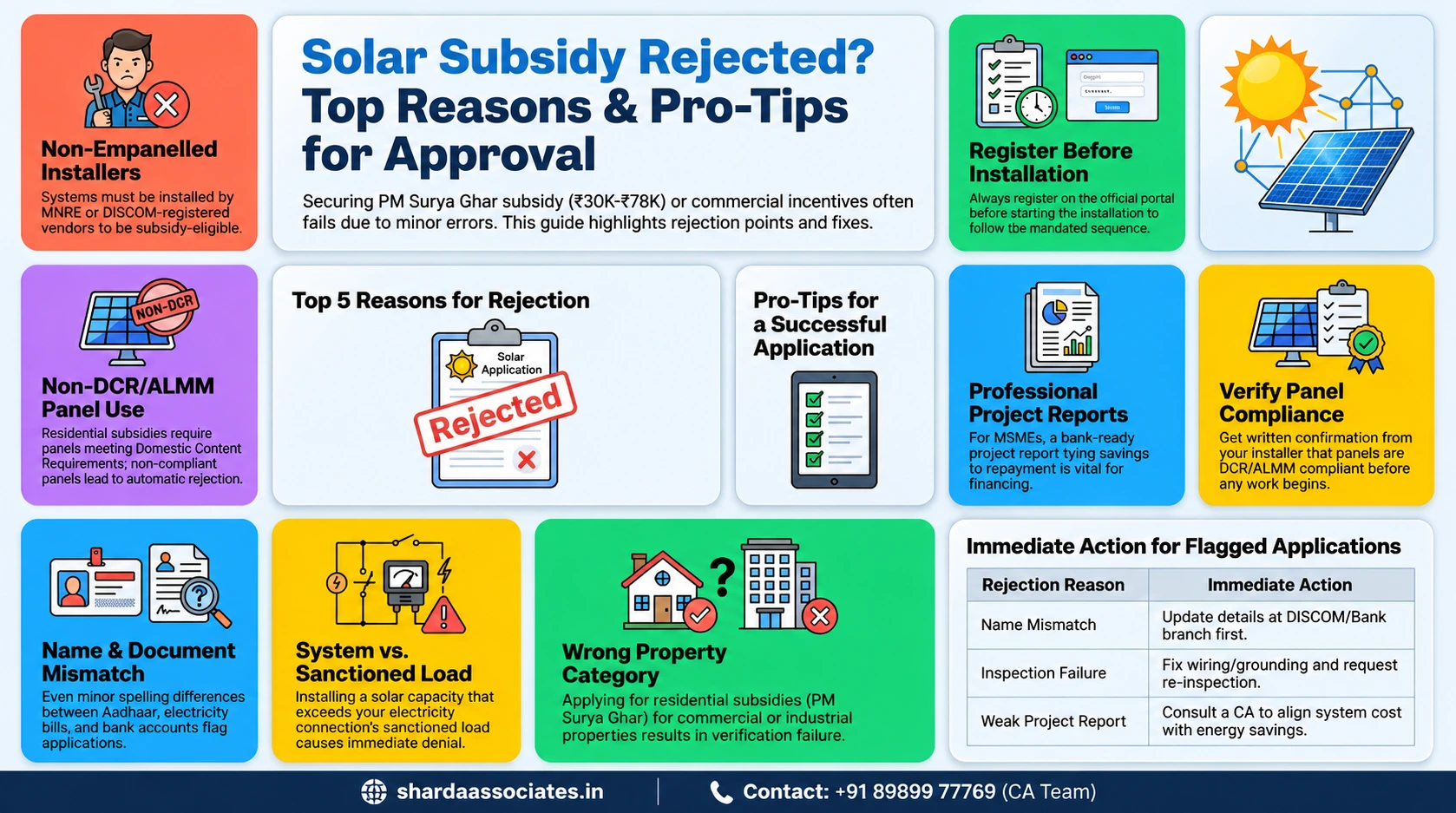
1. Using a Non-Empanelled or Unregistered Installer
This is consistently reported as the single biggest reason for rejection. If your installer isn’t registered/empanelled with MNRE or the relevant DISCOM vendor list, the application is void regardless of installation quality.
2. Non-DCR or Non-ALMM Panels
Most residential subsidy schemes require panels that meet Domestic Content Requirement (DCR) or ALMM (Approved List of Models and Manufacturers) standards. Installing non-compliant panels — even if they work perfectly — makes the system ineligible for subsidy.
3. Name Mismatches Across Documents
The portal typically cross-checks the name on your electricity connection, your Aadhaar card, and your bank account. Even a minor spelling difference between these three can flag or reject the application.
4. System Size Exceeding Sanctioned Load
If your electricity connection’s sanctioned load doesn’t support the solar capacity you’ve installed (for example, a 1 kW sanctioned load with a 5 kW system), the subsidy is denied for exceeding approved limits.
5. Applying After Installation Instead of Before
A large share of rejections happen because applicants install the system first and apply for subsidy registration afterward, assuming the sequence doesn’t matter — in most scheme workflows, it does.
6. Incomplete or Blurry Documentation
Missing documents, unclear photographs of the installed system, expired ID proofs, or incomplete commissioning reports are consistently cited as a top cause of rejection or prolonged delay.
7. Incorrect Bank Account Details
Wrong IFSC codes or account numbers don’t necessarily cause outright rejection, but they do delay or block the Direct Benefit Transfer disbursement even after the application is otherwise approved.
8. Improper Installation or Failed Inspection
If the inspecting officer finds unsafe wiring, improper grounding, or a mismatch between the declared and installed system, the application is marked as failed at the physical verification stage.
9. Applying Under the Wrong Property Category
Commercial, industrial, or agricultural properties applying through a residential-only subsidy portal are rejected at verification — the property classification on your electricity bill needs to match the scheme you’re applying under.
10. Weak or Inconsistent Project Report (For Commercial/Business Solar Loans)
For business and MSME solar installations financed through a bank loan with a linked subsidy, a generic or unrealistic project report — one that doesn’t tie the system cost, expected energy savings and repayment capacity together properly — is a common reason the bank’s own credit appraisal stalls or rejects the file, separate from any DISCOM-level issue.
Rejection Reason vs. Fix: Quick Reference Table
| Rejection Reason | What to Do |
| Non-empanelled/unregistered installer | Reinstall or get compliance certified through an MNRE/DISCOM-empanelled installer |
| Non-DCR/non-ALMM panels | Replace with compliant panels, or confirm compliance certificate with your installer |
| Name mismatch (Aadhaar/bill/bank) | Correct the mismatched name at the DISCOM office or bank branch, then resubmit |
| System size exceeds sanctioned load | Apply to enhance your sanctioned electricity load, or resize the system |
| Applied after installation | Check the scheme’s required sequence; register/regularise before further steps |
| Incomplete or blurry documents | Resubmit clear scans/photos and a complete commissioning report |
| Incorrect bank account details | Update IFSC/account number on the portal to release the DBT |
| Failed physical inspection | Fix the flagged wiring/grounding/mismatch issue and request re-inspection |
| Wrong property category used | Reapply through the correct scheme matching your property classification |
| Weak project report (business/MSME solar loan) | Get a realistic, bank-ready project report prepared before resubmitting to the lender |
How to Avoid These Mistakes From the Start
- Confirm your installer is empanelled with MNRE or your DISCOM’s approved vendor list before signing any agreement.
- Verify panel compliance (DCR/ALMM) with your installer in writing before installation begins.
- Match names exactly across your electricity bill, Aadhaar, and bank account before applying — correct any mismatch at the source (DISCOM office or bank branch) rather than hoping it goes unnoticed.
- Check your sanctioned load on your electricity bill and size the system accordingly, or apply to enhance your sanctioned load first if needed.
- Register on the portal before installation, following the scheme’s prescribed sequence rather than installing first.
- Keep documents clear and complete — sharp photographs, valid ID proofs, and a complete commissioning report submitted together.
- Double-check bank details before submission to avoid disbursement delays.
- For commercial/business solar loans, get a proper project report prepared that realistically ties together system cost, energy savings, and loan repayment capacity, since this is what a bank’s credit team actually evaluates.
What to Do If Your Application Has Already Been Rejected
A rejection generally does not permanently disqualify you — it means the current submission didn’t pass, and in most cases you can correct the specific issue and resubmit. Start by identifying exactly which stage the rejection occurred at (registration, DISCOM feasibility, inspection, or bank appraisal for a linked loan), fix that specific issue, and reapply.
For residential PM Surya Ghar rejections, a corrected resubmission typically goes through DISCOM feasibility review again, which commonly takes another 1–2 weeks, followed by inspection and then disbursement once approved.
Conclusion
Almost every solar subsidy rejection we’ve seen traces back to something specific and correctable — an installer who wasn’t empanelled, a name that didn’t match across three documents, or a project report that wasn’t built to survive a bank’s scrutiny. None of these are dead ends; they’re just the exact thing to fix before you resubmit.
If your rejection is on the business or MSME side and the issue is with your project report or financing documentation rather than the DISCOM process itself, our team at Sharda Associates can take a direct look at what you have and tell you plainly what needs correcting.
Call or WhatsApp our CA team at +91 89899 77769 and send us what you have, and we’ll tell you plainly what needs to change before you put the application back in.
Frequently Asked Questions
1. Does a solar subsidy rejection mean I have to remove my installed system?
No — in most cases the system stays; you correct the specific documentation or eligibility issue and resubmit the application for subsidy approval.
2. Can I still get the PM Surya Ghar subsidy after installation is already complete?
It depends on the specific sequence issue — many schemes require portal registration before installation, so installing first can complicate (though not always permanently block) your subsidy claim; check your scheme’s exact process.
3. Is the PM Surya Ghar subsidy available for commercial properties?
No — the central capital subsidy under PM Surya Ghar is for residential consumers only; commercial and industrial solar installations use separate incentive structures.
4. What’s the most common reason solar subsidy applications get rejected?
Using a non-empanelled installer or non-compliant (non-DCR/non-ALMM) panels is consistently reported as the leading cause of rejection.
5. How long does it take to resolve a rejected solar subsidy application?
This varies by the specific issue — a name-mismatch fix can take a few weeks at your DISCOM or bank, while a fresh feasibility review after resubmission commonly takes another 1–2 weeks.
6. Do business or MSME solar installations need a project report for subsidy-linked financing?
Yes, typically — since these installations are usually financed through a bank loan, the bank requires a project report showing project cost, expected savings, and repayment capacity before releasing funds.
7. Can incorrect bank details delay my subsidy even after approval?
Yes — the subsidy is disbursed via Direct Benefit Transfer, so an incorrect IFSC code or account number can hold up payment even after your application is otherwise approved.
8. What happens if my sanctioned electricity load is too small for my solar system?
The subsidy is typically denied if your installed capacity exceeds your sanctioned load; you may need to apply to enhance your sanctioned load before resubmitting.
9. Can name mismatches really cause a rejection over something so minor?
Yes — even small spelling differences between your Aadhaar, electricity connection, and bank account names are a well-documented cause of rejection or application flags.
10. Where can I get help with the project report needed for a business solar loan and subsidy?
Our CA team at Sharda Associates prepares project reports for subsidy-linked business financing — you can get your solar project report prepared here before approaching your bank.