
The break-even point is the level of sales at which your startup stops making a loss and starts making a profit. To calculate it, divide your fixed costs by the contribution you earn on each unit sold, which is the selling price minus the variable cost per unit. The answer is the number of units you must sell to cover all your costs, and it tells you how long your funding needs to last.
At Sharda Associates, our Chartered Accountants (CA) calculate break-even for startups as part of CA-certified project reports for bank loans and funding. A break-even analysis shows a lender how much you must sell before the business can repay its loan, and it exposes unrealistic assumptions before the bank finds them.
When your project report includes a clear break-even point, along with projected sales, margins and cash flow, lenders and investors can see that you understand your numbers. If you plan to raise money, ask a CA to test your break-even under a few different prices and cost scenarios before you submit the report.
Step 1: Separate Your Fixed and Variable Costs
| Cost type | What it means | Examples |
| Fixed costs | Do not change with the number of units sold in the short run | Rent, salaries of permanent staff, software subscriptions, loan EMI, insurance |
| Variable costs | Rise and fall with each unit sold | Raw material, packaging, delivery, sales commission, payment gateway fees |
| Semi-variable costs | Partly fixed, partly variable | Electricity, phone bills, overtime |
For semi-variable costs, split the fixed part and the variable part, so that each lands in the right group.
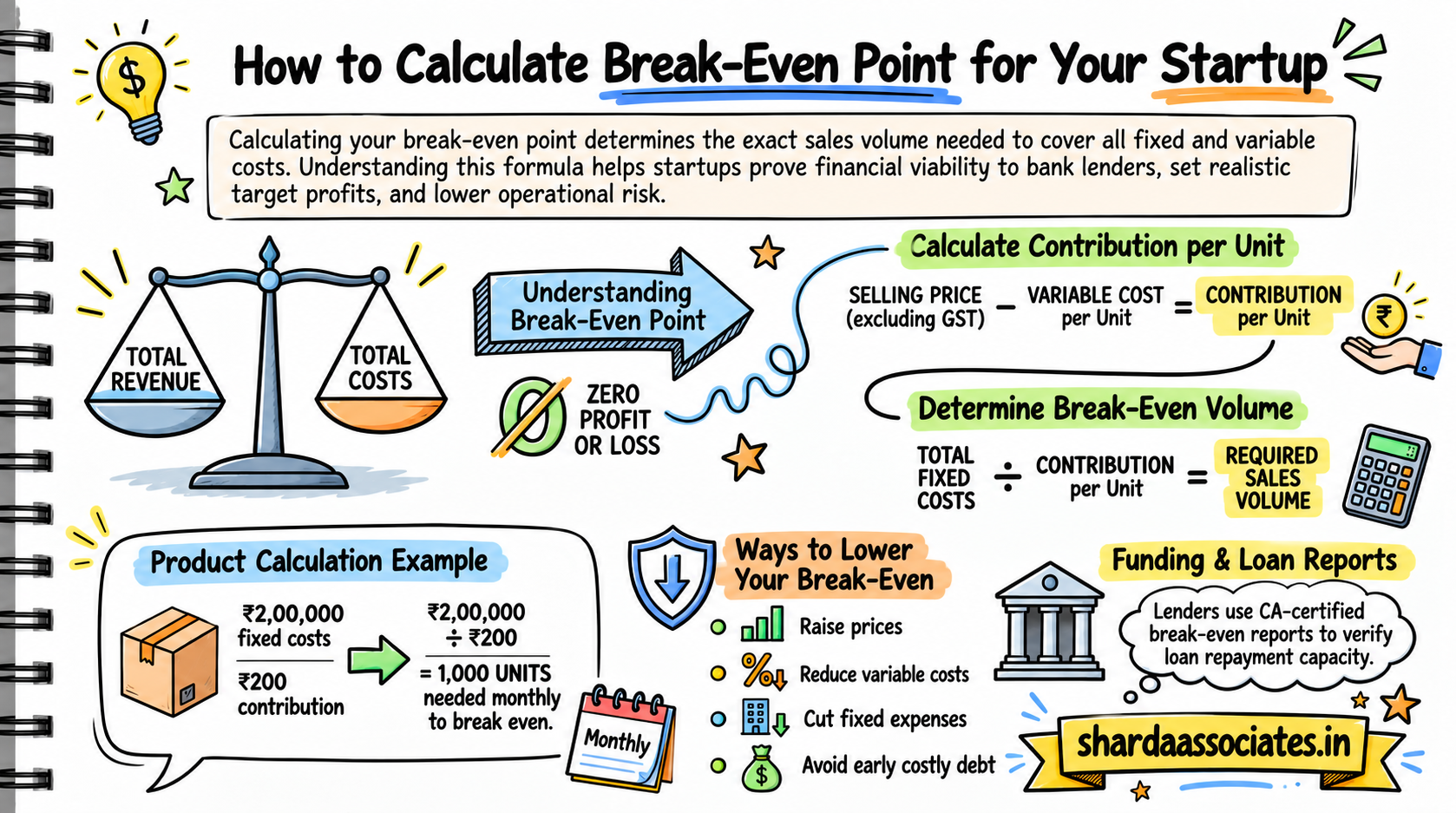
Step 2: Use the Break-Even Formulas
- Contribution per unit = selling price per unit − variable cost per unit
- Break-even point in units = total fixed costs ÷ contribution per unit
- Contribution margin ratio = contribution per unit ÷ selling price per unit
- Break-even point in rupees = total fixed costs ÷ contribution margin ratio
Use the selling price excluding GST, because GST is collected for the government and is not your income.
Step 3: Work Through an Example
A startup sells a product at ₹500 per unit. The variable cost is ₹300 per unit, and monthly fixed costs are ₹2,00,000.
- Contribution per unit = ₹500 − ₹300 = ₹200
- Break-even units = ₹2,00,000 ÷ ₹200 = 1,000 units a month
- Contribution margin ratio = ₹200 ÷ ₹500 = 40%
- Break-even sales = ₹2,00,000 ÷ 40% = ₹5,00,000 a month
Selling fewer than 1,000 units means a loss, and every unit beyond 1,000 adds ₹200 of profit.
Step 4: Find the Sales Needed for Your Target Profit
Add your target profit to the fixed costs, then divide by the contribution per unit.
- Target profit: ₹1,00,000 a month
- Units needed = (₹2,00,000 + ₹1,00,000) ÷ ₹200 = 1,500 units
This tells you whether your sales plan can realistically deliver the income you want.
Step 5: Check Your Margin of Safety
The margin of safety shows how far sales can fall before you hit break-even.
- Margin of safety % = (expected sales − break-even sales) ÷ expected sales × 100
- Expected sales of 1,400 units gives (1,400 − 1,000) ÷ 1,400 = about 28.6%
A higher margin of safety means a safer business. A very thin margin means a small drop in demand can push you into loss.
A Service Startup Example
A consulting startup charges ₹2,000 per billable hour, with variable costs of ₹500 per hour for tools and subcontractors, and monthly fixed costs of ₹1,50,000.
- Contribution per hour = ₹2,000 − ₹500 = ₹1,500
- Break-even hours = ₹1,50,000 ÷ ₹1,500 = 100 billable hours a month
If your team can bill only 80 hours, you need to raise prices, cut fixed costs or find more clients.
Ways to Lower Your Break-Even Point
- Raise prices if the market allows, since a higher price increases contribution per unit.
- Reduce variable costs through better suppliers, bulk buying or cheaper packaging.
- Cut fixed costs by sharing office space, delaying hires or using freelancers.
- Change your mix towards products with a higher contribution margin.
- Avoid costly debt early, since EMIs add to fixed costs.
How Lenders Use Break-Even
Banks look at break-even to see how soon the business covers its costs. They also compare it with the loan repayment schedule and the debt service coverage ratio (DSCR). If your break-even sales are close to your maximum capacity, lenders may see the plan as risky. Show a break-even level that sits comfortably below your projected sales, and explain the assumptions behind price and cost.
Common Mistakes
- Treating all costs as fixed or all as variable.
- Using a selling price that includes GST.
- Forgetting to add loan EMI and owner salary to fixed costs.
- Assuming costs stay the same as the business grows.
- Using one break-even figure for several products with different margins.
- Not updating the calculation when prices or costs change.
When to Ask a CA for Help
Seek help when you have several products, when you plan a loan or investor pitch, or when costs are hard to split. A CA can build a model with different scenarios and connect it to your cash flow and your project report.
Conclusion
Calculating break-even is simple: split your costs, find the contribution per unit and divide the fixed costs by it. Add a target profit and a margin of safety, and you have a clear picture of the sales you need to survive and grow.
Update the numbers often and use them to set prices, plan hiring and decide how much funding to raise. For break-even analysis, financial projections and CA-certified project reports for bank loans and investors, call Sharda Associates on +91-8989977769.
FAQs
Q1. What is the break-even point?
The sales level where total revenue equals total costs, so there is neither profit nor loss.
Q2. What is the break-even formula?
Fixed costs divided by the contribution per unit, where contribution is price minus variable cost.
Q3. Should I include GST in the selling price?
No. Use the price excluding GST.
Q4. How is break-even different from payback period?
Break-even is the sales level at which you cover costs, while payback period is the time taken to recover your investment.
Q5. What is contribution margin?
The amount each unit contributes towards fixed costs and profit after covering its variable cost.
Q6. Can a startup have more than one break-even point?
Yes, for different products or scenarios, and you can also calculate an overall break-even for the mix.
Q7. How often should I recalculate break-even?
Whenever prices, costs or volumes change, and at least every quarter.
Q8. Does break-even matter for a project report?
Yes. Lenders use it to judge risk and repayment capacity.